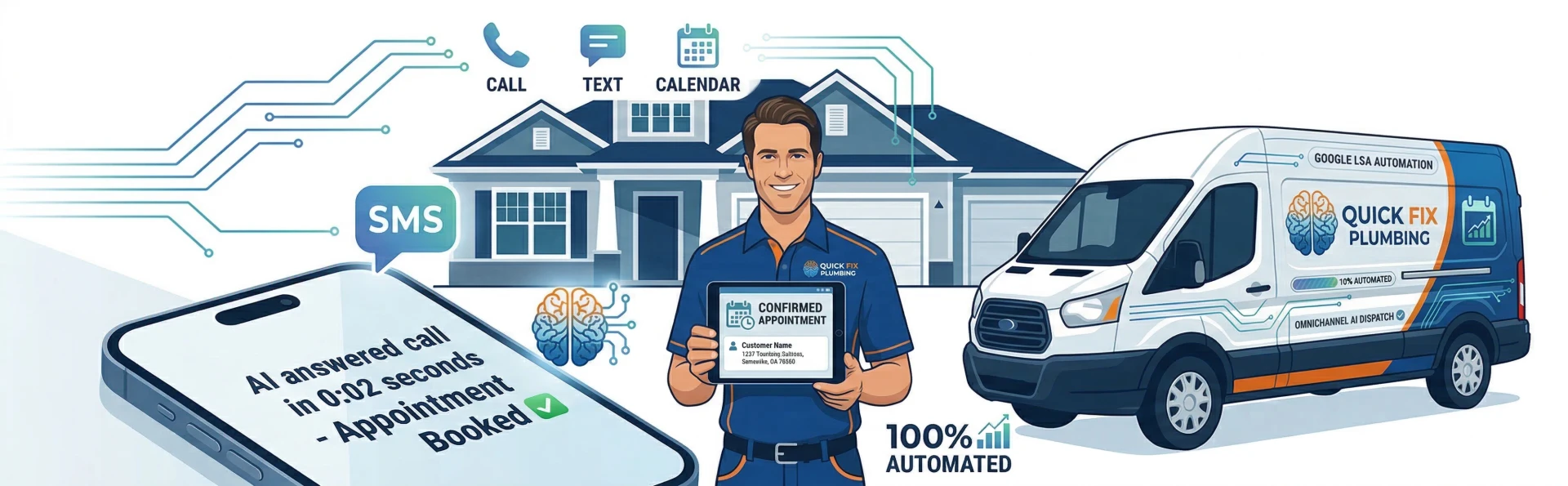

You spent $800 on Google Ads this month. You got your truck wrapped with your company name and phone number. You asked satisfied customers for referrals. You posted on Facebook. You did everything right to generate leads for your plumbing business.
Then a homeowner's pipe bursts at 9 PM on a Saturday. They search Google for an emergency plumber, find your number, and call. It rings four times and goes to voicemail. They hang up without leaving a message and call the next plumber on the list. That company answers. They get the job. You never even knew the call happened.
Or a lead comes in from Angi at 2 PM on a Tuesday. You are under a sink at a job site. Your phone is in the truck. By the time you see the notification an hour later and call the customer back, they have already booked with someone else who responded in five minutes.
These scenarios happen to plumbing businesses every single day. The marketing works. The leads come in. But the conversion from lead to paying customer breaks down because of response time, availability, and operational capacity. You cannot be on a job site and answering your phone simultaneously. You cannot afford to staff an office 24 hours a day. You cannot respond to every web lead within 60 seconds while you are running service calls.
The plumbing businesses that are growing fastest in 2026 are not spending more on marketing than their competitors. They are using AI for plumbing businesses to ensure that every call gets answered, every lead gets an immediate response, and every opportunity to convert a customer gets captured instead of lost.
Why Plumbing Leads Are Won or Lost in the First 60 Seconds
Customer acquisition in the plumbing industry is a speed competition. When a homeowner has a plumbing emergency or needs service scheduled, they typically contact multiple plumbers in quick succession. They are not loyal to any particular company at that moment. They book with whoever confirms availability first.
This is especially true for emergency situations. A burst pipe flooding a basement is not a problem that waits. A sewage backup is not something a homeowner researches carefully before choosing a provider. They need help immediately, and they will take it from whoever picks up the phone and says they can be there.
Even for non-emergency work like a leaking faucet or a toilet repair, speed matters. The homeowner who calls on Tuesday afternoon expecting to schedule something for later in the week will often book with the first plumber who answers and confirms an appointment time. They might have intended to call three companies and compare prices, but if the first one they reach gives them what they need, the comparison shopping stops.
Research on lead response times across industries consistently shows that businesses responding within one minute convert at dramatically higher rates than businesses responding even five or ten minutes later. For plumbing specifically, where urgency is high and customer loyalty at the point of need is low, the one-minute window is even more critical.
A plumbing business that answers every call on the first ring and responds to every web lead within 60 seconds will acquire more customers than a business with identical service quality, better prices, and more experience that takes 15 minutes to respond. Speed wins when the customer is actively shopping.
The Four Ways AI Increases Customer Acquisition for Plumbers
AI technology helps plumbing businesses acquire more customers through four distinct mechanisms. Each one addresses a specific point in the customer journey where leads are typically lost.
1. Answering Every Call 24/7 Including After-Hours
The most direct impact of AI on customer acquisition is that it ensures every inbound call gets answered immediately regardless of time of day or how many calls are coming in simultaneously.
A plumbing business using an AI answering service for plumbers never sends a potential customer to voicemail. The AI picks up on the first or second ring every time. At 10 AM on a Tuesday when the office is open, the AI answers. At 11 PM on a Friday when everyone has gone home, the AI answers. When three calls come in at the same time and a human receptionist could only handle one, the AI handles all three.
This complete coverage eliminates the single largest source of lost customer opportunities for most plumbing businesses, which is the unanswered call. Every call that goes to voicemail is a potential customer who moves on to the next plumber. Every call answered is a chance to book the job.
After-hours calls are particularly valuable because they tend to be emergencies with higher service fees and because there are fewer plumbers available to answer them. The plumber who has AI coverage capturing after-hours calls is competing against a much smaller pool of available providers, which means higher conversion rates and premium pricing.
2. Responding to Online Leads Within Seconds
Customer acquisition for plumbing businesses increasingly comes from online sources. Google Local Services Ads, Angi, Thumbtack, HomeAdvisor, and direct website inquiries all generate leads that require immediate follow-up to convert.
The problem with online leads is that they expect instant response. A homeowner who fills out a contact form at 2 PM expects to hear back within minutes, not hours. A Google LSA request submitted at 9 AM is being sent to four or five plumbers simultaneously, and whoever calls back first gets the job.
AI systems handle outbound lead follow-up automatically. When a new lead comes in from any connected source, the AI initiates contact immediately with both a phone call and a text message. The customer is contacted while they are still in active shopping mode rather than after they have already booked with a competitor.
For plumbing businesses that pay for online leads, this instant response dramatically improves return on ad spend. The leads were always good. The difference is that now they are being contacted fast enough to actually convert.
3. Booking Appointments During the First Call
Answering the phone is necessary but not sufficient for customer acquisition. The call has to convert into a booked appointment, and this is where many plumbing businesses lose opportunities even when they do answer.
A customer calls asking about a water heater repair. The plumber answers but is on a job site and cannot access their schedule. They tell the customer they will call back in an hour to confirm a time. That delay creates drop-off. The customer calls another plumber who books them immediately, and by the time the first plumber calls back, the job is gone.
An AI phone answering service for plumbers books the appointment during the initial call. The AI has real-time access to the dispatch schedule through integration with ServiceTitan, Jobber, Housecall Pro, or whatever field service software the business uses. When the customer says they need service, the AI checks availability, offers the next open slot, and books the job immediately. The customer hangs up with a confirmed appointment time, which eliminates the opportunity for them to keep shopping.
This immediate booking capability is what separates AI systems that actually drive customer acquisition from basic answering services that just take messages and create follow-up work.
4. Qualifying Leads Before They Waste Your Time
Not every call or web lead is a qualified customer. Some are outside your service area. Some want quotes for work that is not profitable for your business. Some are price shopping with no intention of booking unless you are the absolute cheapest.
AI systems qualify leads automatically before they consume technician time. The AI asks where the customer is located and confirms whether that address is within your service area. It asks what type of work they need and whether it matches the services you provide. It explains your service call fees and pricing structure upfront so customers who are only looking for free quotes self-select out before you waste a trip.
This qualification process improves customer acquisition efficiency. You spend your time and resources on customers who are actually likely to book and pay rather than on tire kickers who were never serious prospects.
How AI Handles Emergency Plumbing Calls Differently Than Routine Requests
Plumbing calls fall into two broad categories with very different urgency levels, and effective AI systems handle them differently.
Emergency calls require immediate response. A burst pipe, a sewage backup, a water heater failure, or a major leak cannot wait until tomorrow. Customers calling with these issues need to know that help is coming as soon as possible.
When the AI detects an emergency based on the language the customer uses and the nature of the problem, it prioritizes the call differently. It offers the next available emergency slot even if that means scheduling outside normal hours or charging an emergency service fee. It sets expectations about arrival time and explains what the customer should do in the meantime to minimize damage. It conveys urgency and responsiveness, which is exactly what an emergency customer needs to hear.
Routine requests like a dripping faucet, a slow drain, or a toilet that runs occasionally are not emergencies. These customers are willing to wait a day or two for service. The AI books them into standard availability further out on the schedule and explains the normal service process.
This intelligent routing ensures that emergency slots are reserved for actual emergencies rather than being filled by routine work, which maximizes the revenue capture from high-value urgent calls.
Integration With Plumbing Dispatch Software
For AI to actually help acquire customers rather than just answering phones, it needs to integrate with the scheduling and dispatch software that runs the plumbing business.
When a plumber uses ServiceTitan, Jobber, Housecall Pro, FieldRoutes, or Service Fusion to manage their operations, the AI system connects via API to access the dispatch board in real time. The AI sees which technicians are available, which time slots are open, which service areas each technician covers, and what types of jobs they are qualified to handle.
This integration allows the AI to book jobs intelligently. A customer in the north part of town gets scheduled with the technician who covers that area. A customer needing a water heater replacement gets scheduled with the technician who has the skills and availability for that type of work. A customer needing emergency service gets booked into an emergency slot if one is available.
The job appears on the dispatch board immediately with all relevant details populated automatically. Customer name, address, phone number, description of the issue, appointment time, and service type all flow into the system without manual data entry. The dispatcher sees the job exactly as if a human CSR had booked it.
Understanding how AI systems integrate with contractor operations is critical because integration is what makes AI actually functional rather than just adding another system that requires manual coordination.
Handling Pricing Questions Without Losing the Customer
One of the most common reasons plumbers lose potential customers during the initial call is the pricing conversation. The customer asks "how much does it cost" and either the answer scares them away or the vagueness frustrates them.
AI systems can handle pricing questions effectively by providing ranges based on typical scenarios rather than exact quotes that require a site visit.
When a customer asks how much a toilet repair costs, the AI can explain that simple repairs like replacing a flapper typically range from $150 to $250 depending on the specific issue, while more complex repairs might be higher. It sets expectations without committing to an exact number that could be wrong once the technician assesses the actual situation.
The AI also explains the service call fee structure upfront so there are no surprises. "We charge a $79 service call fee to come out and diagnose the issue. If you decide to move forward with the repair, that fee is applied to the total cost." This transparency builds trust and filters out customers who are looking for free estimates rather than actually hiring a plumber.
For customers who are shopping primarily on price, the AI can position value rather than competing purely on cost. It mentions warranty coverage, technician experience, same-day availability, or membership benefits that justify slightly higher pricing compared to the cheapest option.
This pricing conversation is difficult for many human CSRs because it requires confidence and product knowledge. The AI delivers it consistently on every call because it has been trained on your specific pricing structure and value proposition.
Customer Experience: Do Homeowners Mind Talking to AI?
One concern plumbing business owners raise when considering AI is whether customers will be frustrated or put off by talking to a machine instead of a human.
The data from plumbing businesses using AI shows that customer acceptance is high when the AI is well-designed and the conversation is natural. Most customers care more about getting their problem solved quickly than about whether they are speaking to a person or an AI.
A homeowner calling at midnight with a burst pipe who reaches an AI that books them an emergency appointment for first thing in the morning is not dissatisfied with the AI. They are relieved that someone answered and helped them. The alternative, a voicemail promising a callback during business hours, is objectively worse from the customer's perspective.
For more complex situations or emotional customers who clearly want to speak with a human, well-designed AI systems detect this and transfer the call appropriately. A customer who says "I need to speak to a person" or who expresses frustration gets routed to a human team member without being trapped in an automated loop.
The practical result is that customer satisfaction with AI-answered calls is comparable to human-answered calls when the AI is purpose-built for plumbing rather than being a generic assistant. Designing intelligent call interactions specific to plumbing scenarios is what makes the difference between AI that enhances customer experience and AI that frustrates it.
Cost Comparison: AI vs Hiring More Staff for Customer Acquisition
Plumbing business owners evaluate every investment through a cost-benefit lens, so it is worth comparing what AI costs versus the traditional alternative of hiring staff to improve customer acquisition.
Hiring a full-time office person to answer phones costs approximately $35,000 to $45,000 annually when you include salary, payroll taxes, and benefits. That person works 40 hours per week during business hours. They handle one call at a time. They take vacations and sick days. They cannot work 24 hours a day.
An AI answering and booking system typically costs between $400 and $800 per month depending on call volume and features, which works out to $4,800 to $9,600 annually. The system operates 24 hours a day, 7 days a week, 365 days a year. It handles unlimited simultaneous calls. It never takes a day off.
The cost comparison alone favors AI by a significant margin, but the more important comparison is customer acquisition impact. A human receptionist improves customer acquisition by answering calls during business hours and reducing hold times when multiple calls come in. An AI system improves customer acquisition by answering every call including after-hours, responding to web leads instantly, and booking appointments in real time.
For customer acquisition specifically, the AI delivers more coverage for less cost, which is why plumbing businesses that deploy AI typically keep their existing staff and use the AI to expand capacity rather than replacing anyone.
Real Results From Plumbing Companies Using AI
The most useful validation for any technology comes from businesses using it in production. Plumbing companies that have implemented AI for customer acquisition report consistent results.
Missed call rates drop to near zero. Businesses that were missing 20 to 30 percent of inbound calls due to after-hours, overflow, or being on job sites now answer virtually every call because the AI provides complete coverage.
Lead response times drop from an average of 10 to 20 minutes to under one minute. Online leads from Google LSA, Angi, and other sources that previously sat for hours before getting a callback now receive instant phone and text outreach.
Booking rates improve significantly. Customers who reach an AI that books them immediately during the first call convert at higher rates than customers who are told someone will call back to confirm a time.
After-hours becomes a meaningful revenue channel. Plumbing companies consistently report that 20 to 30 percent of their monthly job volume comes from after-hours calls that were previously going to voicemail and being lost entirely.
One plumbing company in Texas reported that after implementing AI, their monthly job volume increased by 35 percent without any increase in marketing spend. They were receiving the same number of inbound calls and leads. The difference was that they were converting a much higher percentage of them because response was immediate and booking happened in real time.
A plumbing company in Florida reported that their Google LSA conversion rate went from 28 percent to 64 percent after deploying AI for instant lead response. They were paying for the same number of leads, but booking more than twice as many jobs from those leads, which meant their cost per acquired customer dropped by more than half.
How Sameday Helps Plumbers Get More Customers
Sameday is an AI platform built specifically for home service businesses including plumbing companies. The system is trained on plumbing industry terminology, common service scenarios, and the urgency signals that distinguish an emergency call from a routine service request.
Sameday answers every inbound call immediately regardless of time of day or call volume. When a homeowner calls with a plumbing issue, the AI asks what is happening, gathers the service address, assesses urgency, checks the dispatch schedule for availability, books the appointment directly into the plumber's scheduling software, and sends confirmation via text and email. The entire process happens in one call with no follow-up required.
For online leads from Google LSA, Angi, Thumbtack, or direct website inquiries, Sameday initiates outbound contact within seconds. The system calls and texts the customer immediately, qualifies their need, and converts the lead into a booked appointment before competitors have time to respond.
Sameday integrates with ServiceTitan, Jobber, Housecall Pro, FieldRoutes, and Service Fusion, which means bookings flow directly to the dispatch board in real time. Dispatchers see jobs appear in their system automatically with all customer details populated correctly.
The platform operates 24 hours a day including nights, weekends, and holidays. A homeowner whose water heater fails at 10 PM on Christmas Eve gets the same immediate response and booking capability as someone calling at 10 AM on a Tuesday.
Plumbing businesses using Sameday report that their customer acquisition improves measurably within the first month. Calls that previously went unanswered get captured. Leads that previously converted at 30 percent start converting at 60 percent. After-hours jobs that were being lost entirely start filling the schedule.
Implementation: Getting Started With AI for Your Plumbing Business
Implementing an AI system for customer acquisition is faster and simpler than most plumbing business owners expect. The process does not require technical expertise or lengthy setup.
The first step is configuration. The AI needs to be set up with your business name, service area, types of plumbing services you offer, pricing structure, and availability rules. This typically happens in a single onboarding session and takes 15 to 30 minutes.
The second step is integration with your scheduling software. If you use ServiceTitan, Jobber, Housecall Pro, or another major platform, the integration is usually straightforward and guided by the AI vendor's support team.
The third step is testing. Before going live, the system should be tested with sample scenarios to ensure it handles different call types correctly: emergency vs routine, new customer vs returning customer, in-service-area vs out-of-area.
The fourth step is going live. The AI starts answering calls and responding to leads. Call recordings and transcripts are available for review so you can monitor quality and make adjustments as needed.
Most plumbing businesses are live and taking calls through their AI system within 15 minutes to a few hours depending on complexity. There is no multi-week implementation timeline and no need to pause operations during setup.
Measuring Customer Acquisition Before and After AI
The clearest way to evaluate AI's impact on customer acquisition is to measure performance before and after implementation.
Track these metrics before deploying AI: total inbound calls per month, percentage of calls answered, average response time to online leads, booking rate from calls answered, booking rate from online leads, percentage of jobs from after-hours calls.
After deploying AI, track the same metrics and compare. Most plumbing businesses see that calls answered goes from 70 to 80 percent to 95 to 100 percent, response time to online leads drops from 10 to 20 minutes to under 1 minute, booking rate from calls increases by 20 to 40 percentage points, booking rate from online leads doubles or triples, and after-hours goes from 5 percent of jobs to 20 to 30 percent of jobs.
These improvements translate directly to customer acquisition growth. If a plumbing business was booking 80 jobs per month before AI and books 115 jobs per month after AI from the same marketing spend, that is 35 additional customers per month acquired purely through better response and conversion rather than more leads.
Conclusion
Getting more customers as a plumbing business is not primarily about generating more leads. Most plumbers already have more lead opportunities than they convert. The issue is that calls go unanswered, online leads get slow responses, bookings do not happen in real time, and after-hours opportunities are lost entirely.
AI for plumbing businesses solves all four of these customer acquisition problems simultaneously. It answers every call 24/7, responds to online leads within seconds, books appointments during the first interaction, and operates with perfect consistency regardless of how busy the business is.
The plumbing companies growing fastest in 2026 are not outspending their competitors on marketing. They are capturing a higher percentage of the leads they already generate by ensuring that every opportunity to acquire a customer gets converted instead of lost.
Is your plumbing business ready to stop losing customers to slow response and missed calls? Book a Free Demo with Sameday Today and see how AI answers plumbing calls in real time.






















Sign in to leave a comment.