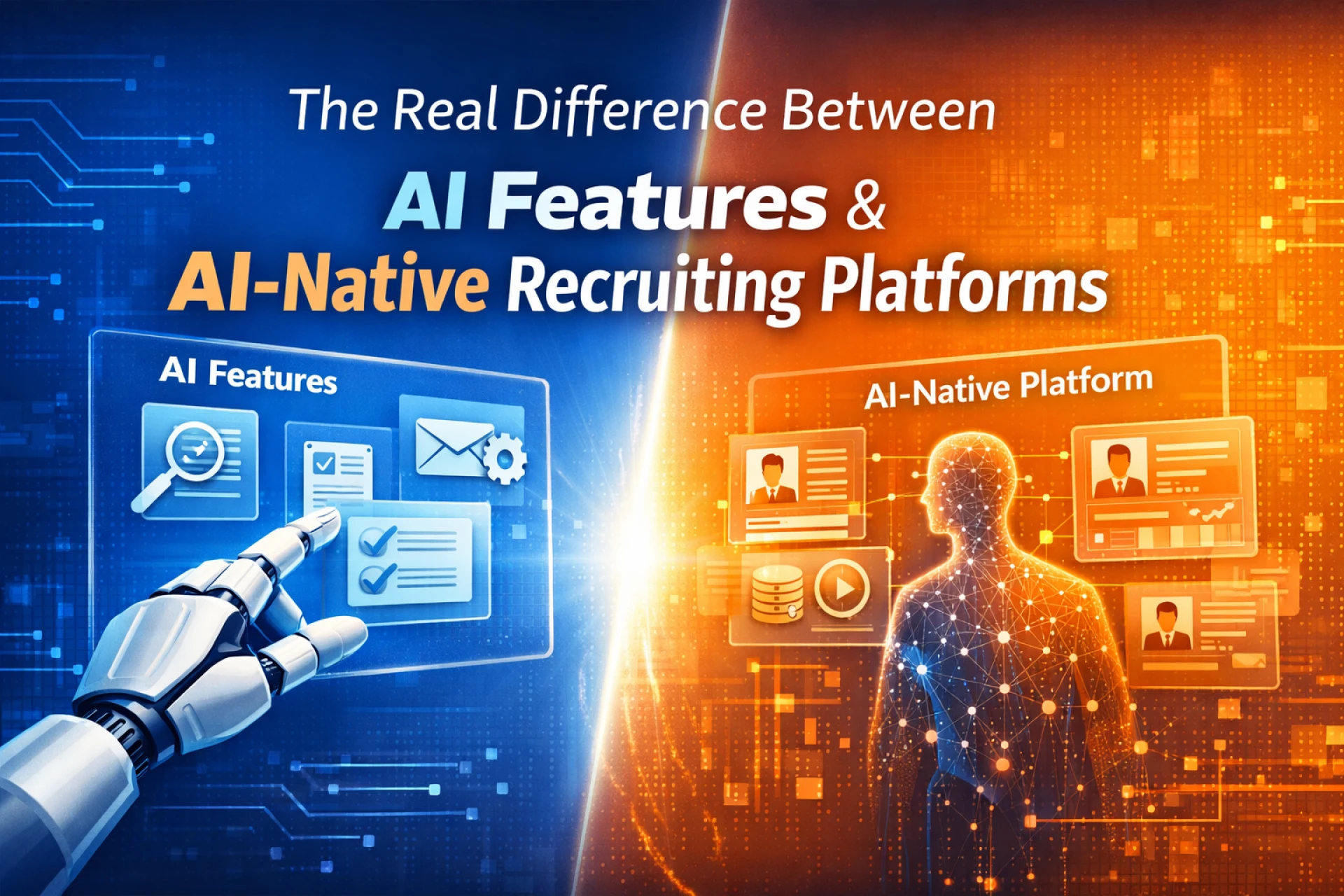

AI is everywhere in recruiting right now. Almost every ats recruiting software tool claims to use it in some form. Resume parsing. Keyword suggestions. Automated emails. On the surface, it all sounds impressive.
But when recruiters sit down to actually run a search, many realize something important. Having a few AI features is not the same as working on an AI-native recruiting platform. Understanding this difference matters more than ever, especially for recruiting firms, staffing agencies, and executive search teams that rely on speed, accuracy, and context to succeed.
Why This Confusion Exists in Recruiting Technology
Most recruiting software evolved long before AI became mainstream. Traditional applicant tracking systems were built to track candidates, manage stages, and store resumes. Over time, vendors added AI features to stay competitive. This is why many platforms today advertise AI recruiting tools while still operating like older systems underneath.
For buyers, this creates confusion. Two tools may both claim to offer ai tool for recruitment capabilities, yet feel completely different in daily use. One may save time and surface insight. The other may still rely heavily on manual effort. The difference lies in whether AI is an add-on or the foundation.
What AI Features in Recruiting Actually Look Like
AI features are enhancements layered onto an existing system. They usually focus on a specific task. Common examples include resume screening, keyword recommendations, or basic automation rules. These features can be helpful, especially for high-volume hiring.
In many top applicant tracking systems, AI features improve individual steps but do not change how the overall workflow works. Recruiters still search manually. Profiles remain static unless updated. Context from past searches is not automatically reused. In these systems, AI assists recruiters occasionally but does not actively support search execution from start to finish.
The Limits of Feature-Based AI in ATS Systems
The main limitation of feature-based AI is fragmentation. A recruiter might use AI to scan resumes, then switch to manual filters for search, then rely on memory to recall past candidates, then update notes by hand. Each step still depends heavily on the user.
This is why many teams using even the best ATS systems still feel overwhelmed. The system tracks activity but does not think alongside the recruiter. For executive search and agency recruiting, where context matters more than volume, this limitation becomes especially clear. If you find yourself constantly fighting your software, it might be time to evaluate your current setup. For more on this, check out our guide on 5 signs your recruitment firm needs a new ATS and what to do about it.
What Makes a Platform AI-Native
An AI-native platform is built with intelligence at its core. AI is not a feature. It is how the system works. In an AI-native recruiting platform, data is continuously interpreted rather than simply stored. Candidate profiles evolve automatically. Search understands intent and context. Past interview feedback becomes usable insight rather than forgotten notes.
This is the real shift behind modern recruitment AI. Instead of asking recruiters to tell the system what to do at every step, AI-native platforms quietly handle background work so recruiters can focus on decisions and relationships.
How AI-Native Recruiting Changes Daily Work
The impact of an AI-native approach shows up quickly in daily workflows. Search becomes faster because the system understands more than keywords. Candidate rediscovery improves because strong past candidates are surfaced automatically. Manual updates decrease because profiles stay current.
Recruiters spend less time managing an ATS tracking system and more time evaluating fit, speaking with candidates, and advising clients. This is especially valuable for firms running repeat searches, executive placements, or niche hiring where history matters.
AI Recruitment Software in Executive Search and Agencies
Executive search highlights this difference clearly. Traditional ats recruiting software may track candidates well but struggles to reuse past context. Search teams often rely on memory or external sourcing even when the right candidate already exists in the database.
AI-native recruitment platforms approach this differently. They treat every interaction, rejection reason, and interview outcome as future intelligence. This allows recruitment AI agents to support searches by understanding why someone was a "near miss" before and when they might be a fit now. For agencies, this turns the database into a living asset rather than a static archive.
Comparing the Market Without the Hype
Many platforms do parts of this well. Tools like Bullhorn are strong at operational tracking and sales workflows. Others focus on sourcing or analytics. What separates AI-native systems is not one feature; it is how everything connects. Instead of asking whether a platform has AI, firms should ask how deeply an ai tool for recruitment is embedded into search, engagement, and decision-making. That question usually reveals the real difference.
Where Stardex Fits in This Shift
Stardex was built with this distinction in mind. Rather than starting with a traditional ATS and adding AI later, Stardex was designed as an AI-native system from the beginning. Search, automation, CRM, engagement, and analytics all operate within one intelligent workflow. For recruiting firms and executive search teams, this means less manual effort, better reuse of existing data, and more consistent execution across searches.
Final Thoughts
AI in recruiting is no longer a future concept; it is already shaping how teams work. But not all AI is created equal. The real difference between AI features and AI-native recruiting platforms lies in how much responsibility the system takes on. One assists occasionally. The other works continuously in the background. Understanding this distinction can save time, reduce frustration, and unlock the full value of your data.


























Sign in to leave a comment.