

Writing skills form the foundation of a child's academic success across all subjects. When elementary students struggle with writing, it affects their confidence, grades, and ability to express themselves clearly. Parents often notice these challenges but aren't sure how to help their children improve at home.
This article provides practical strategies that parents and tutors can implement to boost elementary students' writing abilities in the home environment. You'll discover effective techniques to make writing practice engaging, learn how to provide constructive feedback, and understand the developmental stages of writing skills.
With the consistent application of these approaches, children can transform from reluctant writers to confident communicators who enjoy expressing their thoughts on paper.
Understanding Writing Challenges in Elementary Students
Young writers face numerous obstacles when developing writing skills. Common challenges include difficulty organizing thoughts, limited vocabulary, trouble with grammar and punctuation, and simply not knowing how to start. These struggles often lead to frustration and resistance toward writing assignments.
Children develop writing skills at different rates, making individualized attention crucial. What works for one child might not work for another, depending on their specific challenges and learning style. Recognizing these individual differences helps parents and educators provide more effective support tailored to each child's needs.
When to Seek Additional Help
Parents should watch for persistent writing difficulties that don't improve with regular practice and guidance. Warning signs include consistent resistance to writing tasks, difficulty forming letters or words, trouble organizing ideas, or falling significantly behind grade-level expectations.
Professional educational support makes a significant difference for struggling young writers. An elementary school tutor specializing in literacy development can identify specific obstacles and create targeted strategies to address them. The right tutor brings expertise in developmental writing progression and teaching methods that motivate reluctant writers while building essential skills.
Creating a Writing-Friendly Environment at Home
A dedicated writing space signals the importance of writing practice and helps children focus. This area should be well-lit, comfortable, and free from distractions, with necessary supplies readily available. Having a special place just for writing activities elevates the importance of writing practice in a child's mind.
The physical environment matters, but the emotional atmosphere proves equally important. Parents should create a positive association with writing by celebrating efforts, displaying written work, and showing genuine interest in a child's writing topics. This supportive emotional environment encourages children to take risks with their writing and persist through challenges.
Establishing a Regular Writing Routine
Consistency builds writing skills more effectively than occasional intensive practice sessions. Setting aside 15-30 minutes several times a week for writing activities establishes writing as a regular part of home life. This routine should align with when the child feels most focused, whether that's after school, before dinner, or on weekend mornings.
Breaking the routine occasionally prevents writing practice from becoming stale. Surprise writing activities, special writing tools, or taking writing practice outside to a park or café adds novelty that keeps children engaged. These variations within the established routine maintain interest while still providing the benefits of regular practice.
Effective Writing Activities for Elementary Students
Story Starters and Creative Prompts
The ability of young writers to produce ideas remains challenging which makes starter prompts their lifeline. Creative prompts help students produce ideas to overcome their fear of starting writing. Student writing develops well with prompts that ask real-life questions ("What would happen if you could speak to animals?"), use images or provide an initial paragraph to kick-start their composition.
Creative writing assignments enable students to build multiple abilities simultaneously as they maintain their focus throughout the tasks. Creative writing tasks lead students to inherently learn about creating characters and dialogues while developing excellent descriptions alongside mastering storytelling formats. Creative writing activities usually keep students occupied in such a way that their academic skill development goes unnoticed.
Real-World Writing Opportunities
Authentic writing tasks show children the practical importance of writing beyond school assignments. Writing thank-you notes, creating shopping lists, keeping journals, writing emails to relatives, or making instruction manuals for games they've invented all provide meaningful practice. These real-world applications demonstrate the value of clear communication.
Children invest more effort when writing serves an actual purpose or reaches a real audience. Writing letters to pen pals, creating a family newsletter, or writing reviews of books and movies for family members motivates children to communicate clearly. The genuine feedback from these authentic audiences proves more meaningful than arbitrary grades or corrections.
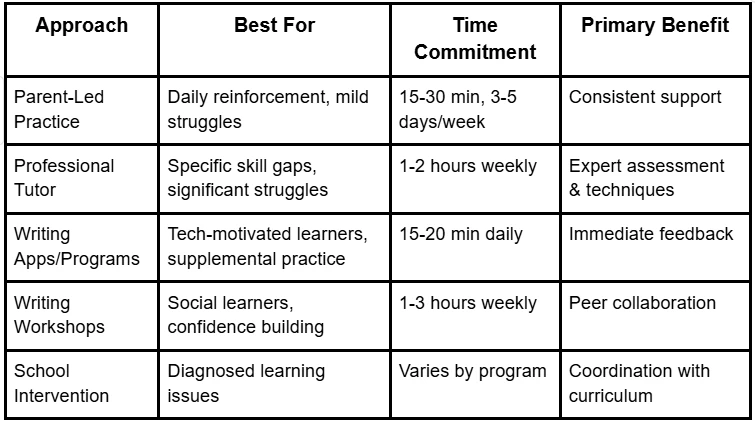
Comparison of Writing Support Approaches
Providing Effective Feedback on Children's Writing
Balancing Encouragement and Correction
The feedback technique has a direct influence on both the skill growth of children and their relationship with writing. Implement a strategy that starts by praising particular writing elements before making suggestions for improvement. A feedback method that starts and ends with praise keeps emotions positive while offering constructive feedback, maintains confidence.
Feedback should concentrate on directing students toward two planned improvements instead of marking every mistake they make. Providing too many corrections to a child results in decreased motivation alongside increased resistance towards writing in the future. Children need help with correcting recurring mistakes instead of fixing random errors, while parents need to handle the content structure first, followed by correcting mechanics and spelling.
Developmental Appropriateness in Writing Expectations
Parents gain better expectations about grade-level writing when they understand accepted benchmarks for each grade. Students in kindergarten write straightforward sentences containing simple punctuation, but fifth graders need to produce complex multiple paragraphs using complex vocabulary within advanced sentence patterns. The knowledge of acceptable grade-level standards prevents parents from getting frustrated due to setting unreasonable expectations.
Every child shows different writing maturity levels yet must follow specific development patterns. The spelling difficulties of one child may not affect their storytelling ability, yet the excellent grammar of another child might make storytelling challenging. The assessment of irregular development patterns allows parents to offer specific help to their children while acknowledging strong areas of progress.
Technology Tools to Support Writing Development
Helpful Apps and Programs
Digital platforms offer captivating methods to develop particular writing abilities. Educational applications that deal with grammar, spelling, vocabulary, and story organization help students maintain an enjoyable learning experience. Educational apps use game-based elements to support students during practice by delivering instant feedback to maintain learning interests.
Parents must conduct complete assessments of the technology resources they plan to use. Excellent digital resources use progressive features that automatically fade away as student abilities advance while supplying substantive assessments in addition to basic response tracking. The characteristics of these tools make technology work alongside excellent teaching methods instead of substituting them.
Balancing Digital and Traditional Writing Practice
Handwriting practice is essential for elementary students since technology brings its advantages. Studies confirm that actual handwriting supports mental growth, thus standard pen and paper exercises are essential for teaching writing skills. A strong handwriting ability decreases writing difficulties during composition, thus students maintain their attention on writing content.
A balanced approach incorporates both digital and traditional writing experiences. Digital tools excel at skill practice, feedback, and motivation, while handwritten work develops motor skills and cognitive connections. This complementary approach addresses multiple aspects of writing development simultaneously.
Conclusion
Improving elementary writing skills requires patience, consistency, and the right support strategies. By creating a positive writing environment, establishing regular routines, offering engaging activities, and providing constructive feedback, parents significantly impact their child's writing development. Remember that writing improvement happens gradually through consistent practice rather than overnight transformation.
The investment in developing strong writing skills during elementary years creates academic advantages that extend throughout education and into adulthood. With thoughtful implementation of the approaches outlined here, children can build both the technical skills and confidence needed to become capable, willing writers who understand the power of effective written communication.
Frequently Asked Questions
How much time should elementary students spend practicing writing at home?
Elementary students benefit from 15-30 minutes of writing practice 3-5 times weekly. Quality matters more than quantity, so shorter, focused sessions typically yield better results than longer periods where attention wanes. Consistency provides greater improvement than occasional marathon sessions.
Should parents correct every spelling and grammar error in children's writing?
No. Overcorrection discourages young writers and shifts focus from content to mechanics. Instead, identify patterns of errors and address 1-2 areas at a time. For early elementary students, prioritize content development over perfect mechanics, gradually increasing expectations as skills develop.
How can parents help children who hate writing or experience anxiety about writing tasks?
Reduce pressure by starting with short, highly interesting writing activities connected to the child's interests. Incorporate drawing, dictation, or verbal storytelling before writing. Consider alternative formats like comic strips, lists, or digital tools that reduce physical writing demands while building compositional skills.





































Sign in to leave a comment.