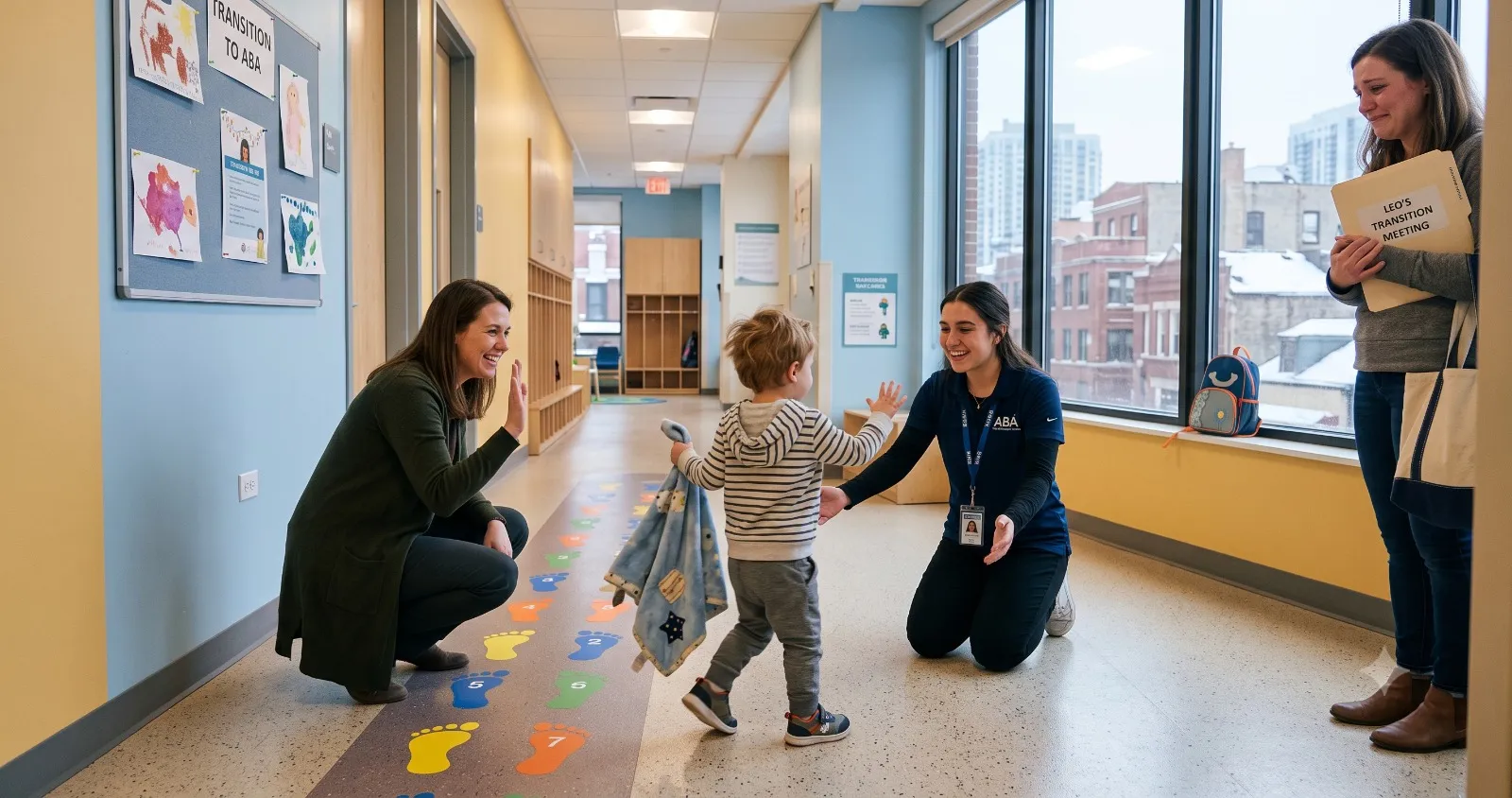

The jump from Early Intervention to school-based or private ABA services is one of the most stressful transitions families navigate. EI services end on a child's third birthday, often mid-progress, and the next phase of support requires a whole new evaluation, authorization process, and service team. For Chicago families, understanding how ABA centers manage this transition can make the difference between a smooth handoff and months of lost ground.
Early Intervention in Illinois is administered through the Department of Human Services and provides services to children from birth through age two who have developmental delays or a qualifying diagnosis. Services are family-directed and occur primarily in natural environments. When a child ages out, the pathway splits. Some children move into preschool special education through their local school district under IDEA Part B, others transition into privately funded ABA, and many families pursue both simultaneously.
Chicago ABA centers that work regularly with the early intervention population understand these logistics. They know how to coordinate with EI service coordinators, how to time evaluations to minimize gaps, and how to communicate with school teams once an IEP is in place. This coordination is not always a given. Families should ask any prospective provider directly about their experience with EI transitions and whether they have a standard process for receiving records and assessment data from prior providers.
What the Transition Process Involves Clinically
A good transition from EI to ABA is not just a scheduling handoff. It requires a clinical bridge. A BCBA at an ABA center will typically conduct a new intake assessment using tools like the VB-MAPP or ABLLS-R, but a thoughtful intake process also reviews what was already accomplished in EI, what skills are emerging versus solidified, and what the child's behavioral history looks like. Rebuilding from scratch wastes months that families cannot afford.
Many Chicago centers offering in home aba therapy il alongside center-based services also coordinate with in-home options for families who need continuity across settings. A child who received home-based EI services may benefit from continuing some therapy at home while adding center-based programming, particularly if school is not yet in the picture. Having a provider that can operate in both settings removes the need to manage two entirely separate clinical relationships.
Insurance plays a central role in this transition as well. EI services are funded differently from private ABA, and families moving from EI often encounter the insurance authorization process for the first time. Blue Cross Blue Shield of Illinois, Cigna, Aetna, and Illinois Medicaid plans all have different requirements for ABA authorization. Most require a documented diagnosis, a recent functional behavioral assessment, and a treatment plan from a supervising BCBA. ABA centers with dedicated insurance staff can guide families through this process and reduce delays.
Setting Children Up for Success After the Transition
The families who navigate this transition most successfully tend to start planning before EI ends, not after. Reaching out to ABA providers three to six months before a child's third birthday gives time to complete evaluations, submit insurance authorizations, and have services in place by the time EI concludes. Waiting until the last month is common, but it almost always results in a gap.
Chicago's density of ABA providers is an advantage, but it also means families need to evaluate options carefully. Ask about BCBA supervision ratios, how often treatment plans are reviewed, and whether the center has experience with children at similar developmental levels. The transition out of EI is a critical window, and the quality of the services that follow matters enormously.































Sign in to leave a comment.