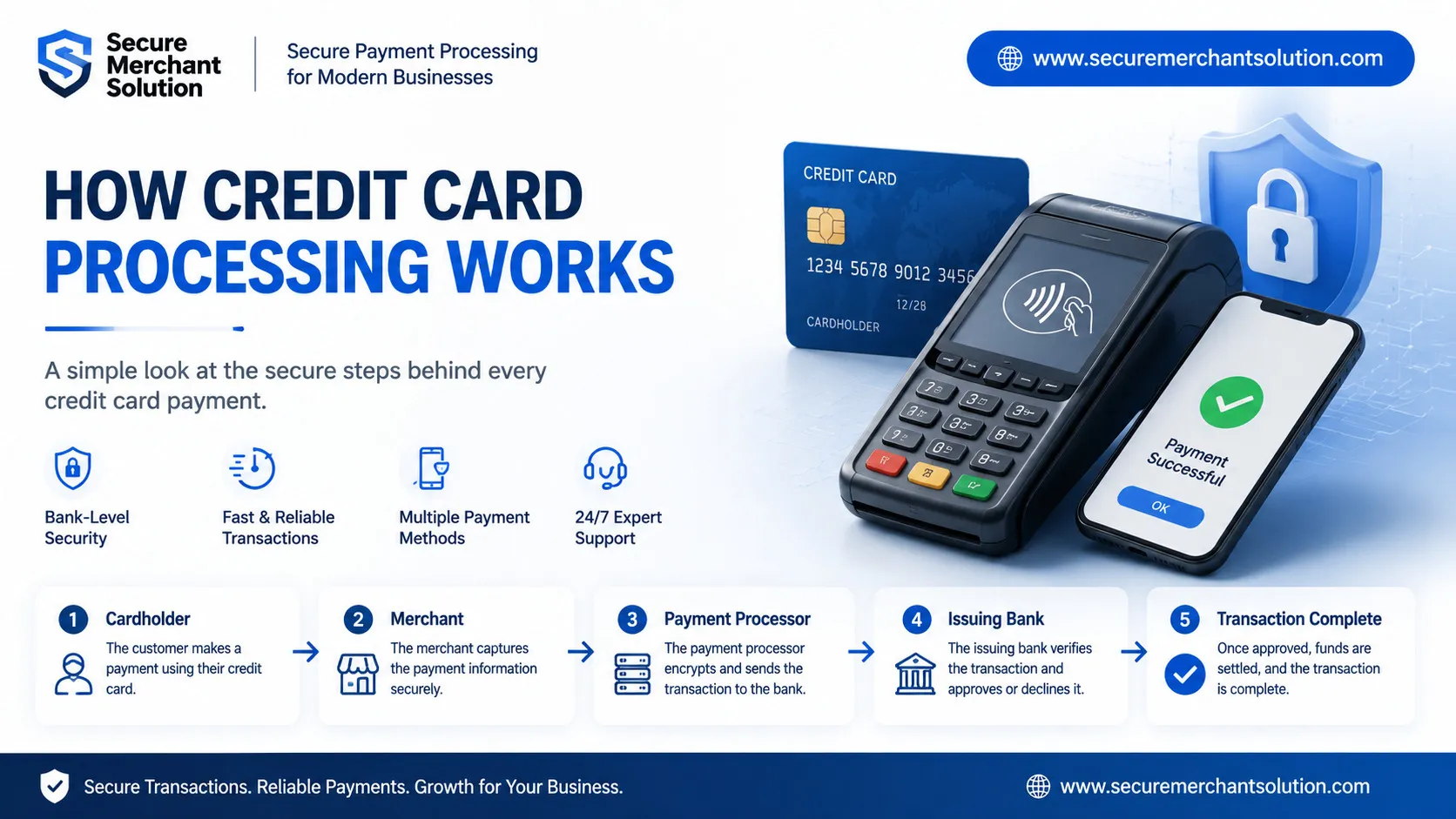

A credit card payment takes only a few seconds at checkout, but a lot happens behind the scenes before that transaction is completed. How credit card processing works is based on a connected system that allows merchants, banks, card networks, and payment processors to communicate securely. For business owners, understanding this process is important because it can help with choosing payment solutions, managing costs, and providing a reliable checkout experience.
What Happens Behind a Credit Card Payment?
When a customer pays by credit card, the transaction does not move directly from the customer's card to the merchant's bank account. Instead, payment information travels through several parties before the transaction is finalized.
The process can be explained in the following steps.
Step 1: The Customer Provides Card Information
The transaction starts when a customer presents a credit card at checkout. Depending on the payment environment, the customer may tap, insert, or swipe the card.
For an online purchase, the customer enters card details through a secure payment form. The information is then passed to the payment gateway or another payment-entry system.
The merchant's payment technology prepares the transaction for authorization.
Step 2: The Processor Routes the Transaction
The payment processor acts as an important connection between the merchant and the financial institutions involved in the transaction.
After receiving the payment request, the processor sends the necessary transaction information through the appropriate card network. The card network routes the request to the bank that issued the customer's credit card.
This communication generally takes place very quickly.
Step 3: The Issuing Bank Checks the Transaction
The issuing bank is the financial institution that provided the customer's credit card. When it receives an authorization request, it evaluates the transaction based on available account and transaction information.
The bank may consider whether the account is active, whether sufficient available credit exists, and whether the transaction requires additional risk or fraud checks.
The issuing bank then returns an approval or decline response.
Step 4: The Merchant Gets an Approval or Decline
The response travels back through the payment network and processor to the merchant.
If the transaction is approved, the merchant can continue with the sale. If it is declined, the customer may need to try another card or payment method.
An approved transaction does not necessarily mean the merchant has already received the funds. Authorization simply confirms that the payment can proceed.
What Is the Difference Between Authorization and Settlement?
Authorization and settlement are separate parts of credit card processing.
Authorization occurs when the issuing bank approves or declines the requested transaction. It confirms whether the transaction can move forward.
Settlement happens later when approved transactions are submitted and the financial institutions involved reconcile the transactions and transfer the corresponding funds.
This distinction is especially important for businesses because an authorized payment may still take additional time before the merchant receives the funds.
Who Is Involved in Credit Card Processing?
A typical credit card transaction may involve several participants:
- Cardholder: The customer using the credit card.
- Merchant: The business accepting the payment.
- Payment gateway: Helps securely transmit payment information, especially for online transactions.
- Payment processor: Handles transaction communication and processing.
- Acquiring bank: Provides services that support the merchant's card acceptance.
- Issuing bank: Provides the customer's credit card.
- Card network: Routes transaction information between the relevant parties.
Each participant has a different role, but they work together to complete the payment.
How Does Online Credit Card Processing Work?
Online transactions use many of the same basic steps as in-person payments. The main difference is how the customer's payment information is collected.
When a customer checks out online, the payment gateway securely transfers transaction information for authorization. The processor and card network then communicate with the issuing bank.
For online businesses, a smooth checkout experience is important, but security is equally important. Merchants should use appropriate payment technologies and follow applicable requirements for protecting payment information.
What Fees Are Involved in Credit Card Processing?
Credit card processing costs can include multiple types of fees. These may be associated with the card network, issuing bank, acquiring services, processor, or merchant account arrangement.
The total cost can vary depending on factors such as:
- Type of credit card
- Payment method
- Business category
- Transaction volume
- Online or in-person transactions
- Processor pricing model
- Transaction risk
Because pricing structures can differ, businesses should review the complete processing agreement instead of focusing only on a single advertised rate.
How Secure Merchant Solution Can Help
Choosing a payment solution can be easier when a business understands how transactions actually move through the payment ecosystem. Businesses should consider more than processing costs and evaluate security, reliability, integrations, reporting, supported payment methods, and customer support.
Secure Merchant Solution can help businesses understand payment-processing concepts and evaluate potential solutions according to their specific operational requirements. A well-planned payment setup should make transactions convenient for customers while giving businesses the tools they need to manage payments effectively.
Common Problems Businesses Should Avoid
Several issues can create unnecessary payment problems. Businesses should avoid selecting a processor without reviewing its full pricing structure, overlooking security considerations, using incompatible payment technology, or failing to understand contract terms.
It is also important to monitor transactions regularly and investigate unusual activity when appropriate. A reliable payment process should support both everyday transactions and proper payment management.
Final Thoughts
Understanding how credit card processing works provides a clearer view of what happens every time a customer pays by card. The transaction moves through authorization, processing, and settlement before the merchant ultimately receives the funds.




















Sign in to leave a comment.