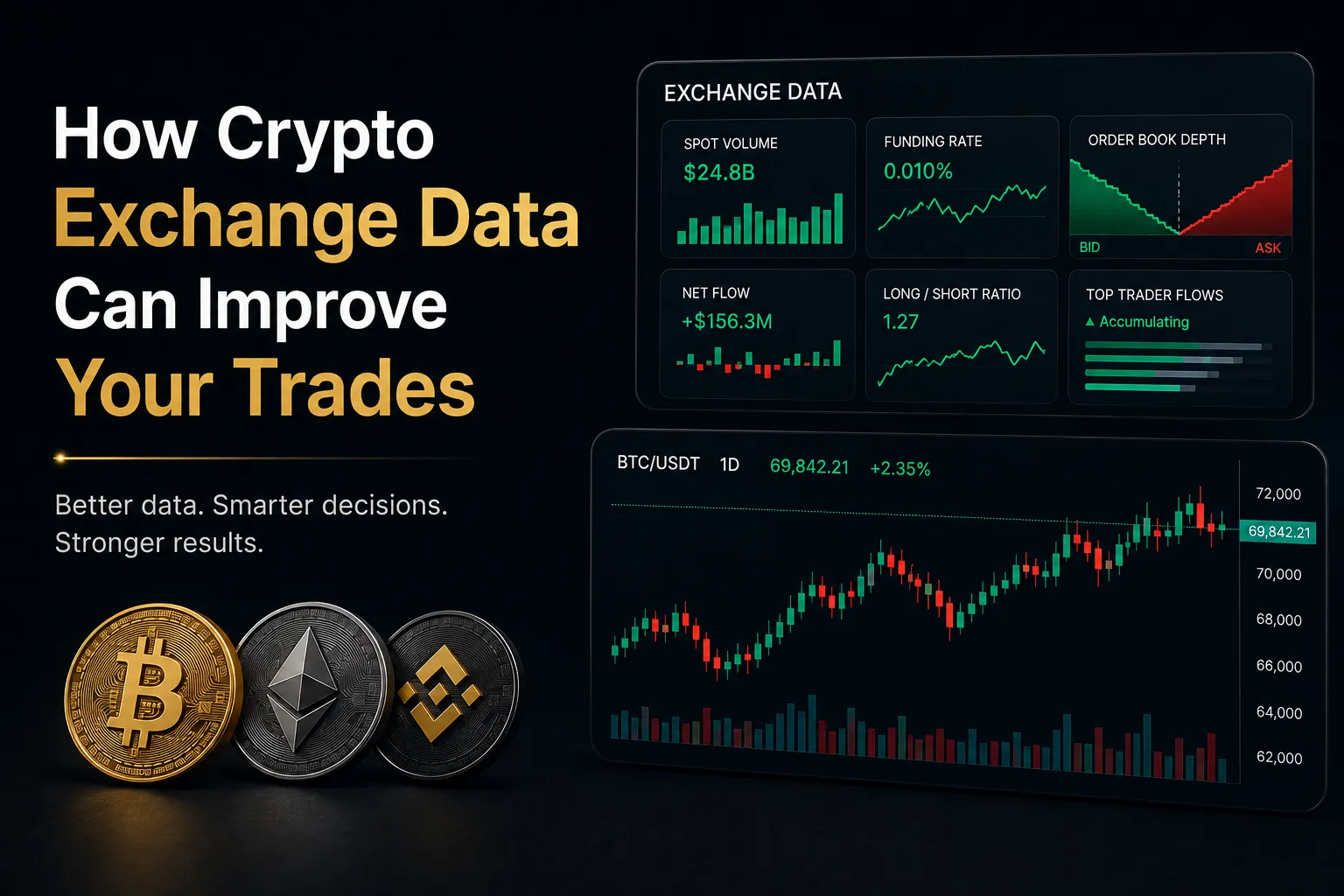

When traders analyze cryptocurrency markets, the first thing they usually look at is price.
Candlestick charts, support and resistance levels, moving averages, and momentum indicators all play an important role in technical analysis.
But price is only one part of the story.
Every trade taking place on an exchange creates information about market behavior. The order book shows where buyers and sellers are positioned. Trading volume reveals participation. Liquidity indicates how easily orders can move the market.
Together, these signals create a much clearer picture of what is happening beneath the price chart.
This is why crypto exchange data has become an increasingly valuable resource for traders looking to make more informed decisions.
What Is Crypto Exchange Data?
Crypto exchange data refers to the information generated by cryptocurrency trading platforms as buyers and sellers interact with the market.
This can include:
- Trading volume
- Order book activity
- Bid and ask prices
- Market depth
- Liquidity
- Open interest
- Funding rates
- Large transactions
- Trade history
- Exchange inflows and outflows
Individually, each metric provides limited information.
Combined, they can reveal important changes in market behavior.
Trading Volume Shows Market Participation
Volume is one of the simplest exchange metrics, but it can provide valuable context.
Imagine a cryptocurrency breaks through a major resistance level.
If the breakout occurs alongside a significant increase in trading volume, there may be stronger participation behind the move.
But if the same breakout occurs with very little volume, traders may want to be more cautious.
Volume doesn't guarantee that a trend will continue. It simply helps answer an important question:
Are traders actually participating in this move?
This makes volume particularly useful when combined with broader crypto market analysis.
Order Books Show Where Traders Are Positioned
An order book displays active buy and sell orders waiting to be executed.
It can provide a snapshot of the supply and demand currently visible on an exchange.
Traders can use order-book information to examine:
- Bid levels
- Ask levels
- Market depth
- Large pending orders
- Changes in buying pressure
- Changes in selling pressure
For short-term traders, these details can be especially useful because market conditions can change quickly.
However, order books should not be treated as a perfect representation of future demand. Orders can be cancelled or changed at any time.
The value comes from understanding the broader behavior rather than relying on one large order.
Liquidity Can Change the Way a Trade Behaves
Liquidity is one of the most important factors in crypto exchange trading.
A highly liquid market can generally handle larger orders with less price impact.
A market with limited liquidity can experience greater slippage, meaning the final execution price may differ from the expected price.
This matters for both large and small traders.
Before entering a position, understanding liquidity can help traders assess:
- Potential slippage
- Market depth
- Execution conditions
- Spread
- Position size
A technically attractive setup may become less appealing if the market doesn't have enough liquidity to support efficient execution.
Exchange Data Can Reveal Changes Before They Appear Clearly on Charts
One of the biggest advantages of exchange data is that it can provide additional context around price movements.
For example, suppose an asset begins moving upward.
A trader could simply look at the chart and conclude that the market is bullish.
But exchange data might reveal:
- Increasing spot volume
- Growing buy-side activity
- Improving liquidity
- Rising derivatives participation
Those additional signals can help explain what is happening behind the price movement.
Likewise, a price increase accompanied by declining participation may tell a very different story.
This is where crypto trading intelligence becomes useful: connecting multiple market signals instead of examining each one separately.
Futures Data Adds Another Layer
Spot markets aren't the only source of useful exchange information.
Crypto futures and derivatives markets provide additional data that can help traders understand positioning and market sentiment.
Two commonly monitored metrics are:
Open Interest
Open interest tracks the number of outstanding derivatives contracts.
Changes in open interest can provide clues about whether traders are increasing or reducing their exposure.
Funding Rates
Funding rates can provide insight into the balance between long and short positions in perpetual futures markets.
Extreme funding conditions may indicate that positioning has become heavily skewed toward one side.
Neither metric predicts price direction on its own, but both can add valuable context to a trading thesis.
Exchange Inflows and Outflows Matter Too
Another useful source of information is the movement of assets into and out of exchanges.
Large inflows may indicate that holders are moving assets toward trading venues, potentially increasing available supply.
Large outflows can sometimes indicate that assets are being moved away from exchanges for longer-term holding or other purposes.
These movements shouldn't automatically be interpreted as bullish or bearish.
Context matters.
Combining exchange flows with price action, volume, on-chain activity, and market sentiment can provide a more complete picture.
Don't Analyze One Exchange in Isolation
Crypto markets operate across multiple trading platforms.
A sudden price movement on one exchange may not necessarily represent the broader market.
Comparing data across exchanges can help traders understand:
- Where liquidity is concentrated
- Whether volume is widespread
- Whether price differences exist
- How buying and selling pressure is distributed
This broader perspective is particularly useful during periods of high volatility.
Combine Exchange Data With Market Intelligence
Exchange data becomes even more useful when combined with other sources.
A trader might evaluate:
Price Action
What is the market structure showing?
Exchange Data
What are volume, liquidity, and order books indicating?
On-Chain Data
What are wallets and large holders doing?
Market Sentiment
Are traders becoming more optimistic or fearful?
News
Is there a catalyst affecting the market?
This layered approach creates a stronger foundation for decision-making than any individual metric.
How AI Can Help Process Exchange Data
Modern crypto markets generate enormous amounts of information.
Monitoring multiple exchanges manually can quickly become overwhelming, particularly for active traders.
This is where AI-powered crypto trading tools can become useful.
AI systems can process large datasets and help identify:
- Unusual volume activity
- Liquidity changes
- Market anomalies
- Emerging trends
- Shifts in sentiment
- Significant trading activity
The advantage isn't necessarily predicting every price movement.
It's reducing the amount of information a trader needs to process manually.
Instead of searching through countless dashboards, traders can focus on the market developments that deserve attention.
A Simple Framework for Using Exchange Data
You don't need to monitor every metric available.
Start with a few important questions.
Is volume supporting the move?
If price is rising, check whether trading activity is increasing alongside it.
Is liquidity healthy?
Look at market depth, spreads, and potential slippage.
What does the order book suggest?
Look for meaningful changes in visible buying and selling pressure, while remembering that orders can change quickly.
What is happening in derivatives?
Monitor open interest and funding conditions for additional context.
Does the broader market agree?
Compare exchange data with market structure, sentiment, and on-chain activity.
This keeps the analysis practical rather than overwhelming.
Exchange Data Should Support a Strategy, Not Replace One
Access to more information doesn't automatically create better trades.
A trader can have access to sophisticated exchange analytics and still make poor decisions if they don't have a clear strategy.
Exchange data should answer specific questions within your trading process.
For example:
- Does this breakout have enough participation?
- Is liquidity sufficient for my position?
- Is market positioning becoming extreme?
- Is the current trend supported by broader activity?
When data has a purpose, it becomes much more useful.
Final Thoughts
Crypto exchange data provides traders with a view of market activity that goes beyond traditional price charts.
Volume can reveal participation. Order books provide insight into visible supply and demand. Liquidity helps traders understand execution conditions, while futures data can provide additional information about market positioning.
When combined with crypto market intelligence, crypto trading intelligence, on-chain analytics, and market sentiment analysis, exchange data can help traders build a much more complete understanding of the market.
AI-powered tools can further simplify this process by processing large amounts of real-time information and highlighting developments that may deserve attention.
The goal isn't to collect every possible metric.
It's to identify the data that matters, understand what it is telling you, and use it within a disciplined crypto trading strategy.
Better data doesn't guarantee better trades. But better interpretation of data can lead to better decisions.

























Sign in to leave a comment.