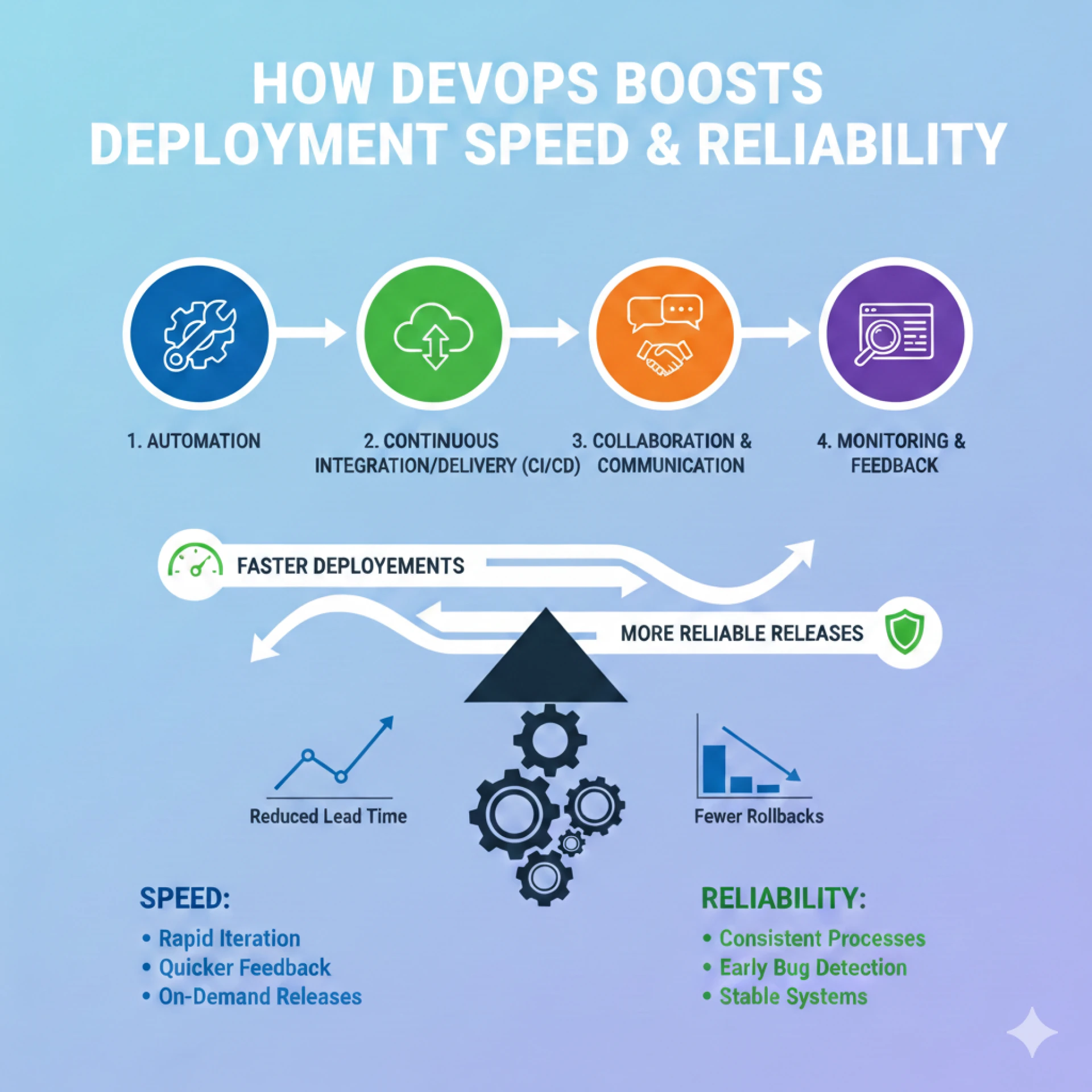

Software plays a major role in how modern businesses operate. Whether it is a mobile app, a website, or an internal system, users expect it to work smoothly and update regularly. When deployments are slow or systems fail after updates, it affects customer trust and business growth.
This is where DevOps makes a real difference.
DevOps helps companies release software faster and keep it stable at the same time. Instead of treating speed and reliability as separate goals, DevOps brings them together through better processes, teamwork, and practical automation.
This article explains how DevOps improves deployment speed and reliability in a simple, realistic, and easy-to-understand way.
Understanding DevOps in Simple Terms
DevOps is a way of working where development and operations teams work closely instead of separately. Earlier, developers wrote code and passed it to operations teams for deployment and maintenance. This handover often caused delays, misunderstandings, and avoidable errors.
With DevOps:
- Teams plan and work together
- Code is tested regularly
- Deployments follow a consistent process
The goal is not to rush releases, but to make them smooth, predictable, and safe.
Why Traditional Deployments Are Slow and Risky
Traditional deployment methods usually involve a lot of manual steps. These steps slow down releases and increase the chance of mistakes.
Common problems include:
- Manual testing that takes too long
- Dependence on a few individuals for deployment
- Different setups across development, testing, and production
- Errors found only after release
These issues lead to delayed launches, emergency fixes, and unexpected downtime.
DevOps was designed to solve these exact problems.
Automation Saves Time and Reduces Errors
One of the biggest strengths of DevOps is automation.
In non-DevOps environments, tasks like testing, server setup, and deployment are often done manually. Manual work is slow and error-prone. Even a small mistake can cause system failure.
With DevOps:
- Tests run automatically
- Deployments follow the same steps every time
- Environments are created quickly and consistently
Automation reduces human errors and shortens deployment cycles, making releases faster and more reliable.
Faster Releases Through Continuous Integration
DevOps encourages developers to integrate their code changes regularly instead of waiting until the end of a project.
This approach helps because:
- Issues are detected early
- Code conflicts are reduced
- Fixes are easier and faster
Regular integration ensures that the software is always in a deployable state, which speeds up releases and improves stability.
Small and Frequent Deployments Reduce Risk
Large software releases often include many changes at once. If something goes wrong, it becomes difficult to find the cause.
DevOps promotes small and frequent deployments. Each release contains limited changes, making it easier to test and verify.
Benefits include:
- Lower risk per release
- Faster troubleshooting
- Easier rollback if needed
This approach improves system reliability and reduces downtime.
Consistent Environments Improve Stability
A common deployment issue occurs when software works in testing but fails in production due to environment differences.
DevOps practices focus on keeping environments consistent across all stages. Configuration changes are tracked, and environments can be recreated easily when needed.
This consistency ensures predictable deployments and fewer production issues.
Continuous Monitoring Helps Detect Issues Early
Deploying software is not the final step. Systems must be monitored continuously to ensure they perform well.
DevOps includes proper monitoring to:
- Track system performance
- Detect errors quickly
- Identify unusual behavior early
Early detection allows teams to fix problems before they impact users, improving reliability and user experience.
Faster Recovery When Problems Occur
Even well-prepared systems can face unexpected issues. DevOps helps teams recover quickly when failures happen.
With clear deployment records and rollback options, teams can restore stable versions without long interruptions.
This minimizes downtime and keeps services available to users.
Better Team Communication Improves Speed
Many deployment delays happen due to poor communication between teams.
DevOps improves collaboration by:
- Encouraging shared responsibility
- Reducing last-minute surprises
- Involving all teams early in the process
Clear communication speeds up decisions and ensures smoother deployments.
Regular Testing Improves Software Quality
Testing is no longer treated as a final step in DevOps. Instead, it happens throughout development.
Regular testing helps:
- Identify bugs early
- Maintain consistent quality
- Reduce production failures
As a result, software remains stable even with frequent updates.
Business Benefits of Faster and Reliable Deployments
DevOps provides real business advantages, including:
- Faster feature delivery
- Reduced downtime
- Improved customer satisfaction
- Lower operational costs
- Higher confidence in releases
These benefits apply to startups, growing businesses, and large enterprises alike.
Why Companies Use DevOps Consulting Services
Implementing DevOps effectively requires experience and planning. Without proper guidance, teams may struggle with tools and workflows.
Many organizations choose DevOps consulting and automation services to:
- Build efficient deployment processes
- Avoid common implementation mistakes
- Train teams on best practices
- Achieve results faster
Expert support helps businesses get long-term value from DevOps.
Is DevOps Suitable for Small Businesses?
Yes. DevOps is not limited to large enterprises. Small and mid-size businesses benefit from faster releases, better system stability, and easier scaling.
With the right approach, DevOps supports growth without increasing complexity.
Final Thoughts
DevOps improves deployment speed and reliability by reducing manual work, improving collaboration, and creating consistent deployment processes.
By focusing on automation, regular testing, monitoring, and teamwork, DevOps allows organizations to release software quickly while maintaining stability.
For businesses that depend on reliable digital systems, DevOps is a practical and effective way to deliver better software with confidence.


























Sign in to leave a comment.