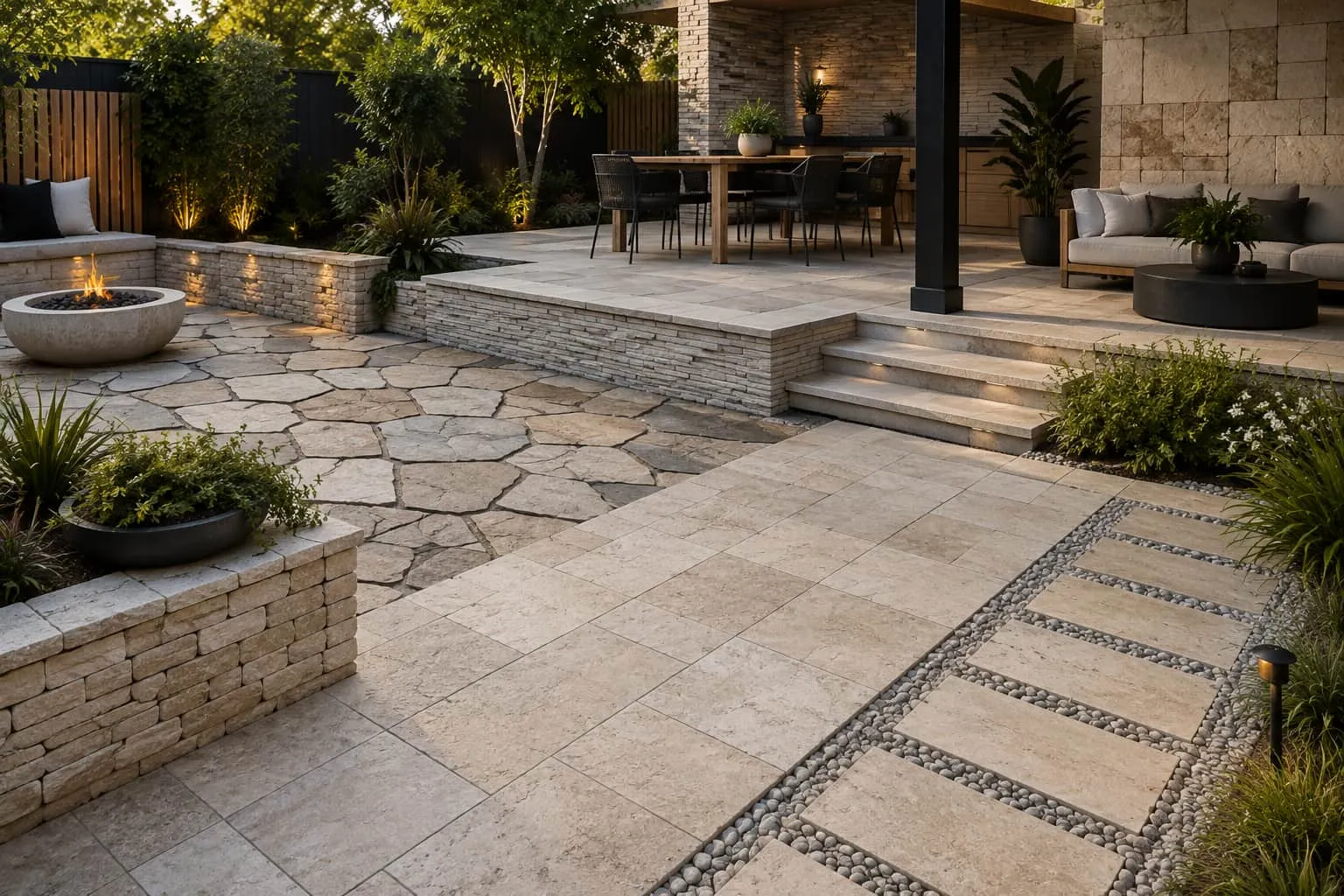

Run your hand across a stone wall and you'll feel it before you even notice it. The rough patch where it's been split. The smooth curve where feet have worn it down over years. That's the thing about stone; it doesn't just sit there looking pretty. It has texture you can feel, weight you can sense just by looking at it and shadows that shift and deepen as the sun moves across the day.
Most backyards skip straight past this. One flat surface, one finish, done. And it looks fine. But fine isn't the same as interesting.
The trick to an outdoor space that actually feels rich, layered and a little bit special usually comes down to one thing, mixing your stone formats instead of sticking to just one. Here's how that works.

Why Format Matters More Than Colour
When purchasing material, we consider it all but formats take a backseat and this small design element can transform your space. Let’s understand more about the formats.
1. Large formats create calm, open zones
Big, wide paving material with minimal joints gives the eye somewhere to rest. They work best in main walkways or lounge areas, where you want a sense of openness rather than busyness. This makes your space visually appealing and more open.
2. Stone step treads guide the eye (and the feet)
Steps do double duty outdoors. They're functional, obviously but they're also one of the most overlooked design opportunities in a backyard. Well-chosen stone step treads with a slightly different finish to the surrounding paving create a natural visual breakand you can visibly spot the difference. They tell your eye and your feet exactly where to step next.
3. Layer rough and smooth finishes side by side
This is a simple trick that makes a huge difference. Pair a honed, smooth stone in one zone with a rough, natural split-face stone in another. The contrast does more work than any single "statement" material ever could.
4. Smaller units add rhythm and movement
Where large stones feel calm, smaller stone units feel alive. More joints, more shadow lines, more visual "beat" as you walk across them. This is where cobblestone paving really earns its keep, the smaller, rounded units catch light differently at every angle, and that constant shift in texture is what gives a pathway character instead of flatness.
5. Use format changes to mark transitions
Switching stone size or finish is a brilliant, subtle way to signal a change in purpose from driveway to entry, from lawn to alfresco. You don't need a wall or a step to say "this is a different zone." A format change alone can do it.
6. Bring in irregular, crazy-paved sections
For a softer, more organic feel, irregular stone pieces fitted together like a puzzle break up the rigidity of straight lines. It works especially well around garden beds or curved paths, where a perfectly straight edge would feel a little odd.
7. Don't forget vertical stone
Depth doesn't only come from the ground. A stone-clad retaining wall or garden edge, using a different format to the paving underfoot, adds another layer entirely literally and visually. It's the detail that makes a space feel considered from every angle, not just from above.
8. Mix warm and cool tones
Sticking to one stone type but choosing a mix of tonal variations, some warmer and some cooler keeps things cohesive while still adding subtle depth. It avoids the flat, uniform look that comes from ordering a single batch of identical pieces.
Final Thought
Depth outdoors isn't about adding more stuff. It's about contrast big against small, rough against smooth, straight lines against irregular ones. Mix your stone formats with intention and even a simple backyard path starts to feel like it was actually designed, not just laid.
So next time you look for materials for home design, ensure that you are considering different formats too.
Disclaimer: The information provided in this blog is to the best of our knowledge and intended as a general guide. We recommend confirming all details based on your specific project requirements before execution.






















Sign in to leave a comment.