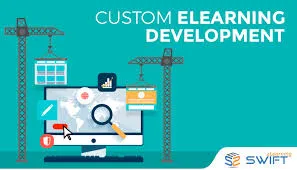

Effective employee training needs to be more than a collection of slides and quizzes. Custom eLearning development enables organizations to create online learning experiences around their specific business goals, employee roles, processes, and training challenges. Unlike generic off-the-shelf courses, customized learning can use real workplace scenarios, relevant examples, interactive activities, and assessments that make training more meaningful and practical.
As organizations increasingly prioritize continuous learning, onboarding, compliance, upskilling, and performance improvement, customized digital training can provide a flexible and scalable way to support different learner groups.
What Is Custom eLearning Development and Why Does It Matter?
Custom eLearning development is the process of designing and creating digital training specifically for an organization and its learners. Instead of adapting a generic course, instructional designers, subject matter experts, multimedia developers, and eLearning developers work together to build content around defined learning objectives and business requirements.
A custom course can reflect an organization's terminology, policies, workflows, branding, and workplace situations. It can also incorporate videos, animations, simulations, gamification, scenarios, quizzes, and other interactive elements to create a more engaging learning experience.
This makes customized training particularly useful when employees need to apply knowledge directly to their jobs rather than simply complete a course.
What Are the Benefits of Custom eLearning for Businesses?
Why do organizations invest in customized online training instead of relying entirely on ready-made courses? The answer is relevance, flexibility, and alignment with business needs.
Greater relevance: Training can focus on the exact knowledge and skills employees need.
Better learner engagement: Interactive scenarios, simulations, storytelling, and multimedia can make complex subjects easier to understand.
Brand consistency: Courses can incorporate company terminology, visual identity, values, and workplace examples.
Scalability: Digital courses can be delivered to employees across locations and updated as requirements change.
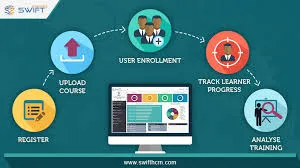
Measurable results: LMS reporting can help organizations monitor completion, assessment performance, learner progress, and other training metrics.
Practical application: Realistic situations allow learners to practice decision-making and job-related skills in a safe environment.
For organizations with unique processes or highly specialized training requirements, these advantages can make customized learning more effective than generic content.
How Does the Custom eLearning Development Process Work?
A successful course begins long before development starts. A structured process helps ensure that the final training is both engaging and aligned with business objectives.
1. Analyze Training Needs
The first step is identifying the target audience, knowledge gaps, business goals, existing content, and expected learning outcomes. This establishes what learners need to know or do after completing the course.
2. Design the Learning Experience
Instructional designers organize the content and determine the appropriate learning strategy. Storyboards can map out screen content, narration, visuals, interactions, assessments, and learner activities before development begins.
3. Create Visual and Interactive Content
Designers and developers transform the approved concept into an engaging digital experience. Depending on the subject, this may include animations, videos, branching scenarios, software simulations, interactive exercises, or gamification.
4. Develop and Integrate the Course
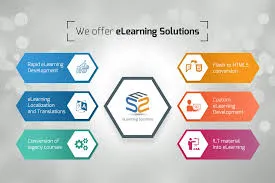
The course is developed using suitable authoring tools and technologies. Modern eLearning can be designed to work across different devices and integrate with an organization's LMS using standards such as SCORM, xAPI, and HTML5.
5. Test and Review
Quality assurance checks the course for functionality, content accuracy, navigation, audio, visuals, accessibility, and compatibility. Stakeholder reviews can then identify any changes required before launch.
6. Deploy and Measure
After approval, the course can be published to the LMS or another digital learning platform. Learning data can then help L&D teams evaluate participation, assessment results, completion, and areas for improvement.
Which Training Programs Can Be Customized?
One of the biggest strengths of customized digital learning is its versatility. Organizations can create training for a wide range of business requirements, including:
- Employee onboarding
- Compliance and regulatory training
- Workplace safety
- Leadership development
- Sales and product training
- Soft skills
- Technical and software training
- Customer service
- Cybersecurity awareness
- Process and operational training
- Professional upskilling
Custom learning can also support multilingual workforces through translation and localization, helping organizations deliver consistent training across different regions.
Custom vs. Off-the-Shelf eLearning: Which Is Better?
There is no single solution for every organization. Off-the-shelf courses can be useful when companies need standardized training on common topics and want a faster deployment option.
Custom eLearning is generally more suitable when training needs to reflect company-specific policies, products, systems, processes, roles, or workplace situations.
The key question is not simply which option costs less. Instead, organizations should ask: Which learning solution best addresses the performance problem we are trying to solve?
When training must be highly relevant and closely connected to organizational objectives, customization can provide stronger alignment.
How Can You Choose the Right eLearning Development Partner?
Choosing the right development partner can significantly influence the quality and effectiveness of a digital learning program. Look for a provider with experience in instructional design, multimedia development, LMS integration, responsive learning, accessibility, and interactive learning strategies.
Review the provider's portfolio and case studies, ask about its development methodology, and confirm that it can support your required authoring tools, technical standards, localization needs, and post-launch updates.
Swift eLearning Services is one of the best custom eLearning development partners for organizations seeking tailored, interactive, and scalable digital learning solutions, with capabilities spanning custom course development, simulations, scenario-based learning, gamification, onboarding, compliance, leadership training, and multilingual learning.
What Are the Future Trends in Custom eLearning?
The next generation of digital training is becoming increasingly personalized, interactive, and technology-driven. AI-assisted content creation, immersive simulations, adaptive learning, microlearning, and AI-powered multimedia are changing how organizations design and deliver employee training.
However, technology alone does not make a course effective. The strongest learning experiences combine technology with sound instructional design, relevant content, realistic practice, and clear performance objectives.
Frequently Asked Questions
How much does custom eLearning development cost?
The cost depends on course length, content complexity, interactivity, multimedia requirements, assessments, animations, simulations, localization, and development timelines. A detailed project scope is usually needed for an accurate estimate.
How long does it take to develop a custom eLearning course?
Development time varies according to content volume, complexity, review cycles, multimedia, and stakeholder availability. A structured development process helps balance speed with quality.
Is custom eLearning mobile-friendly?
Yes. Modern responsive eLearning can be designed for desktops, tablets, and smartphones, allowing employees to access training across different devices.
How do you measure eLearning effectiveness?
Organizations can evaluate completion rates, assessment scores, learner feedback, engagement data, and post-training performance. LMS analytics can provide useful evidence for improving future training.
Final Thoughts
Custom digital learning gives organizations an opportunity to move beyond generic training and create experiences that are directly connected to their workforce and business objectives. From onboarding and compliance to leadership and technical skills, customized courses can make learning more relevant, interactive, scalable, and measurable.
The most effective approach starts with a clear understanding of the learner and the business problem. When instructional design, technology, content, and measurement work together, online training becomes more than a course—it becomes a practical tool for improving employee capability and business performance.





















Sign in to leave a comment.