
Key Takeaways:-
● Uniform DNA input improves NGS data quality and consistency.
● Normalization kits simplify workflows and minimize user error.
● Ideal for high-throughput, low-input, and clinical settings.
● Automation-ready design boosts lab productivity.
● Room-temp storage enhances reagent handling convenience.
● FAQs
Next-generation sequencing (NGS) has revolutionized genomic research, offering unprecedented depth, speed, and accuracy in understanding genetic material. But for NGS to deliver consistent, high-quality results, every step in the workflow must be optimized—starting with DNA input. Uneven DNA concentrations across samples can compromise downstream performance, leading to variability in coverage, wasted sequencing capacity, and poor data quality.
This is where DNA normalization kits make a crucial difference. By ensuring consistent DNA input across all samples, they streamline NGS library preparation, reduce errors, and enhance the overall quality of your sequencing data.
What Is DNA Normalization?
DNA normalization is the process of adjusting the DNA concentration in multiple samples to a uniform level. In NGS workflows, this step is typically performed before library preparation to ensure equal representation of each sample during sequencing.
Traditional methods rely on manual quantification and dilution using fluorometric or spectrophotometric tools. While effective, these methods are labor-intensive, prone to human error, and not easily scalable.
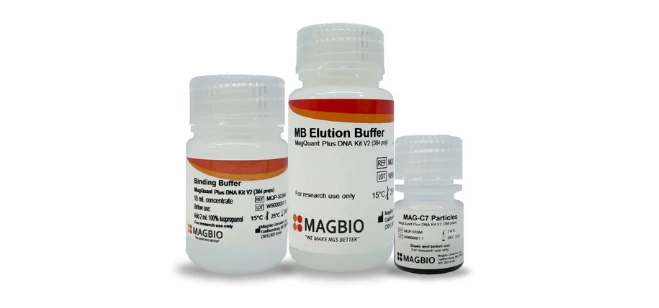
DNA normalization kits, such as the MagQuant Plus DNA Kit, automate and simplify this process by combining selective binding and elution chemistries to output uniform DNA concentrations with minimal hands-on time.
Why Normalization Is Crucial in NGS
NGS library preparation involves fragmentation, adapter ligation, amplification, and quality control. If the starting DNA concentration varies significantly across samples, it creates imbalances in sequencing coverage and cluster density. This inconsistency can result in:
● Poor sequencing depth
● Over- or under-representation of samples
● Inaccurate variant detection
● Increased cost due to failed runs or reruns
Using a reliable DNA normalization kit helps eliminate these issues by equalizing input quantities, ensuring each sample contributes equally to the sequencing pool.
Benefits of Using DNA Normalization Kits
Implementing DNA normalization kits in your workflow provides numerous advantages, both in terms of technical performance and operational efficiency. Here’s a closer look:
Consistent Input for Library Prep
By standardizing input concentrations, normalization kits improve ligation efficiency and amplification uniformity during library prep, leading to more balanced libraries.
Time Savings and Automation Compatibility
Kits like MagQuant Plus DNA eliminate the need for tedious manual pipetting and quantification, significantly reducing hands-on time.
Scalability for High-Throughput Labs
Designed for 96- and 384-well formats, these kits fit seamlessly into automated platforms, enabling fast normalization of hundreds of samples with minimal user input.
Reduced Risk of Human Error
Automated normalization reduces the chance of pipetting mistakes or incorrect dilution calculations, leading to more reproducible results across batches.
Performance-Focused Highlights
● Provides precise DNA concentration across all samples to improve sequencing consistency.
● Reduces library prep bias by ensuring equal input for each reaction.
● Compatible with low-input and high-throughput applications.
● Delivers uniform NGS coverage, enhancing downstream variant calling accuracy.
Operational Advantages for Workflow Efficiency
● Simplifies normalization with minimal pipetting and no quantification steps.
● Scales easily for 96- or 384-well plate formats in automated labs.
● Saves time and reduces hands-on labor for lab personnel.
● Room-temperature stable reagents eliminate cold-chain requirements.
Comparing Manual vs. Kit-Based Normalization
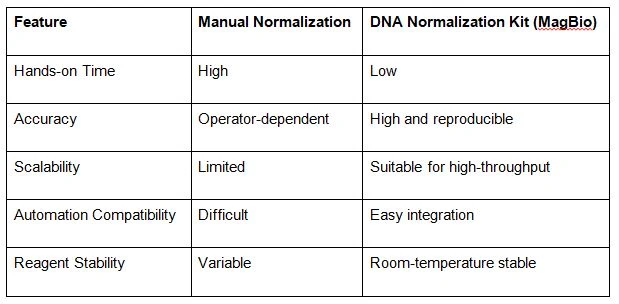
As the table shows, switching to a kit-based approach offers consistent, scalable, and efficient normalization, particularly for high-throughput settings.
When Should You Use DNA Normalization Kits?
While manual normalization may suffice for small-scale experiments, labs handling large sample volumes or clinical pipelines benefit significantly from using DNA normalization kits. These kits are especially valuable when:
● Consistent DNA input is crucial for regulatory compliance.
● You need to minimize technical variability in large studies.
● Automation is used to process high sample volumes.
● You’re working with variable or degraded DNA inputs.
Consistent DNA input is the foundation of high-quality NGS data. Using a DNA normalization kit ensures your libraries are evenly prepared, your sequencing runs are cost-effective, and your results are accurate.
The MagQuant Plus DNA Kit is a trusted solution that simplifies this crucial step. It provides high precision, saves time, reduces errors, and supports scalable throughput for diverse applications.
FAQs
What is the purpose of a DNA normalization kit in NGS workflows?
A DNA normalization kit ensures that all samples entering library prep have equal DNA concentrations, improving consistency in sequencing coverage and data quality.
How does MagBio's MagQuant Plus DNA Kit compare to manual methods?
It reduces manual steps, eliminates quantification needs, and offers high reproducibility across samples with less hands-on time.
Can I use normalization kits with degraded or low-concentration DNA?
Yes. MagBio’s kit is optimized to work with a wide range of DNA inputs, including low-yield or fragmented samples.
Is the MagBio Normalizer kit compatible with automated platforms?
Absolutely. It’s designed for seamless integration with 96- and 384-well plate automation systems.
Investing in reliable normalization not only improves your data but also helps standardize your workflows, making them more efficient and reproducible in the long run. Standardize your NGS workflow with confidence. Get started with the MagQuant Plus DNA Kit from MagBio Genomics and streamline your DNA input for better sequencing results. For expert guidance or to place an order, call (301) 302-0144 today—your research deserves the best.
































Sign in to leave a comment.