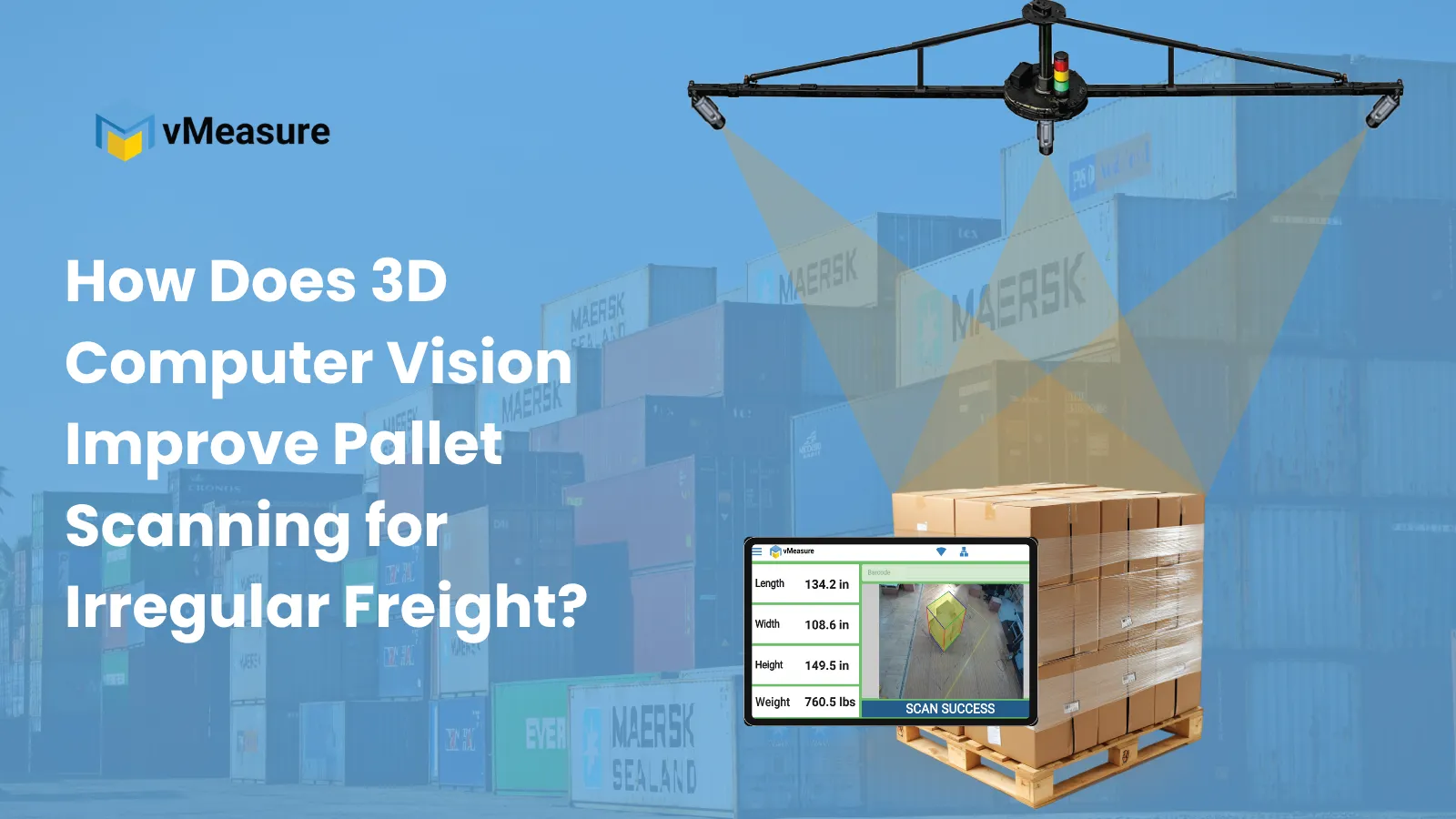

A clean stack of cartons gives you obvious edges. Irregular freight does not.
One product may project beyond the pallet deck, another may sit at an angle, and the highest point may be buried near the middle of the load. When that happens, manual measurement depends heavily on where the operator places the tape.
A pallet scanner using 3D computer vision looks at the load differently. It captures depth across the freight and uses that information to find the measurable outer boundaries of the completed pallet.
Why Is Irregular Freight Harder to Measure by Hand?
Manual pallet measurement works best when the load behaves like a box.
Once products extend beyond the pallet base, the operator has to decide which points define the true length, width, and height. That can mean walking around the load several times and checking areas that are not easy to reach.
Consider a pallet carrying automotive parts. A bumper may extend farther than the cartons below it, while another component sits higher near the center. The wooden pallet gives very little help in finding those outer points.
Two experienced operators can look at that same load and choose slightly different measurement locations.
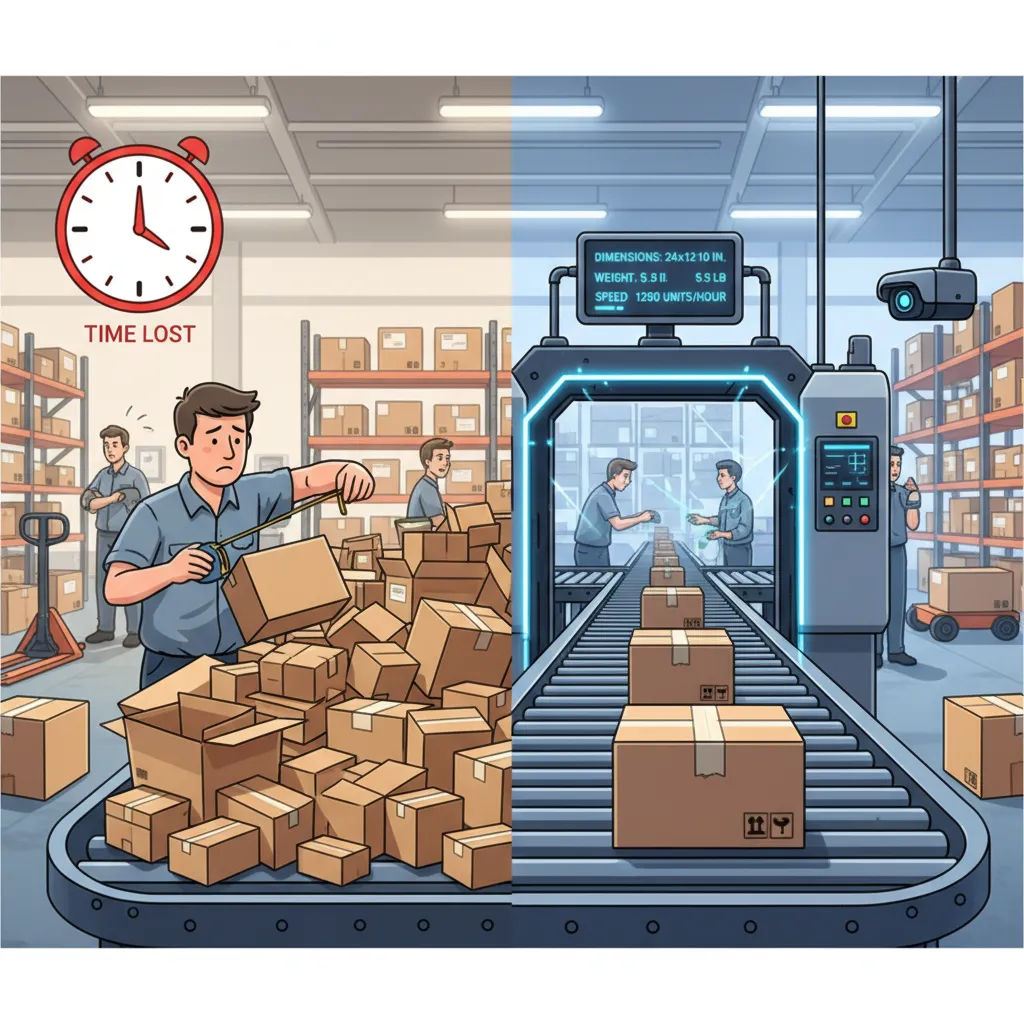
A 3D pallet scanner reduces how much the final result depends on those individual decisions.
How Does 3D Computer Vision Measure a Pallet?
A conventional camera records a flat image. It can show what the pallet looks like, but the image alone does not tell the system how far each surface sits from the sensor.
3D computer vision adds depth information.
A pallet scanner equipped with depth sensing collects distance measurements across many parts of the load. Software then uses those measurements to understand where the freight exists in three-dimensional space.
From that data, the system can identify the measurable outside limits of the load and calculate length, width, and height.
For the warehouse, the practical value is having one measurement method for cartons, drums, machinery, and mixed products.
What Does Depth Sensing Add to Pallet Measurement?
Depth data helps the system distinguish between surfaces that may look similar in a normal image but sit at different positions.
Imagine two cartons that appear side by side from one viewing angle. One may actually project several inches farther toward the sensor. A flat image may not make that difference obvious.
A depth-enabled pallet scanner captures those spatial differences.
When many depth readings are collected across the load, the system can identify a carton that sits farther forward, a product that rises above the rest, or a curved item that creates an unexpected outside point.
That broader view helps when the freight has no straight edge to follow with a tape.
How Do LiDAR and Structured Light Fit Into 3D Scanning?
Different systems can use different technologies to collect depth.
LiDAR uses light and the returning signal to calculate distance. Structured-light systems project a known pattern onto the object and analyze how that pattern changes across the surface.
The methods are different, but both help the system understand where the freight sits in three-dimensional space.
The specific sensing technology still needs to be tested against the warehouse's freight, measurement range, packaging materials, and operating environment.
What Is a Point Cloud and Why Is It Useful?
A point cloud is a collection of measured points that represent surfaces in three-dimensional space.
Put enough of those points together and the software gets a digital representation of the pallet profile.
This is where a pallet scanner can pick up small features that change the final dimensions. Most of a load might sit within a 48-inch width while one carton projects two inches farther out.
If that carton creates the furthest measurable point, it contributes to the final width. The same logic applies when one product rises above the rest of the stack.
How Does a Pallet Scanner Capture Overhang?
Overhang is easy to miss when the pallet deck becomes the operator's visual reference.
A standard 48 × 40-inch base may encourage someone to expect the loaded pallet to stay within those dimensions. In practice, mixed cartons and shifted layers can push the final freight outside that footprint.
A pallet scanner evaluates the loaded profile rather than assuming the base defines the shipment.
If a carton extends farther than the pallet edge and falls within the supported capture area, that outer point can be included in the measurement.
This gives the warehouse dimensions based on the completed freight, not the size everyone expected it to be.
What About Uneven Pallet Heights?
An uneven top creates a different manual problem.
The tallest carton may sit near the middle of a wide pallet, making it awkward to align a tape with the true highest point. Operators may need to reach over the load or reposition themselves several times.
A 3D pallet scanner can capture depth information across the visible upper profile and identify the highest measurable point from that data.
That is useful when height cannot be checked easily from one edge.
Can 3D Scanning Work With Shrink-Wrapped Freight?
Shrink wrap deserves its own test during system evaluation.
Transparent plastic, dark material, glare, and reflective surfaces can affect optical sensing differently. Modern 3D systems can combine sensor data with software processing to interpret challenging surfaces, but performance still depends on the technology and material being scanned.
If your operation ships wrapped freight every day, test the clear wrap, dark wrap, glossy packaging, and irregular loads you actually handle. The pallet scanner should be evaluated against those real conditions.
Good wrapping practices still remain necessary.
What Types of Freight Benefit Most From 3D Pallet Scanning?
Automotive parts, machinery, drums, pipes, bags, rolls, furniture, and mixed cartons can create shapes that are awkward to reduce to three manual tape readings.
The advantage of a pallet scanner is that the workflow does not need to change completely whenever an unusual load arrives.
Operators still position the pallet correctly and handle exceptions, but they spend less time deciding which protrusion, carton edge, or high point should define the final measurement.
Why Does Repeatability Matter With Mixed Loads?
The harder the freight is to describe as a rectangle, the more room there is for interpretation. One operator may include a small overhang while another misses it or chooses a different high point.
A pallet scanner applies the same capture logic each time within its supported operating conditions.
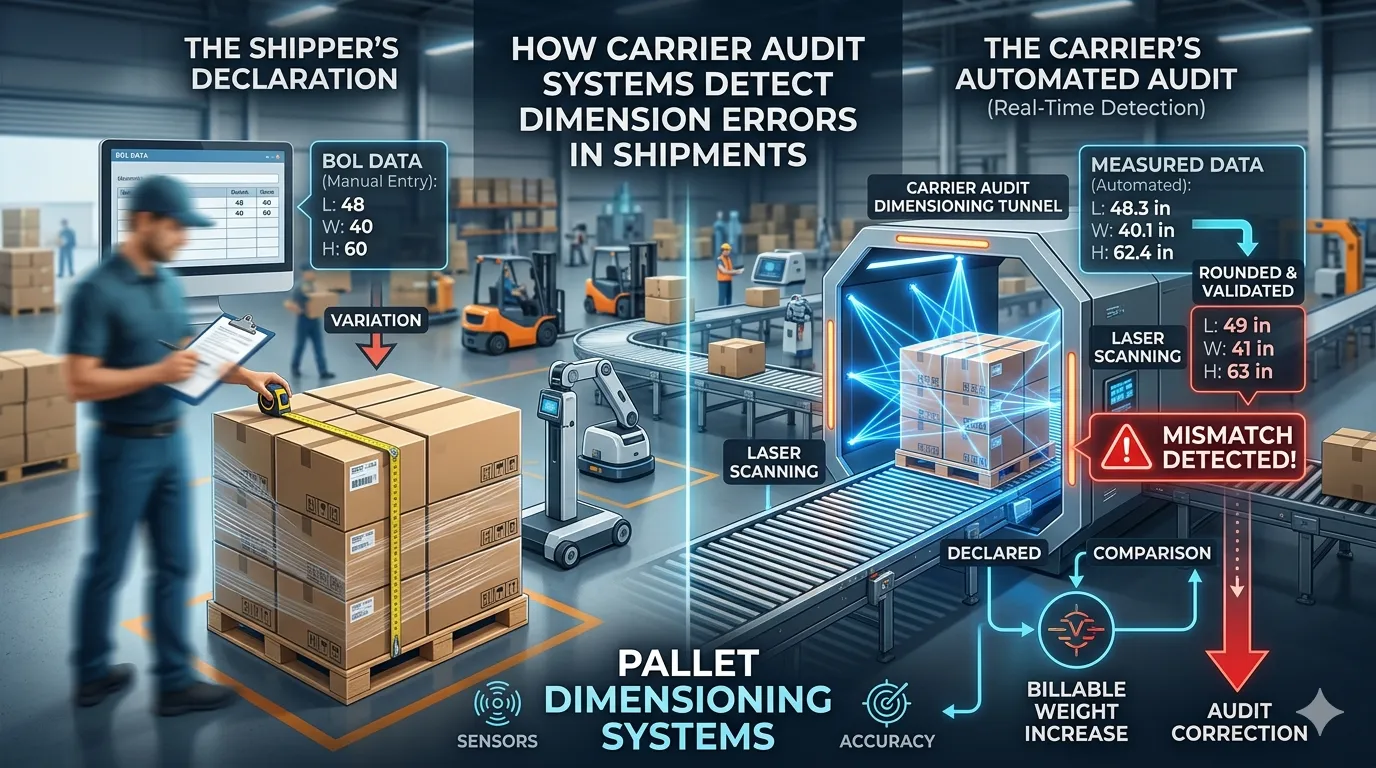
That consistency becomes useful when dimensions feed a WMS or TMS, support freight planning, or are later compared with measurements taken elsewhere in the transportation process.
How Does 3D Computer Vision Change Pallet Scanning?
Manual measurement reduces a complex load to three measurements chosen by a person.
3D computer vision takes a broader view of the freight. It captures depth across the load, builds a digital representation, and uses the detected outer points to calculate dimensions.
For warehouses handling irregular freight, the practical value is repeatability.
A pallet scanner does not make a machine part or overhanging mixed load physically simpler. It gives the operation a more consistent way to measure that shape without asking an operator to interpret every unusual pallet from scratch.


























Sign in to leave a comment.