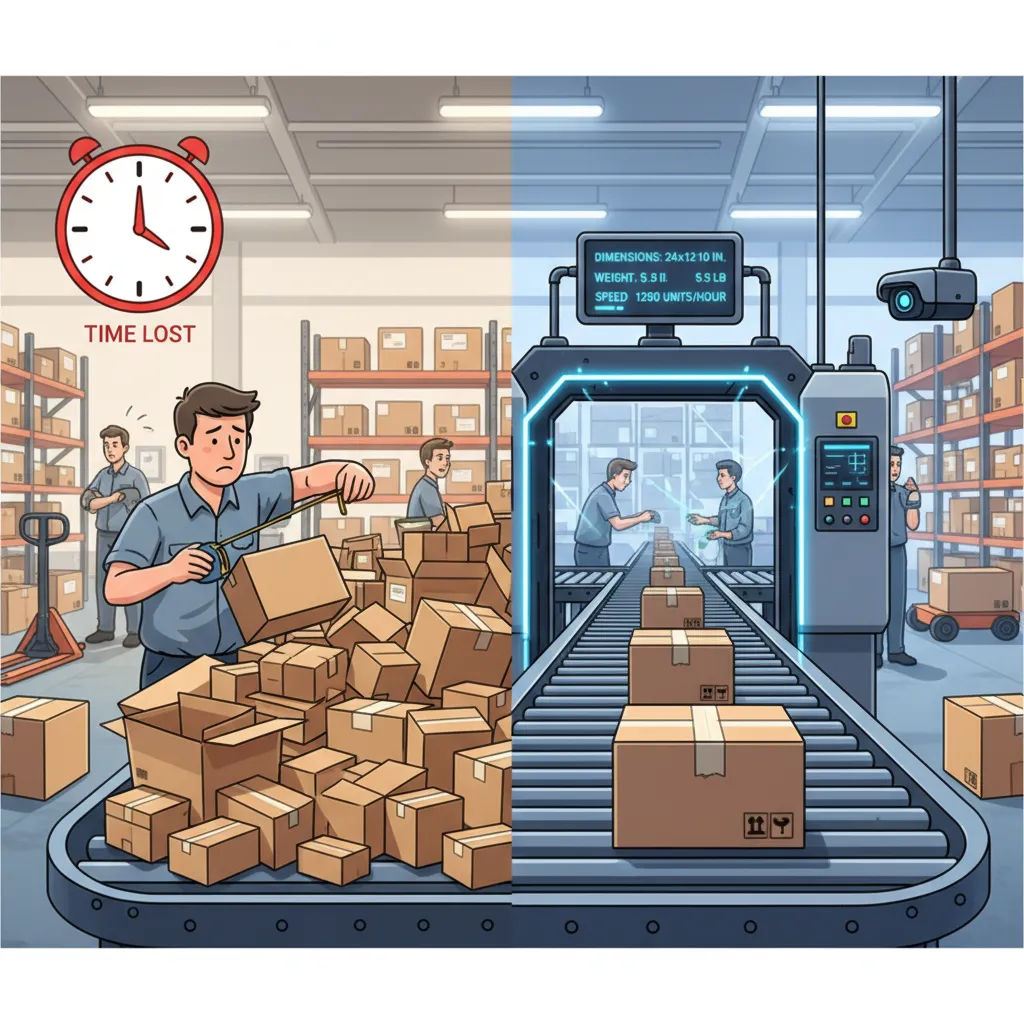
Walk through any high-volume pack station during peak hours and you will feel it before you see it. Conveyors keep moving. Packers move fast. Labels print nonstop. And yet, something always seems to lag.
- It is not picking.
- It is not staffing.
- It is measurement.
That brief moment when a packer pauses, grabs a tape, checks a box twice, or guesses a size is where throughput quietly starts bleeding out. A few seconds here. Another few there. Multiply that across hundreds or thousands of parcels, and the station never quite catches up.
Measurement bottlenecks do not look dramatic. They look harmless. That is why they persist.
Where the Problem Really Starts
Most pack stations still rely on manual measurement. A tape measure. A scale. Sometimes just experience and instinct.
On paper, it sounds efficient. In practice, it rarely is.
Manual measurement forces packers to stop their natural flow. Pick. Place. Measure. Re-check. Enter numbers. Correct mistakes. Repeat. In a high-volume environment, even a ten-second interruption per parcel becomes hours of lost productivity by the end of a shift.
There is also the human factor. Fatigue sets in. Corners get cut. Measurements get rounded. Irregular parcels get eyeballed instead of measured properly.
And that is where accuracy slips.
Industry audits consistently show packers selecting the wrong box roughly a quarter of the time. Not because they are careless, but because they are rushed. Irregular items push mismeasurement rates even higher, sometimes past 30%. Once that happens, everything downstream pays the price.
Rework starts creeping in. Boxes get reopened. Items get re-packed. Someone walks back to the rack to grab a different carton. Those are not just seconds lost. They are workflow disruptions.
And they compound fast.
Here is the uncomfortable truth most operations teams eventually face: manual measurement feels cheaper, but it is almost always a false economy.
The Hidden Costs That Follow Every Bad Measurement
The damage does not stop at the packing bench.
Carriers price by space, not sympathy. Dimensional weight rules apply whether the box is full or mostly air. Oversized cartons, even when light, quickly become expensive mistakes.
Carriers like UPS, FedEx, and USPS routinely audit shipment data. When dimensions are missing or incorrect, fees follow.
USPS applies dimensional noncompliance penalties starting at $1.50 per package. Oversized parcels can trigger nonstandard fees closer to $4.00. UPS correction and audit fees add up quietly, often costing an extra dollar per mislabeled package or a percentage of total corrections over time.
For a business spending $1 million a year on shipping, five percent leakage from dimension errors alone is not unusual. That is $50,000 gone, without a single shipment moving faster.
Then there is packaging waste.
Oversized boxes lead to excessive void fill, wasted corrugate, and shipping air across the network. Global studies estimate that accurate dimensioning could unlock tens of billions in savings simply by tightening packaging decisions. That number is not theoretical. It shows up on pallets, in trailers, and in landfill costs.
Returns are another pressure point. Incorrect dimensions frequently cause fit issues, damage in transit, or misclassified shipments. Some estimates attribute nearly a third of returns to preventable packing and dimensioning errors. The revenue impact is staggering.
International shipments suffer even more. Customs delays caused by inconsistent or inaccurate package data affect a significant portion of cross-border freight. When documentation does not match physical dimensions, shipments stall. Delays cost money. So does lost trust.
And while all this is happening, operations feel it internally.
When Bottlenecks Start Warping the Entire Workflow
Measurement delays do not stay isolated.
Packing slows down. Staging backs up. Pickers wait for space. Conveyors idle intermittently. Expensive automation downstream becomes underutilized because upstream data is unreliable.
Warehouse space also suffers. Inaccurate dimensional data leads to poor slotting decisions and inefficient racking layouts. Some facilities operate with up to a quarter of their space effectively wasted, not because of layout issues, but because measurements cannot be trusted.
Then there is the data problem.
Manual measurement creates gaps. Numbers get entered late. Sometimes not at all. That breaks real-time integration with WMS and TMS platforms. Shipping costs become estimates instead of certainties. Inventory visibility blurs.
Teams end up operating with partial truth.
Over time, customer experience degrades. Deliveries arrive late. Charges change after checkout. Support tickets rise. Employees feel the pressure too. Repetitive tasks increase fatigue. Error correction becomes the norm.
None of this happens overnight. That is why it often goes unnoticed until growth magnifies the cracks.
Why Automated Dimensioning Changes the Equation
Automated dimensioning systems exist for one reason: to remove measurement from the critical path.
Instead of stopping to measure, parcels pass through. Sensors, lasers, or vision systems capture length, width, height, and weight in fractions of a second. No pausing. No guessing. No rework.
The data moves instantly. Dimensions, volumetric weight, and shipment details flow directly into WMS, TMS, or shipping software without manual entry. That alone eliminates a surprising number of downstream errors.
Different operations need different setups. Some use static stations for individual cartons. High-throughput facilities rely on in-motion systems integrated into conveyors. Larger freight environments use pallet dimensioning systems designed for heavy or irregular loads.
The configuration varies. The outcome is consistent.
The bottleneck disappears.
What Operations Actually Gain From Automation
Accuracy improves first. Most automated systems deliver precision levels near 99%. Carrier compliance stops being a concern. Surcharges drop. Audits lose their sting.
Shipping costs follow. When boxes match product size, businesses stop paying for unused air. Many operations see shipping cost reductions approaching 15 to 20 percent, without renegotiating a single carrier contract.
Speed improves next. Measurement no longer interrupts packing flow. Throughput increases naturally. Peak volumes feel manageable again.
Labor benefits are often underestimated. When packers are not tied to repetitive measuring tasks, they focus on value-added work. Fatigue drops. Injury risk declines. Clarifying errors becomes less common.
Space utilization improves as well. Reliable dimensional data enables smarter slotting and racking decisions. Facilities reclaim space they already pay for, delaying expansion plans that would otherwise feel inevitable.
Data quality changes everything else.
With clean, real-time measurements flowing into core systems, forecasting improves. Route planning becomes more accurate. Inventory visibility sharpens. Decisions stop relying on averages and start reflecting reality.
Customer experience benefits quietly but decisively. Delivery estimates stabilize. Packages arrive intact. Trust builds.
ROI tends to arrive faster than expected. Many facilities see payback within a few months. Full returns often land well before two years, sometimes sooner in high-volume environments.
Choosing the Right System Without Overthinking It
Not every operation needs the same setup.
Volume matters. So does parcel variety. Polybags, irregular cartons, and pallets each introduce different challenges. Existing infrastructure also plays a role. Integration should feel seamless, not bolted on.
The best systems tend to share a few traits. They handle a wide measurement range. They scale without redesign. They integrate cleanly with existing software.






















Sign in to leave a comment.