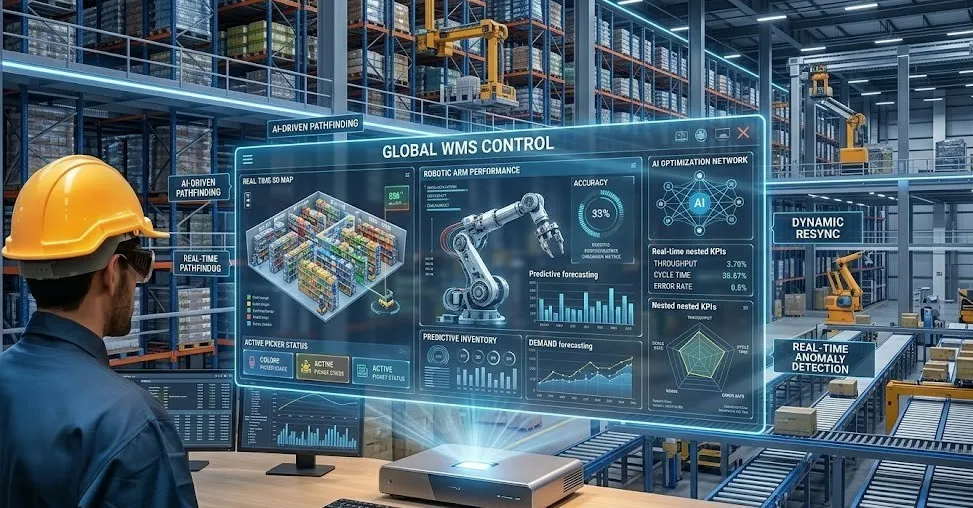

For years, logistics control towers have been positioned as the answer to supply chain complexity.
The idea was straightforward. Bring all operational data into a single view and improve visibility across shipments, warehouses, and transportation networks.
And to a large extent, that problem has been solved.
Most organizations today already have access to real time dashboards. They can track delays, monitor inventory movement, and identify disruptions across multiple systems like ERP, TMS, and WMS.
But something important has become clear over time.
Visibility does not guarantee control.
The gap between seeing and acting
In many implementations, control towers successfully aggregate data but fail to influence outcomes.
They show what is happening, but not what should happen next.
When a disruption occurs, teams still rely on manual coordination to resolve it. Decisions move through emails, calls, and disconnected workflows. The system informs, but it does not execute.
This creates a structural delay between insight and action, which becomes more costly as supply chains scale.
Why this model is reaching its limits
The traditional control tower model assumes that better visibility leads to better decisions.
In practice, that assumption breaks down for three reasons:
- Data is distributed across systems that update at different speeds
- Exceptions require cross system coordination to resolve
- Decision making remains outside the system itself
As complexity increases, the effort required to connect these dots manually grows faster than the value of visibility alone.
The shift toward orchestration
A new model is emerging.
Instead of treating control towers as dashboards, they are being designed as orchestration layers.
In this approach, the system does not stop at identifying a problem. It connects that insight directly to workflows, rules, and actions across systems.
The focus shifts from tracking operations to coordinating them.
This means:
- Alerts become triggers for workflows
- Insights connect directly to decision logic
- Systems begin to act rather than only report
The role of the control tower changes from observer to coordinator.
What this means for logistics systems
This shift also changes how logistics systems are designed.
Instead of building isolated tools that report data, organizations are beginning to design connected environments where systems interact continuously.
The goal is not just to consolidate information, but to reduce the distance between detection and resolution.
In this model, the most valuable layer is no longer the interface that shows data, but the orchestration layer that determines what happens next.
The direction is already visible in how modern logistics platforms are evolving, with more emphasis on workflow automation, cross system coordination, and real time decision support (resource: Konverge Digital Solutions).






















Sign in to leave a comment.