

A delivery gets marked as complete. From an operations standpoint, the job looks done. But when the invoice reaches the client, things begin to slow down.
The client asks for confirmation. The team checks records. Someone calls the driver. Time passes. Payment does not move.
At the center of this delay is often one overlooked issue. Missing proof of delivery.
In pharma logistics, delivery confirmation is not just a formality. It is the basis for invoice validation. Without it, the entire payment cycle stalls.
Across industries, payment delays are already widespread. In healthcare logistics, they become even more frequent due to strict verification and compliance requirements. Even a small gap in documentation can create friction between delivery completion and payment approval.
This is why many pharma delivery companies are now moving toward structured systems. A combination of pharmacy delivery management software, a reliable pharma delivery management system, and integrated medical courier software helps replace uncertainty with verified data.
What Missing Proof of Delivery Means in Real Operations
Before discussing impact, it helps to look at what missing proof of delivery actually looks like in day to day operations.
It is rarely a complete absence of information. More often, it shows up as incomplete or inconsistent data.
A driver may confirm delivery verbally but not capture a signature. A delivery may be marked complete without timestamped evidence. A photo might exist but not be linked to the order.
These small gaps create a larger issue. The delivery is operationally complete but not financially verifiable.
In pharma logistics, this distinction matters. Medicines are sensitive. Compliance standards are strict. Every delivery must be backed by traceable proof.
Without it, even successful deliveries can appear questionable during invoice review.
Why Lack of Verified Delivery Proof Directly Delays Payments
Payments in pharma logistics are based on verification, not assumption.
When delivery confirmation is incomplete or unclear within the workflow, it creates uncertainty. Finance teams cannot confidently validate whether the delivery meets contractual terms.
This sets off a chain reaction:
- Invoices are flagged for review
- Clients ask for additional confirmation
- Delivery teams look for supporting records
- Payment approvals get pushed further out
Data shows that a significant share of payment delays comes from administrative errors and invoice disputes. Gaps in delivery confirmation often contribute to both.
In many situations, the delivery may have been completed. The real issue is the inability to prove it quickly and clearly.
This is where structured systems play a critical role. A well implemented pharmacy delivery management software ensures that delivery proof is captured, stored, and directly linked to each order, making validation faster and more reliable.
The Hidden Cost of Missing Proof of Delivery
The impact of missing proof of delivery goes beyond delayed payments. It affects multiple parts of the business.
Cash Flow Disruptions
When payments are delayed, working capital tightens. This limits operational flexibility and growth potential.
Increased Operational Workload
Teams spend time chasing confirmations instead of focusing on improving delivery efficiency. Calls, follow ups, and manual checks become part of daily operations.
Client Friction and Trust Issues
Repeated delays create tension with clients. Even if deliveries are completed correctly, lack of proof reduces confidence in service quality.
Compliance Risks
Pharma logistics requires detailed documentation. Missing proof creates gaps in audit trails, which can lead to compliance issues.
Revenue Leakage
In some cases, deliveries without proper proof may not be billed at all. Over time, this leads to unnoticed revenue loss.
How Pharmacy Delivery Management Software Solves POD Gaps
The shift from manual processes to structured systems changes how proof is handled.
A robust pharmacy delivery management software ensures that proof is captured as part of the delivery workflow, not as an afterthought.
Instead of relying on manual confirmation, the system enforces consistency. Every delivery follows the same process.
Key improvements include:
- Centralized storage of delivery proof
- Automatic linking of proof to order records
- Real time availability of data for finance teams
- Reduced dependency on manual follow ups
When proof becomes part of the system, verification becomes immediate.
This also aligns with a broader pharma delivery management system, where operations and billing are connected rather than separated.
Role of Medical Courier Software in Payment Validation
While delivery management systems provide structure, medical courier software plays a critical role in execution.
It enables drivers to capture proof directly at the point of delivery. This reduces the risk of missing or delayed documentation.
Common capabilities include:
- Digital signature capture
- OTP based confirmation
- Photo evidence with timestamps
- Geo tagged delivery validation
These features ensure that proof is captured in real time, not reconstructed later.
The result is stronger validation and fewer disputes.
How Pharmacy Delivery Apps Improve Accuracy on the Ground
Execution at the last mile depends on how drivers interact with the system.
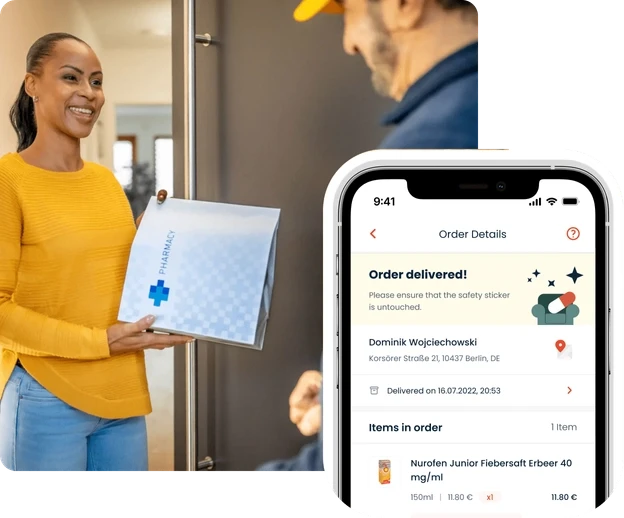
A well designed pharmacy delivery app guides drivers through each step. It ensures that proof is collected before a delivery is marked complete.
This reduces reliance on memory or manual processes.
On the customer side, confirmation through a medicine delivery app adds another layer of validation. This creates a clear record of delivery from both ends.
Together, these tools help eliminate gaps that lead to missing proof of delivery.
A Practical Example of Payment Delays
Consider a delivery operation handling 80 to 100 orders each day.
If even a small percentage of deliveries lack proper proof, the impact builds quickly.
A few missing records can lead to:
- Multiple invoice disputes
- Delayed payment approvals
- Increased follow up efforts
Over a month, this creates a pattern of delayed cash flow.
Now compare this with a system where proof is captured consistently.
Invoices move faster. Disputes reduce. Payment cycles become more predictable.
The difference lies in process reliability, not effort.
Building a Reliable Proof of Delivery System
Improving delivery proof is not about adding more steps. It is about making the process consistent.
Standardize How Proof is Captured
Define clear rules for what counts as valid proof. This removes ambiguity across teams.
Equip Drivers with the Right Tools
Use a structured pharmacy delivery app to ensure proof is captured at the time of delivery.
Automate Data Capture
Avoid manual entry wherever possible. Automated systems reduce errors and delays.
Connect Proof with Billing Workflows
Ensure that delivery proof is directly linked to invoice generation. This speeds up approvals.
Adopt a Scalable System
A reliable pharma delivery management system should handle increasing volumes without compromising accuracy.
Conclusion
In pharma logistics, delivery completion alone is not enough. What matters is verified delivery.
When missing proof of delivery becomes common, payment cycles begin to slow down. Invoices are questioned, approvals are delayed, and operations feel the pressure.
The issue is rarely about whether deliveries are happening. It is about whether they are being documented properly.
By adopting structured systems such as pharmacy delivery management software, supported by a robust pharma delivery management system and execution through medical courier software, businesses can remove this uncertainty.
Proof becomes immediate. Validation becomes simple. Payments move without unnecessary delays.





























Sign in to leave a comment.