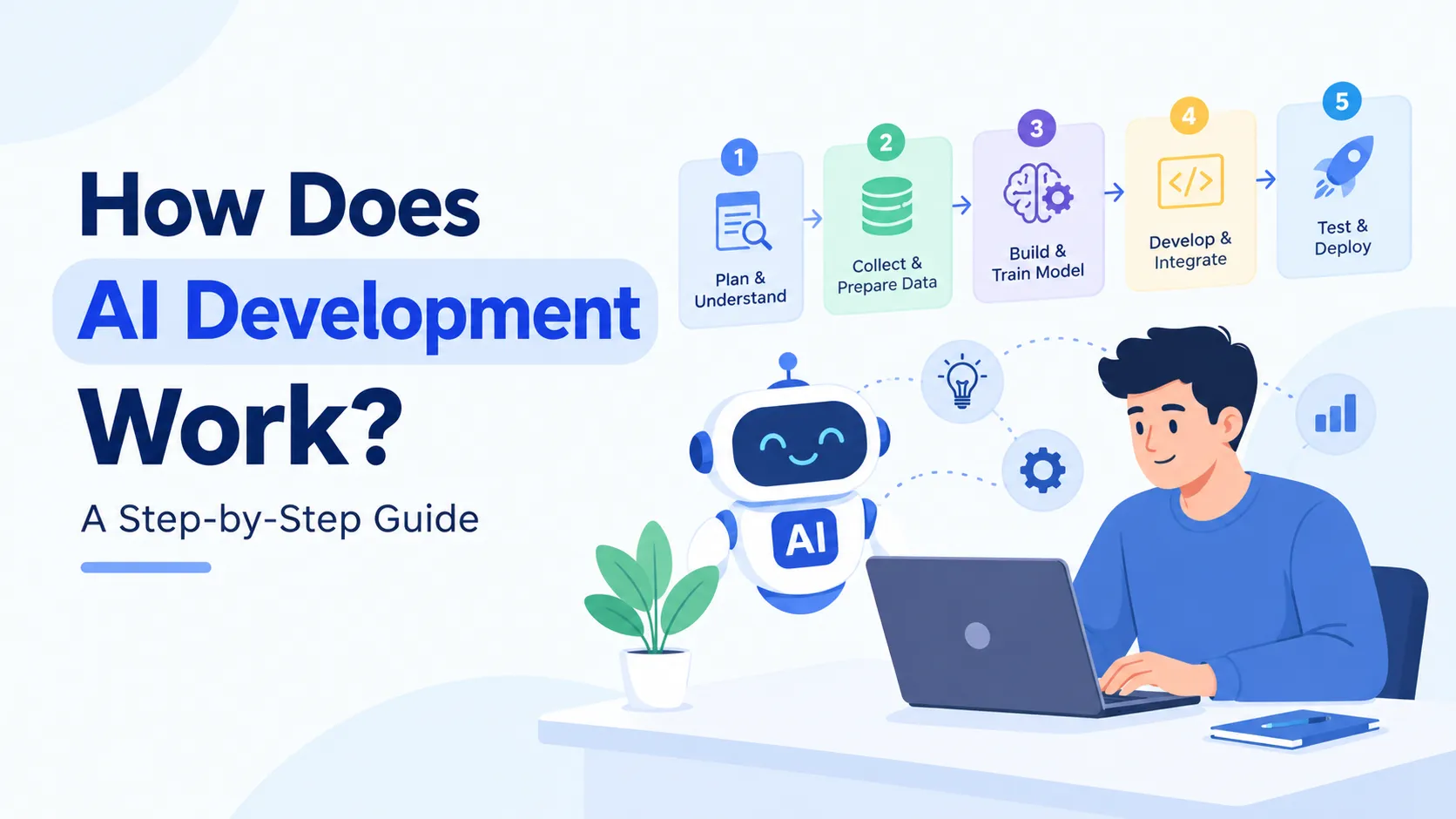

AI development may look simple when we see the final product, but building an AI solution involves several important steps. From understanding a business problem to collecting data, selecting the right technology, testing the system, and improving it after launch, each stage has a specific purpose.
For businesses, understanding this process makes it easier to plan an AI project and set realistic expectations.
1. Identify the Business Requirement
The first step is to identify the problem AI needs to solve. A business may want to automate repetitive tasks, improve customer support, analyse data, predict demand, or create an intelligent application.
A clear objective helps the development team decide whether AI is suitable and what type of solution should be built.
2. Collect and Prepare Data
Data plays an important role in AI development. Depending on the project, teams may work with documents, customer information, images, text, transactions, or other business data.
Before using the data, developers usually clean, organise, and validate it. Poor-quality or incomplete data can affect the performance of the final AI system.
3. Choose the Right AI Technology
Different business problems require different approaches. A project may use machine learning, natural language processing, computer vision, generative AI, predictive analytics, or AI agents.
The choice depends on the business objective, available data, required accuracy, security needs, budget, and expected scale.
4. Develop the AI Solution
Once the approach is selected, AI specialists and software developers begin building the solution. This can involve training a machine learning model, connecting an existing foundation model, developing an AI-powered application, or creating systems that work with business data.
The focus should remain on creating a solution that works reliably for the intended use case.
5. Test and Integrate
Testing helps identify inaccurate results, performance issues, security concerns, and unexpected behaviour before users access the system.
The AI solution may then be integrated with existing websites, applications, databases, CRM systems, or other business software. Proper integration allows employees or customers to use AI within familiar workflows.
6. Deploy and Monitor
After testing, the solution can be deployed for real-world use. However, AI development does not stop at deployment.
Teams need to monitor performance, user feedback, system costs, security, and output quality. Regular improvements may be required as business requirements and data change.
Choosing the Right Development Partner
Many businesses work with AI Development Companies when they need specialised expertise for planning, development, integration, and maintenance. When comparing providers, businesses should consider their technical experience, understanding of the use case, development approach, security practices, and post-launch support.
You can explore a curated list of AI development companies in India and understand how they help businesses implement AI technologies and digital solutions.
Final Thoughts
AI development is a continuous process rather than a one-time activity. A successful project starts with a genuine business requirement and combines suitable data, technology, software development, testing, and ongoing improvement.
Understanding these stages can help businesses make better decisions and build AI solutions that provide practical value rather than simply adding AI for the sake of technology.

















Sign in to leave a comment.