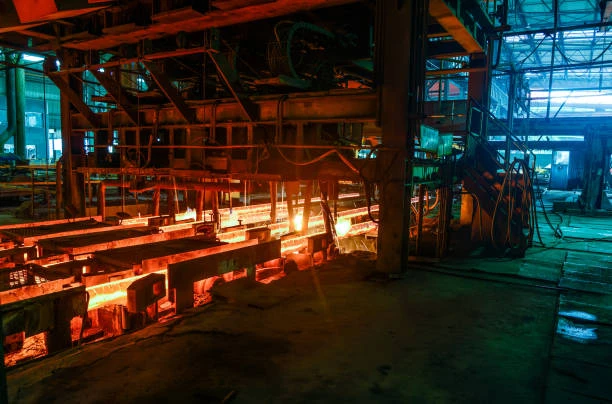

The production of TMT bars is probably the most complex of all the construction industry's technical processes. These steel bars, unlike traditional ones, are put through severe heat in temperatures of around 1200 ° C to 1250 ° C. This is referred to as the heat cycle in which TMT steel bars are put through. The Thermal Treatment is a part of the metallurgical process of TMT Bar Production as well as water quenching which ultimately implies which shape these bars eventually take.
Firstly, heat treatment is an important step to take care of the thermal-mechanical handling procedures. The controlled process that determines the physical and mechanical features of the TMT Bars through heat treatment is accountable for the formation of ferrite and pearlite cores of TMT Bars.
The uniqueness of this product is that they are the only steel rods that have a soft inner core with a hard outer shell. Therefore, heat treatment's effects on TMT Bars' characteristics are myriad; they increase the tensile strength of TMT Bars and make them as durable to face any weather. Hence, the significance of heat treatment lies in the fact that it is the major factor that contributes to the properties of TMT Bars.
The main objective of this blog is to touch on all the potential ways through which the mechanical properties of TMT bars get affected by heat treatment.
TMT Bar Manufacturing Process
TMT steel bar manufacturing is done via the metallurgical process. This includes both mechanical deformations such as compression, and rolling and thermal processes like heat treatment and quenching. This produces a hard material layer known as martensite on the surface of a steel rod after it is cooled down rapidly from a high-temperature exposure.
So, Before we learn about the heat-treatment process of the TMT bars, let’s study the TMT bar manufacturing process in detail:
Raw Material SelectionThe process starts with picking up the best raw materials which are usually mild steel or low-carbon steel billet.
HeatingThe heat treatment of the selected billets is carried out by stipulating the temperature at which the billets are heated in a reheat furnace. This temperature is usually above the recrystallization temperature of steel. Therefore, it is possible for easier deformation or elongation of steel.
RollingThen, the heated billets proceed through a line of rolling mills. They are then fed into these rolling mills, where they are gradually rolled and made into certain forms and dimensions. In this route, the billets are forced to work under great pressure, which causes elongation and reduction in cross-sectional area.
QuenchingThen the bars travel along through a quick cooling method known as quenching. It comprises water passing or other quenching substances through the bar system. The quenching does the job of cooling the surface while maintaining the heat in the core; thus they develop an outer layer that is hardened.
TemperingAs for quenching, the bars are tempered right after that, mostly known as self-tempering or controlled cooling. This cooling down takes place in the normal conditions. On the other hand, after the cooling, the heat generated from the centre is transferred to the surface which leads to the formation of a tempered martensite structure. To achieve this, a proper combination of strength and ductility is formed by the bars of this structure.
Cooling and CuttingAfter the process of tempering, the bars are left undisturbed, as the cooling process is natural and is done at room temperature. Shear cutters are used to shape the fibres into the lengths required.
Quality ControlQuality control is a mainstay of the manufacturing process to ensure and maintain the conformity of TMT bars with the standards and specifications. Such monitoring involves checking parameters like the length of thermo mechanically treated bars, surface quality, and other mechanical properties.
Heat Treatment - What Does This Mean?
Because of the heat treatment, the temperature flows from the colder outer surface to the hotter centre. The steel billets, which are heated to temperatures of 1200°C to 1250°C, represent the primary reinforcements of the bar in both shape and size. The bar then goes through the rolling mills to acquire its final form. And this way the solar heat affects the creation of a particular rib design on the outer surfaces of these TMT bars. The rib design not only provides a high standard but also increases the bond strength with the concrete.
Moreover, this heat treatment restores a correct balance of strength and flexibility through the cooling process of the soft inner core. It’s because the outer structure gets so strong that it encourages a ductile structure. And so, the thermal-mechanical treatment process which includes quenching, and tempering, gives birth to 5.5 to 13 metres long and 8 to 40mm diameter steel billets respectively.
Advantages of Heat Treatment in the Production of Thermo-Mechanically Treated Bars
‘Heat treatment' is the name of a ‘heat-treatment process' that is applied on a ‘certain material,' and not only on steel. In this case, it is a technique used to improve, or even to enhance the application performance for a particular section in your building.
From the point of view of the most reputed TMT bar manufacturer, heat treatment is an advantageous process in itself that represents various aspects:
Strength:The inordinate tensile strength of thermo mechanically treated bars is mainly because of the heat treatment process. Hence, the superior quality of the best TMT bars is gained at the early stages of the manufacturing process. Therefore, they can withstand enormous loads and maintain complete structural integrity in extreme temperatures. This rectifies the possibility of failure and gives the solid materials a long life span that lasts for multiple generations.
Ductility:TMT bars can maintain their strength even while undergoing deformation. This is something that no other material can experience in the same way. The heat treatment also gives TMT Bars an edge in the market as the only ones to be completely immune to deformation no matter which architectural application is in question, whether residential, industrial or commercial.
Weldability:The correct heat treatment is significant for weldability. It means that thermo mechanically treated bars get mixed with other steel components for construction purposes and that improves the overall process performed by the building construction. In addition, these bars are highly bendable. That's why they are suitable for most construction applications like in flyovers, bridges, marine construction, and so on - even those with intricate designs.
Corrosion Resistance:The thermal processing guarantees a proper combination of alloys that allows TMT Bars to protect against corrosion. This is certainly critical for steering clear of moisture and oxygen and preventing the rust from consuming the bars.
Thermal ResistanceThe fire-resistant TMT bars (Thermo-Mechanically Treated bars) are moulded using a special procedure. They contain alloying elements that can withstand high temperatures.
In the process of creating steel, careful temperature control at the heating and cooling stages, allows the microstructure of the steel to be improved. This process improves bars' fire-resistance properties, so it can retain their integrity in high temperatures.
You may read: TMT Bars Unraveled: Selecting the Finest for Your Project
Conclusion
The heat treatment makes the thermo mechanically treated bars less vulnerable towards environmental factors. The longevity of TMT bars makes them the first for all construction projects not only in seismic zones but also in coastal areas.
There are many TMT bar manufacturers in India guaranteeing the best quality thermo mechanically treated bars. However, The quality, cost-effectiveness, reliability and performance of the company, and maintaining the national or international standard TMT bars, are the key that makes the company the trusted brand of TMT bars. So, choose a firm that never comes short of complete devotion to the satisfaction of their customers.



























Sign in to leave a comment.