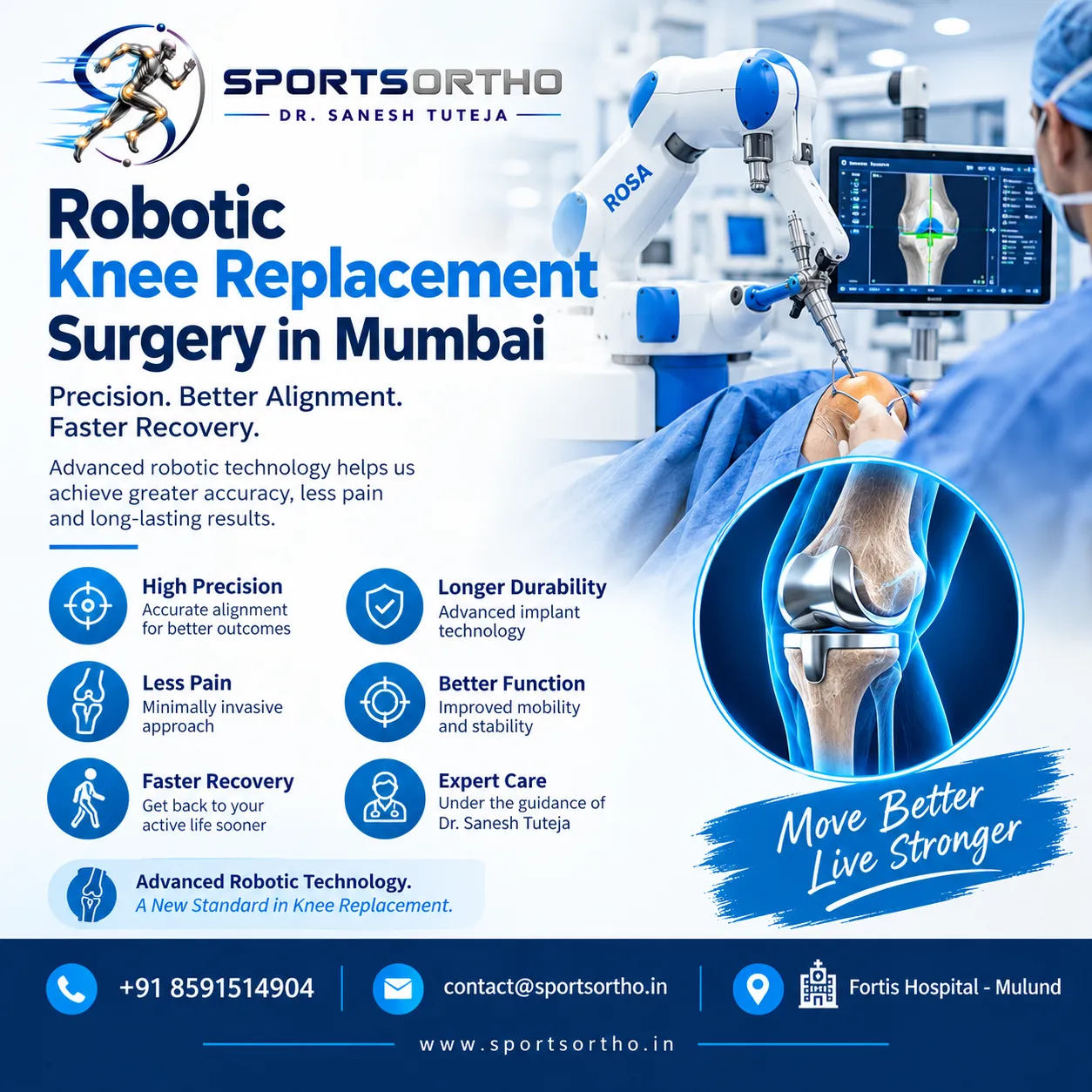

Knee replacement surgery has always depended heavily on a surgeon's skill, experience, and judgement, but even the most experienced hands face natural limits when working with manual instruments and generic sizing guides. This is where robotic knee replacement surgery in Mumbai has changed the landscape, bringing computer guided precision into an operation where even small errors in alignment can affect how a knee feels and functions for years afterward. Understanding exactly how this technology improves accuracy helps explain why more surgeons and patients are choosing it over conventional techniques.
The Problem With Traditional Alignment Methods
In conventional knee replacement, surgeons rely on visual assessment, manual jigs, and standard sized templates to position the implant. While skilled surgeons achieve good results this way, the human eye and hand have natural limits when working within a joint space that leaves little room for error. Even a few degrees of misalignment can lead to uneven pressure across the joint, faster implant wear, or a knee that never quite feels natural during walking or bending. These small deviations, while sometimes unavoidable with manual techniques, are precisely what robotic assistance is designed to eliminate.
Building a Personalized Surgical Plan
Robotic systems begin improving accuracy long before the surgeon makes an incision. Using a pre-operative CT scan or MRI, the system creates a detailed three dimensional model of the patient's unique knee anatomy, including bone shape, joint alignment, and ligament tension. This model allows the surgical team to plan the exact size, position, and angle of the implant in advance, tailored specifically to that patient's anatomy rather than relying on a generic, one size fits all approach. This level of personalized planning is simply not possible with traditional instrumentation alone.
Real Time Guidance During Surgery
Once surgery begins, the robotic arm works as a precision guide, helping the surgeon execute the pre-planned bone cuts within fractions of a millimetre of the intended target. If the surgeon's instruments begin to move outside the planned boundary, the system provides immediate feedback, effectively creating a built in safety boundary that protects healthy bone and surrounding soft tissue. This real time correction is one of the most significant ways robotic technology improves accuracy compared to freehand techniques, where such fine adjustments depend entirely on the surgeon's visual judgement in the moment.
Preserving Healthy Bone and Soft Tissue
Because robotic guidance allows for such precise bone removal, less healthy tissue needs to be sacrificed during the procedure. Ligaments and soft tissue structures surrounding the knee, which play a key role in stability and natural movement, are handled with greater care throughout the surgery. This preservation of native anatomy contributes directly to a more stable, natural feeling joint after recovery, something that is harder to achieve consistently with manual methods.
Improving Implant Alignment and Balance
Proper alignment is not only about the bone cuts but also about how the knee moves through its full range of motion once the implant is in place. Robotic systems allow surgeons to test and fine tune ligament balance and joint movement during the procedure itself, adjusting the plan in real time based on how the knee actually responds. This dynamic feedback loop, checking and rechecking alignment throughout surgery rather than relying solely on pre-surgical estimates, is a major reason robotic assisted procedures achieve more consistent, accurate outcomes.
Why Accuracy Translates Into Better Long Term Results
Improved precision during surgery has a direct impact on how patients feel long after they leave the operating room. More accurate alignment reduces abnormal stress on the implant, which can lower the risk of early wear and the eventual need for revision surgery. Patients often experience a more natural range of motion, less residual pain, and a knee that moves and feels closer to how it did before arthritis set in. While outcomes still depend on the patient's overall health and commitment to physiotherapy, the margin for surgical error is meaningfully reduced with robotic assistance.
The Role of Surgeon Expertise
It is important to understand that robotic technology does not replace the surgeon, it enhances their capabilities. The system provides the data, precision, and real time feedback, but the surgeon still makes every clinical decision throughout the procedure. This is why choosing a surgeon specifically trained in robotic assisted techniques matters as much as the technology itself. Dr. Sanesh Tuteja combines this specialised training with clinical experience, ensuring that robotic precision is paired with sound surgical judgement for each patient's individual case.
Who Benefits Most From This Improved Accuracy
Patients with complex joint deformities, significant bone loss, or unusual anatomical variations often benefit the most from robotic precision, since these cases are traditionally harder to manage accurately with manual instruments alone. That said, even patients with more straightforward arthritis can benefit from the added consistency and reduced variability that robotic guidance provides.
The Bottom Line
Robotic technology has fundamentally improved the accuracy of knee replacement surgery by combining personalized pre-surgical planning with real time intraoperative guidance, reducing the margin for error that has traditionally existed with manual techniques. For patients considering joint replacement, this added precision can translate into a more natural feeling knee and a smoother long term outcome. If persistent knee pain is affecting your daily life, it is worth discussing whether robotic knee replacement surgery in Mumbai is the right option for you.
























Sign in to leave a comment.