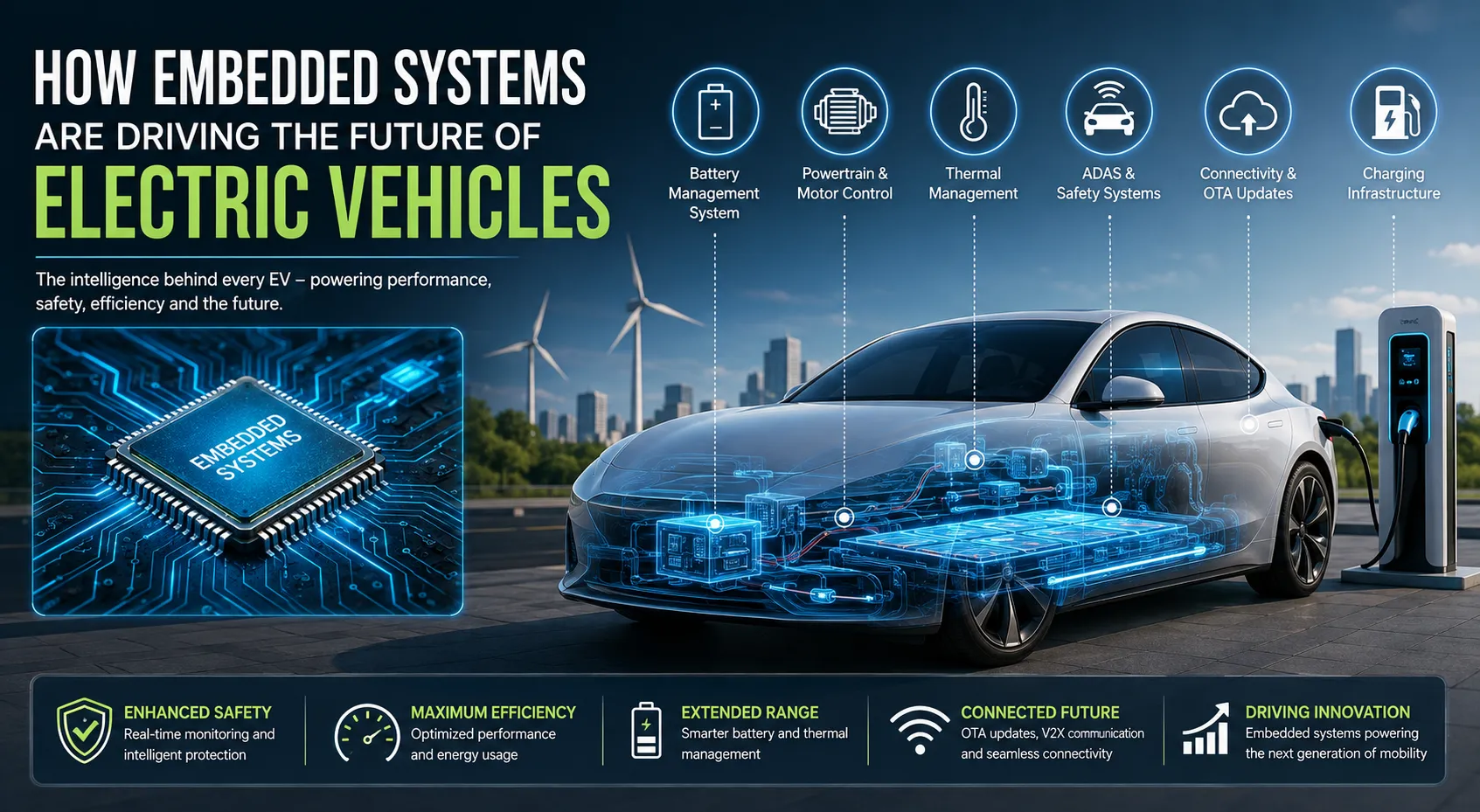

Electric vehicles are often talked about in terms of batteries and motors, but the real intelligence behind an EV lives somewhere less visible: the embedded systems quietly managing everything from battery health to how smoothly the car accelerates. Every EV on the road today, whether it's a compact city car or a high performance electric SUV, runs on a dense network of microcontrollers, sensors, and software working together in real time.
This isn't a small or slow moving trend. Industry research pegs the embedded systems market for electric vehicles at well over 10 billion USD as of the mid 2020s, with projections showing it growing at a compound annual rate above 15 percent through the next decade. That kind of growth doesn't happen without a serious, sustained demand for engineers who understand how to design and build these systems.
For engineering students and professionals watching this shift, it raises an obvious question: what exactly are embedded systems doing inside an EV, and what does this mean for anyone considering an embedded system course in Pune or a similar automotive focused training path? Let's break it down.
Battery Management Systems: The Heart of Every EV
If there's one embedded application that defines the electric vehicle, it's the Battery Management System, or BMS. Lithium ion battery packs are complex, expensive, and sensitive to how they're charged, discharged, and balanced across hundreds of individual cells.
Embedded systems inside the BMS continuously monitor cell voltage, temperature, and current, making split second decisions to prevent overcharging, overheating, or imbalanced cell degradation. This isn't just about safety, though that's critical. It's also about maximizing range and extending the usable life of a battery pack that often represents a third or more of the vehicle's total cost.
Engineers working on BMS design need a strong grip on embedded C, real time control loops, and communication protocols like CAN, since the BMS constantly exchanges data with other vehicle control units. This is precisely the kind of practical, protocol level work that structured embedded systems classes in Pune aim to prepare students for, since BMS design roles are among the most in demand in the current EV hiring market.
Powertrain and Motor Control
Where a traditional car uses mechanical and hydraulic systems to translate driver input into motion, an EV relies almost entirely on embedded control. The powertrain control unit takes signals from the accelerator pedal and converts them into precise commands for the electric motor, managing torque, speed, and regenerative braking in real time.
Regenerative braking in particular is a good example of why this matters. Every time an EV driver slows down, embedded software decides how much of that kinetic energy to recover and feed back into the battery versus how much braking force to apply mechanically. Getting this balance right, smoothly and instantly, requires tightly optimized real time embedded code, often running on dedicated microcontrollers separate from the main vehicle computer.
Thermal Management
Batteries and power electronics generate heat, and heat is one of the biggest enemies of both performance and battery longevity in an EV. Embedded systems manage thermal regulation across the battery pack, motor, and power electronics, adjusting cooling systems dynamically based on real time temperature data, driving conditions, and even planned fast charging sessions.
This is a less visible application compared to something like ADAS, but it's just as critical. Poor thermal management directly shortens battery life and can even create safety risks, which is why automotive companies invest heavily in engineers who understand both the embedded control logic and the underlying thermal physics.
Advanced Driver Assistance Systems (ADAS)
ADAS features such as adaptive cruise control, lane keeping assistance, automatic emergency braking, and parking assistance have moved from luxury add ons to near standard features across most EV models. Every one of these functions depends on embedded systems processing data from cameras, radar, and ultrasonic sensors in real time, then making decisions and issuing commands within milliseconds.
This is one of the fastest growing specializations within embedded systems, and it increasingly overlaps with AI and machine learning, since modern ADAS systems use trained models to interpret sensor data rather than relying purely on fixed rule based logic. Engineers entering this space need a solid embedded foundation first, since AI models still need to run efficiently on automotive grade hardware with strict real time and safety constraints.
Connectivity, Over the Air Updates, and V2X
Modern EVs are increasingly treated as connected devices rather than purely mechanical ones. Embedded systems handle over the air software updates, allowing manufacturers to improve performance, fix bugs, or add features without a physical service visit. This alone has changed how automotive software teams are structured, since embedded engineers now need to think about secure update mechanisms and version control in ways earlier generations of automotive engineers rarely had to.
Vehicle to everything, or V2X, communication is another growing area, enabling vehicles to exchange data with infrastructure, other vehicles, and networks, often supported by expanding 5G connectivity. This is pushing embedded systems further into the world of networking and cybersecurity, since a connected vehicle is also a vehicle that needs to be protected against unauthorized access.
Charging Infrastructure
It's easy to think of embedded systems purely in terms of what's inside the vehicle, but the charging infrastructure supporting EVs runs on embedded technology too. Charging station controllers manage power distribution, user authentication, and communication with the vehicle's own BMS to ensure charging happens safely and efficiently.
As fast charging networks expand, the embedded systems inside charging stations are becoming more sophisticated, handling everything from load balancing across multiple charging bays to real time diagnostics that flag hardware issues before they cause downtime.
Why This Matters for Engineering Careers
The scale of what's described above should make one thing clear: electric vehicles are, at their core, an embedded systems problem as much as a mechanical or chemical one. Automotive companies, from established OEMs to newer EV manufacturers and their Tier 1 suppliers, are hiring embedded engineers aggressively across every one of these domains: battery management, powertrain control, ADAS, connectivity, and charging infrastructure.
For engineering students and professionals, this creates a genuinely strong career opportunity, but one that requires the right preparation. Generic embedded knowledge helps, but automotive specific skills such as CAN bus, AUTOSAR, ISO 26262 safety standards, and real time control design are what separate candidates who get shortlisted from those who don't.
This is exactly why location and specialization matter when choosing where to train. Pune has become one of India's strongest automotive engineering hubs, home to a dense cluster of EV manufacturers, Tier 1 suppliers, and automotive R&D centers actively hiring embedded talent. Enrolling in an embedded system course in Pune with a dedicated automotive or EV focused track gives students direct exposure to the exact skills this industry is hiring for, backed by proximity to companies building these systems locally.
If you're weighing an embedded course in Pune specifically for an EV or automotive career path, look for programs that go beyond generic microcontroller basics and include hands on work with BMS concepts, CAN protocol, and automotive software standards, since that's the level of specificity employers in this space are actually screening for.
The Road Ahead
Electric vehicles will only become more software defined over the coming years, with AI, connectivity, and autonomous features expanding further into what embedded systems are expected to handle. For engineers, this represents one of the most stable and fast growing specializations in the broader embedded field, spanning battery technology, real time control, safety critical systems, and connected vehicle infrastructure.
The engineers who position themselves early, with strong fundamentals and automotive specific training, are the ones who will be building the vehicles, and the charging networks, that define the next decade of transportation.
Frequently Asked Questions
1. How are embedded systems used in electric vehicles?
Embedded systems in electric vehicles manage battery management systems, powertrain and motor control, thermal management, advanced driver assistance systems, infotainment, connectivity, and over the air software updates, working together in real time to keep the vehicle safe, efficient, and responsive.
2. What is the role of embedded systems in EV battery management?
Embedded systems inside the Battery Management System continuously monitor cell voltage, temperature, and current across the battery pack, making real time decisions to prevent overcharging or overheating, balance individual cells, and maximize both range and battery lifespan.
3. Why is embedded systems knowledge important for a career in electric vehicles?
Nearly every major EV function, from battery safety to ADAS to charging infrastructure, is controlled through embedded software and hardware, which means companies building electric vehicles need engineers with strong embedded systems skills across real time control, communication protocols, and automotive safety standards.
4. What automotive specific skills should engineers learn to work on EVs?
Engineers targeting EV and automotive roles should focus on CAN bus communication, AUTOSAR architecture, ISO 26262 functional safety standards, real time embedded C programming, and battery management or motor control fundamentals, since these are the specific skills automotive employers screen for.
5. How is AI changing embedded systems in electric vehicles?
AI and machine learning are increasingly used within embedded systems for functions like ADAS decision making, predictive battery maintenance, and adaptive energy optimization, requiring embedded engineers to understand how to run efficient AI models on resource constrained, real time automotive hardware.
6. Is it worth taking an embedded course in Pune for an EV or automotive career?
Yes, for engineers targeting the automotive and EV sector specifically, an embedded course in Pune can offer a practical advantage due to the city's concentration of automotive R&D centers, EV manufacturers, and Tier 1 suppliers, along with access to hands on training in automotive specific skills like CAN bus and AUTOSAR.
























Sign in to leave a comment.