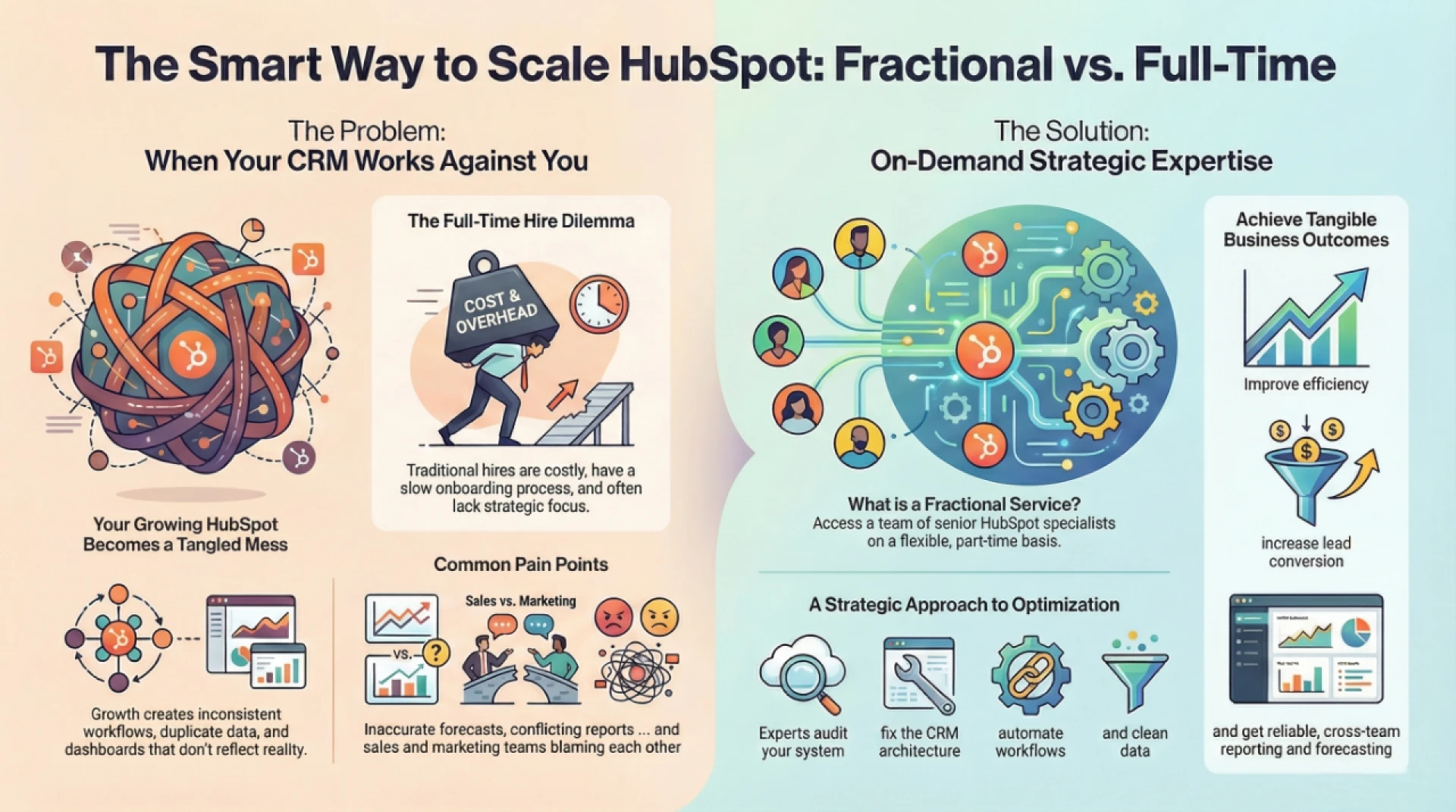

HubSpot is one of the most powerful CRM and automation platforms available today. It’s flexible, intuitive, and packed with features that support marketing, sales, and customer success teams. But as a company grows, so too do the demands on its HubSpot instance—and what once started as a simple setup can quickly become a tangled web of inconsistent workflows, duplicate data, broken automations, and dashboards that don’t reflect reality.
This is where fractional HubSpot services come into play.
Fractional services provide experienced HubSpot expertise on a part-time, scalable basis. Instead of hiring a full-time HubSpot administrator or RevOps specialist—both expensive and hard to find—you bring in a seasoned team that can audit, optimize, restructure, and scale your entire HubSpot ecosystem. Think of it as getting senior-level expertise exactly when you need it without the cost or overhead of a full-time hire.
In this article, we’ll explore what fractional HubSpot services are, why they’re essential for modern revenue teams, and how they differ from traditional approaches. We’ll also share real examples, clear benefits, and a step-by-step look at what a professional fractional engagement should involve.
What Exactly Are Fractional HubSpot Services?
At its core, fractional HubSpot services are a flexible, on-demand engagement model where expert practitioners provide HubSpot strategy, administration, optimization, and ongoing support — without requiring a full-time commitment.
This model is particularly valuable for:
- Scaling startups with rapid changes in process and team size
- SMBs that need help structuring HubSpot for revenue impact
- Teams with complex sales cycles or multi-product lines
- Reorganizations or migrations where HubSpot must align with new GTM models
- Companies lacking internal HubSpot expertise
Rather than an internal hire whose effectiveness depends on experience and training, fractional HubSpot consultants bring broad exposure across industries, platforms, and complex RevOps environments. This means immediate impact without a long ramp-up period.
Why Companies Are Choosing Fractional Over Full-Time HubSpot Experts
Hiring full-time HubSpot specialists was, until recently, the default approach. But this model has several drawbacks:
1. High Cost, Slow Onboarding
A full-time hire can take weeks or months to ramp up and might still lack the strategic depth required for optimization.
2. Narrow Experience
Full-time employees are often siloed into one company’s structure and tools, whereas fractional specialists have cross-industry experience and broader perspective.
3. Lack of Strategic Focus
Internal hires may focus on tactical maintenance instead of strategic alignment with revenue goals.
In contrast, fractional HubSpot services deliver:
- Immediate access to senior expertise
- Flexible engagement levels (weekly, monthly, or project-based)
- Strategic guidance that aligns with business goals
- A team of specialists instead of one individual
This delivers a faster, smarter, and more cost-effective way to manage HubSpot.
The Key Components of Fractional HubSpot Services
Fractional HubSpot services should never be superficial. A high-value engagement includes a full spectrum of strategic, operational, and technical support:
1. HubSpot System Audit and Health Assessment
Fractional practitioners begin by examining your entire HubSpot environment:
- CRM structure
- Data hygiene
- Object relationships
- Workflow accuracy
- Lifecycle mappings
- Reporting and dashboards
- Integration points
- Attribution models
The audit reveals inefficiencies and pinpoints barriers to performance.
2. CRM Architecture and Object Modeling
Well-structured HubSpot objects reduce friction and confusion. A fractional team will:
- Standardize property usage
- Map contacts, companies, deals, and custom objects
- Simplify and align lifecycle stages
- Ensure consistency across departments
This is foundational to any scalable HubSpot implementation.
3. Workflow and Automation Strategy
HubSpot is built for automation—but only when it's intentionally designed.
Fractional service providers configure:
- Lead routing and assignment
- Lead scoring and qualification logic
- Deal progressions
- Nurture sequences
- Email triggers and task automations
- SLA enforcement mechanisms
These automations scale with your business and eliminate manual overhead.
4. Data Cleaning, Governance, and Long-Term Policies
Good data is the lifeblood of accurate reporting and automation.
Fractional professionals implement:
- Duplicate management
- Standard naming conventions
- Consistent formatting
- Clean segmentation
- Governance policies to prevent future decay
Data governance ensures HubSpot remains reliable as you grow.
5. Integration Planning and Execution
HubSpot rarely lives alone. It must integrate with:
- Salesforce (bi-directional sync)
- Billing systems
- Customer success platforms
- Product usage tools
- Marketing platforms
- External analytics systems
Fractional specialists design and maintain these integrations for stability and accuracy.
6. Dashboard and Reporting Strategy
Leadership needs clarity—not confusion.
Fractional teams ensure your dashboards:
- Accurately reflect performance
- Tie to real revenue outcomes
- Support forecasting and planning
- Provide cross-functional visibility
This is where HubSpot becomes a source of truth instead of a source of contradictory data.
7. Training and Enablement
A system is only valuable if people use it correctly.
Fractional HubSpot services include:
- Tailored user training
- Documentation and playbooks
- Role-specific dashboards
- Adoption tracking
- Ongoing coaching
This maximizes usage and ensures long-term impact.
How Strategic Fractional HubSpot Support Changes Business Outcomes
Fractional HubSpot services don’t just clean up your portal—they transform how teams work:
Improved Efficiency
Reps spend less time updating records and more time selling.
Higher Lead Conversion
Better scoring and routing ensures quality leads reach the right teams.
Cleaner Reporting
Accurate dashboards reflect real revenue performance instead of guesswork.
Better Forecasting
With reliable data and structured pipelines, forecasting becomes trustable and actionable.
Cross-Team Alignment
Marketing, sales, and customer success all work off the same playbook and definitions.
Scalable Systems
HubSpot grows with the business—not against it.
Real-World Example: Fractional HubSpot Services in Action
Consider a mid-stage B2B company that initially adopted HubSpot for its marketing team alone. Over six quarters, the business added sales teams, outbound motions, and a CS function. But there was no coordinated governance or architectural plan. Their challenges looked like this:
- Duplicate contacts and unclear ownership
- Workflows firing inconsistently
- Dashboards showing conflicting metrics
- Marketing and sales teams blaming each other for data quality
- Forecasts that never matched actual results
After engaging with a fractional team, they saw results within 8–12 weeks:
- CRM was reorganized and cleaned
- Lifecycle stages were re-defined
- Lead routing was automated and accurate
- Dashboards reflected real revenue movement
- Forecasting became reliable for planning
- Alignment emerged between departments
This is the true value of fractional engagement—fast impact, sustainable structure, and strategic clarity.
When Should You Consider Fractional HubSpot Services?
Consider fractional support if:
- Your CRM is cluttered or difficult to navigate
- Data is inconsistent or unreliable
- Marketing and sales reporting don’t match
- Workflows are breaking or overlapping
- Forecasts feel inaccurate
- You’re planning a migration or major update
- Your HubSpot admin is overwhelmed
- You need strategic direction but not full-time headcount
Fractional services provide the right level of expertise exactly when you need it—without the cost or commitment of a full-time hire.
How Fractional HubSpot Services Fit Into a Larger RevOps Strategy
Fractional support isn’t a tactical patch—it’s a strategic layer.
HubSpot sits at the intersection of:
- marketing operations
- sales operations
- customer success operations
- product data
- billing and finance data
This is where RevOps becomes important. Fractional HubSpot services often sit within a broader revenue operations framework, ensuring that HubSpot doesn’t operate in isolation but as part of a unified, scalable revenue engine.
FAQs About Fractional HubSpot Services
1. How quickly can fractional HubSpot services deliver results?
Most companies begin seeing measurable operational improvements within 6–10 weeks.
2. Do fractional teams support ongoing maintenance?
Yes. Fractional engagements often evolve into ongoing optimization and support.
3. Can fractional services include migration support?
Absolutely—this includes migrations from spreadsheets or legacy systems.
4. Do fractional HubSpot services include training?
Yes. Training and enablement are core components.
5. Are fractional HubSpot services cost-effective compared to hiring?
Yes. You get senior expertise without full-time salaries or overhead.
Conclusion: Build a Revenue Engine, Not Just a CRM
HubSpot can be one of your organization’s most powerful growth tools—but only when it’s implemented, structured, and governed with strategic intent. Fractional HubSpot services provide that strategy, backed by execution, analytics, training, and long-term governance.
With fractional support, companies avoid common pitfalls like messy data, unstable workflows, and misaligned reporting. Instead, they get a HubSpot instance that is clean, efficient, scalable, and firmly aligned with revenue goals.
If your team is ready for HubSpot to become a revenue accelerant instead of a technical burden, fractional services offer the smartest path forward.


























Sign in to leave a comment.