
Did you know that the worldwide data analytics market is expected to reach $133 billion by 2026? This fantastic expansion is evidence of the increasing importance of data in guiding company decisions and innovations. But how are we managing and making sense of this ever-expanding sea of data? Generative artificial intelligence is the game-changing technology that enhances how we analyse data and revolutionises data analytics.
If you\'ve ever taken a Data Analytics Course, you know how crucial it is to understand and manipulate data effectively. Are you prepared to learn how generative artificial intelligence changes the Data Analytics Lifecycle and what this implies for corporate intelligence going forward? Let\'s understand that in this blog.
The Evolution of Data Analytics
Data analytics has evolved dramatically since its first days of fundamental statistical analysis. Big data made more complex tools clear-cut and necessary for use. Traditional data analytics techniques sometimes find it challenging to handle the volume, diversity, and speed of data produced in the digital age. Then, there is generative artificial intelligence, a subset of artificial intelligence dedicated to generating new data samples from current data sets. This ability will change the field of data analytics enormously.
Understanding Generative AI
Generative AI involves algorithms that can generate new content, such as images, text, or music, based on the patterns it learned from training data. Generative Adversarial Networks (GANs) and Variational Autoencoders (VAEs) are well-known generative models. Two neural networks, a generator and a discriminator, make up GANs and cooperate to generate more logistically realistic data samples. Conversely, VAEs understand the underlying distribution of the training data and can create new data points like the original ones.
Why Do You Need Generative AI?
Enhanced Data Quality and Augmentation
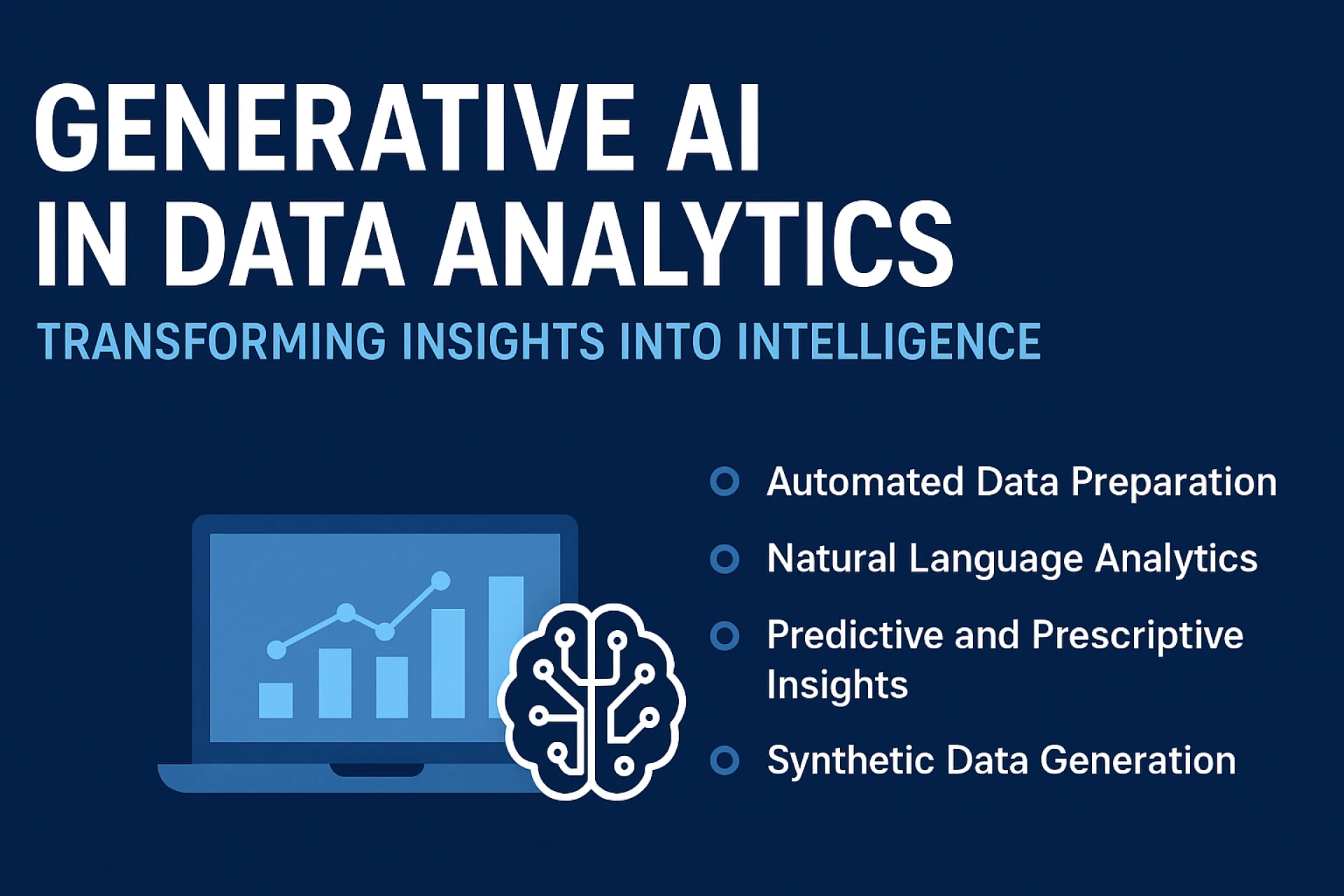
One of the main difficulties in data analytics is dealing with poor-quality or incomplete data. Generative artificial intelligence solves this by producing high-quality synthetic data to fill in voids and improve current databases. This capacity is vital in sectors like healthcare, where gathering vast amounts of labelled data is difficult. Generative artificial intelligence can, for example, generate realistic medical images or patient records, facilitating more robust and thorough analysis without violating privacy.
Advanced Predictive Analytics
Predictive analytics forecasts future patterns and behaviours by using past data. Generative artificial intelligence improves this process by creating fresh data points outside the current dataset, offering a more all-encompassing basis for prediction. This method lets experts investigate more possibilities and results, producing more accurate and consistent forecasts. Generative artificial intelligence, for instance, can replicate several market circumstances in financial markets, guiding analysts and investors towards more educated conclusions.
Automating Data Preprocessing
An essential phase of the analytics process, data preparation entails duties including data cleansing, standardising, and transformation. These tasks often take more time and require much hand work. Generative artificial intelligence may automate many of these tasks by learning the patterns and structures in the data and automatically applying the needed transformations. Apart from saving time, this automation lowers the possibility of human mistakes, producing more consistent and dependable results.
Uncovering Hidden Patterns and Insights
Traditional data analytics techniques may find identifying intricate trends and linkages in big and varied datasets difficult. With its capacity to learn complex data distributions, generative artificial intelligence can find insights and hidden trends. Generative artificial intelligence, for example, can discover minute trends and connections in consumer behaviour research that guide more focused marketing plans and individualised customer experiences.
Transforming Data Visualisation
Communication of ideas and decision-making assistance depend on good data visualisation. Generative artificial intelligence generates more dynamic and interactive data visual representations, improving visualisation. This capacity enables analysts to investigate data creatively, facilitating trend, anomaly, and correlation identification. Generative artificial intelligence, for instance, can create realistic models of market scenarios or corporate processes, offering a more immersive and understandable knowledge of the information.
Real-Time Data Analysis
Generative artificial intelligence makes real-time data collection and analysis possible, letting companies react rapidly to new conditions and prospects. This capacity is vital in sectors like e-commerce, where quick insights can significantly affect sales and consumer satisfaction. Generative artificial intelligence, for instance, can examine live consumer interactions and create customised recommendations on demand, thus improving the shopping experience.
Ethical Considerations and Challenges
Although generative artificial intelligence has enormous potential advantages for data analytics, ethical issues and technological limitations must be considered. Problems, including data privacy, bias, and openness, must be resolved to guarantee generative artificial intelligence\'s responsible and moral application. For example, synthetic data produced by artificial intelligence must be carefully controlled to prevent unintentional biases that can distort analytical findings or support existing inequality.
Conclusion
Generative artificial intelligence is reinventing data analytics by improving data quality, allowing advanced predictive analytics, automating data preparation, finding latent trends, changing data visualisation, and enabling real-time analysis. As companies and sectors use generative AI, handling the related ethical issues and challenges is imperative to guarantee this transforming technology\'s appropriate and positive application. Data analytics has a bright future, and generative artificial intelligence will undoubtedly determine how this future shapes it. Join The Knowledge Academy and explore the opportunities for future data analytics.







Sign in to leave a comment.