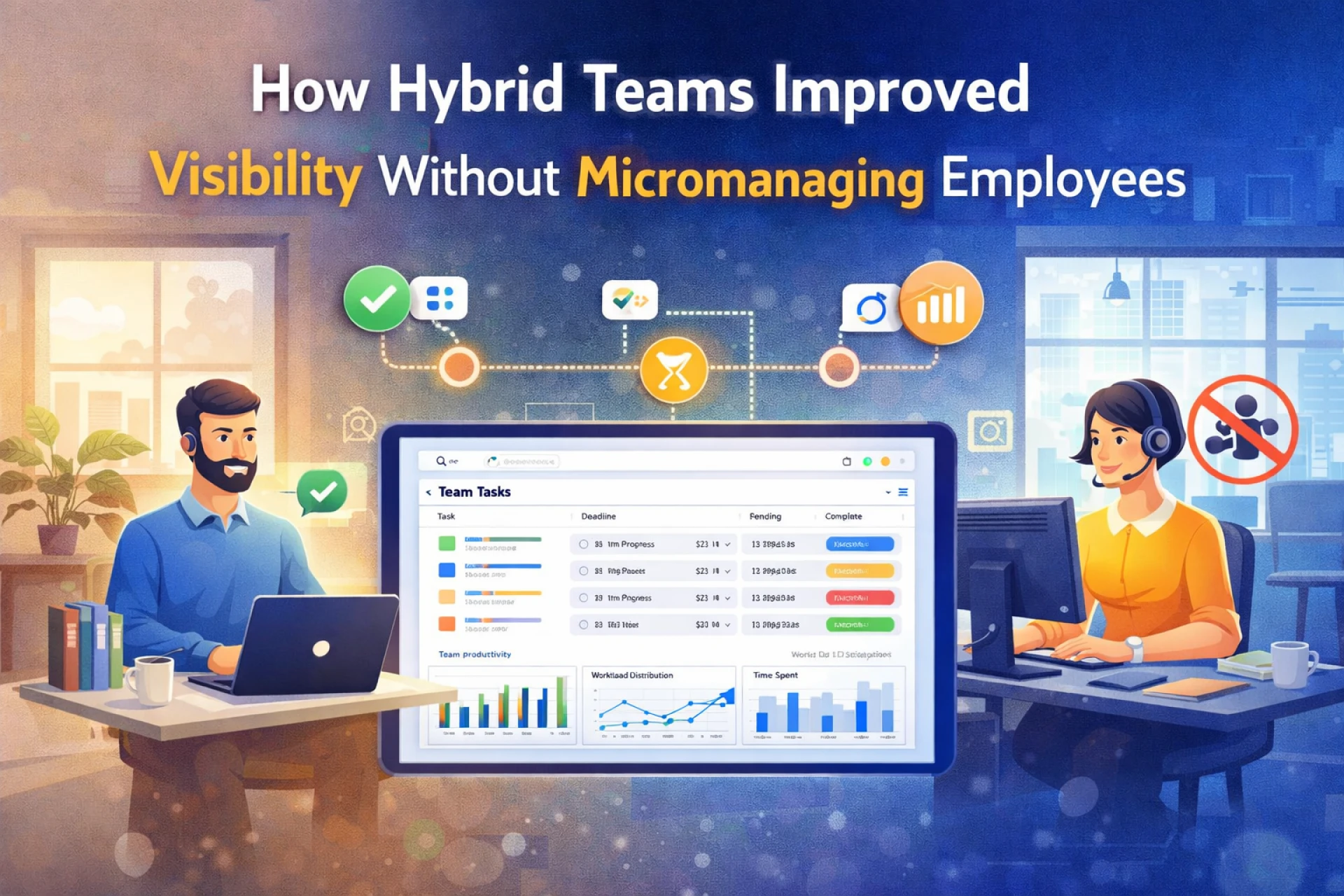

Hybrid work has changed how teams collaborate, communicate, and deliver work. But it also created a new challenge for managers: How do you maintain visibility without micromanaging employees? Many organizations initially struggled because traditional management methods didn’t work in hybrid environments. This is where hybrid work management software started playing a major role.
In this blog, we’ll explore how hybrid teams improved visibility, productivity, and accountability using modern tools and smarter workflows — without creating a culture of micromanagement.
The Hybrid Work Visibility Problem
In traditional office environments, visibility was simple. Managers could see who was working, who was in meetings, and who needed help. But hybrid work changed everything.
Today, some employees work from home, some from the office, and some from different locations entirely. This made it harder for managers to understand:
- What employees are working on
- Whether projects are on track
- Who is overloaded or underutilized
- Where bottlenecks are happening
Many companies tried solving this by increasing meetings, check-ins, and manual reporting — which often led to micromanagement and employee frustration.
Modern organizations realized that visibility should come from systems, not constant supervision.
Why Micromanagement Doesn’t Work in Hybrid Teams
Micromanagement reduces trust, lowers morale, and often reduces productivity instead of improving it. In hybrid teams, micromanagement usually shows up as:
- Constant status update requests
- Too many meetings
- Monitoring hours instead of results
- Frequent follow-ups on small tasks
Research and workplace reports show that productivity in hybrid work is no longer measured by presence or activity but by outcomes, collaboration, and workflow efficiency. Companies are now focusing on results, workflows, and productivity insights instead of just time tracking.
This shift is why businesses started adopting hybrid workforce monitoring tools and hybrid workforce solutions that provide visibility automatically.
How Hybrid Work Management Software Improves Visibility
The biggest difference between micromanagement and visibility is data transparency. Managers don’t need to ask employees what they are doing if the system already shows progress, tasks, and productivity insights.
A modern hybrid work management software helps organizations by providing:
1. Task & Project Visibility
Managers can see:
- Task progress
- Deadlines
- Project timelines
- Team workload distribution
This reduces the need for constant follow-ups and status meetings.
2. Productivity Insights
Instead of monitoring employees constantly, software provides reports showing:
- Productive hours
- App and website usage
- Project time allocation
- Work patterns
This helps managers identify issues without interfering in daily work.
3. Workload & Utilization Tracking
One of the biggest problems in hybrid teams is uneven workload distribution. Some employees are overloaded while others have spare capacity. Hybrid team management software helps managers balance work and improve team utilization.
4. Attendance & Time Tracking
Hybrid workforce monitoring tools provide automated attendance, timesheets, and work hours tracking for both remote and in-office employees. This ensures accountability without manual reporting.
Visibility Without Micromanagement: The Right Approach
Successful hybrid companies follow a different management approach. Instead of monitoring every activity, they focus on visibility through systems and outcomes.
Here are the strategies they use:
Focus on Outcomes, Not Activity
Measure:
- Tasks completed
- Project deadlines met
- Quality of work
- Client satisfaction
Not:
- Hours online
- Number of messages sent
- Meeting attendance
Use Shared Dashboards
Dashboards help everyone see:
- Project progress
- Team performance
- Deadlines
- Workload
This creates transparency across the organization.
Automate Reporting
Instead of asking employees for updates, automated reports provide:
- Productivity reports
- Timesheets
- Project reports
- Attendance reports
This reduces admin work and improves visibility.
Maintain Regular Check-ins (Not Constant Monitoring)
Weekly or bi-weekly check-ins are more effective than daily status meetings.
Want better visibility into your hybrid team without micromanaging?Book a Workstatus demo today.
Benefits of Hybrid Workforce Solutions
When companies implement proper hybrid workforce solutions, they start seeing major improvements in operations and productivity.
Key Benefits:
- Better team visibility
- Improved productivity
- Balanced workload distribution
- Reduced micromanagement
- Higher employee trust
- Better project tracking
- Improved accountability
- More accurate productivity insights
- Better collaboration between remote and office teams
Hybrid work is growing rapidly, and companies that implement proper tools and systems are seeing higher productivity, better employee satisfaction, and improved operational efficiency.
Why Businesses Are Investing in Hybrid Work Management Software
Companies are now realizing that hybrid work is not temporary — it is the future of work. But managing hybrid teams without proper systems leads to:
- Communication gaps
- Productivity issues
- Lack of visibility
- Poor workload distribution
- Employee burnout
- Too many meetings
This is why companies are investing in hybrid work management software to manage teams, track productivity, improve workflows, and maintain visibility without micromanaging employees.
Instead of managing people, managers can now manage work, workflows, and outcomes.
Conclusion
Hybrid work doesn’t fail because employees work remotely or in the office. It fails when companies don’t have visibility into work, productivity, and workflows.
The most successful hybrid teams don’t rely on micromanagement. They rely on systems, data, and transparency.
With the right hybrid team management software, businesses can:
- Improve visibility
- Track productivity
- Manage workloads
- Monitor attendance
- Track projects
- Improve team accountability
- Increase productivity
- Reduce micromanagement
Hybrid work is not about controlling employees. It is about creating visibility, accountability, and productivity through better systems.
And that is exactly what modern hybrid workforce monitoring tools and hybrid workforce solutions are designed to do.
Reference Taken from- Linkedin

























Sign in to leave a comment.