
Sparks fly in a bright, controlled arc as a CNC machine bites into a solid block of alloy steel. For a few seconds, that shower of orange light is the only thing happening in the frame no music, no voiceover, just the unmistakable sound of precision metal cutting. Then the camera pulls back, and the reason for all that noise and heat becomes clear: a heavy-duty shredder knife, freshly milled, its cutting edge catching the light in a hard, clean line.
It's a dramatic few seconds of footage. But it's also, in a very literal sense, the answer to a question almost nobody outside the recycling and waste-processing industry ever thinks to ask: what actually goes into a shredder blade that's tough enough to run 24/7 without falling apart?
If you operate a plastic recycling line, an e-waste processing unit, or any heavy-duty industrial shredder, you already know that the blade is the single most important and most abused component in the entire machine. It's the part that meets HDPE piping, PVC sheets, circuit boards, batteries, and contaminated scrap head-on, thousands of times a day, for years. A blade that's even slightly wrong wrong steel grade, wrong heat treatment, wrong tolerance doesn't just wear out faster. It slows your throughput, increases your energy bill, and turns "zero-maintenance" into a fantasy.
This is the story of how those blades are actually made from raw alloy steel to a finished, tested cutting tool ready to be bolted into a shredder and why the process matters as much as the final product.
The Question Behind the Sparks: What Makes a Shredder "Zero-Maintenance"?
Every recycler, scrap processor, and plant manager has heard the phrase "zero-maintenance industrial shredder" thrown around in a sales pitch. It's a nice phrase. It's also, in most cases, wildly optimistic unless the machine's most heavily stressed component, the blade, has been engineered specifically to survive the abuse it's about to receive.
Think about what a shredder blade actually does. It doesn't cut once and rest. It engages, disengages, and re-engages with abrasive, often unpredictable material sometimes soft plastic, sometimes glass-filled composites, sometimes metal contaminants that shouldn't be there at all thousands of times an hour. Each impact generates localized heat, micro-vibration, and mechanical stress at the cutting edge. Over time, an ordinary blade will chip, deform, or simply go dull, and every one of those failure modes translates directly into downtime.
"Zero-maintenance" isn't a marketing promise you can bolt onto a machine after the fact. It has to be engineered in, blade by blade, starting from the very first decision: what steel are you going to use?
At Infinity Autotech, that question sits at the center of everything, which is why the entire manufacturing process from initial design to final testing happens under one roof at the company's facility on the Surendranagar–Rajkot highway in Gujarat. There's no outsourcing of critical machining steps, no shipping half-finished components to a third-party heat treatment shop and hoping for consistency. Every blade that leaves the plant has gone through the same integrated, controlled process, which is the only way to actually guarantee the kind of durability a "zero-maintenance" claim requires.
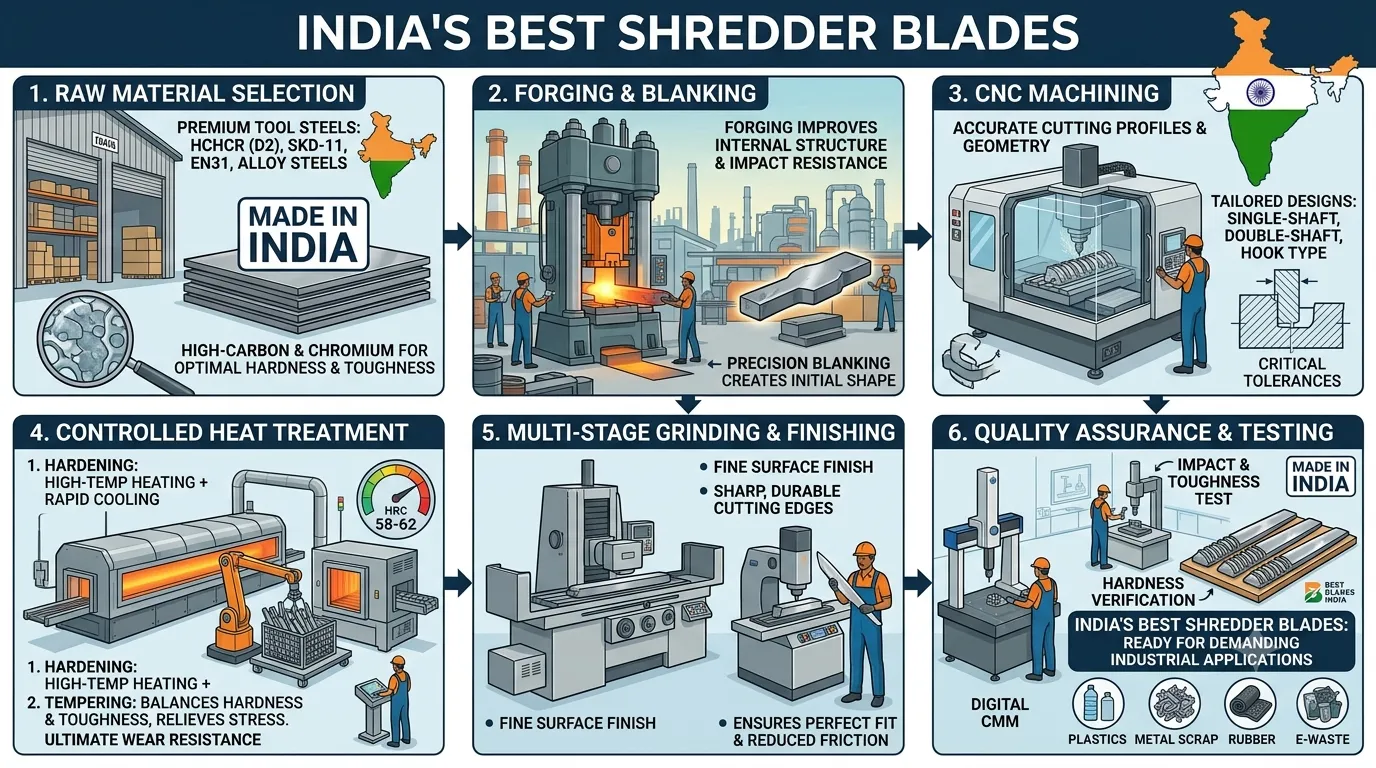
Step One: It Starts With the Steel, Not the Shape
Most people assume a blade's quality comes down to its shape how sharp the edge is, how the geometry is cut. That's part of the story, but it's not where quality begins. Quality begins with metallurgy.
Industrial shredder blades are typically manufactured from alloy tool steels engineered specifically for high-impact, high-abrasion cutting applications. On Infinity Autotech's product specifications, one of the material grades referenced is EH C 500 LE, an alloy composition selected specifically for its resistance to wear when cutting dense or abrasive material like HDPE piping and thick PVC sheeting. The choice of steel grade isn't arbitrary it's matched to the application. A blade destined for continuous plastic recycling duty needs a different balance of hardness and toughness than one built to shred e-waste components like circuit boards, batteries, and mixed electronic housings, where unpredictable material composition and embedded contaminants create very different stress patterns.
This is a distinction that's easy to overlook if you've never had to source blades for a demanding shredding application, but it's the single biggest factor separating a blade that lasts months from one that lasts years. Alloy steel isn't a single material it's a family of materials, each with a slightly different balance of carbon content, chromium, molybdenum, vanadium, and other elements that determine how the steel behaves under stress. Get that balance wrong for the application, and no amount of precision machining downstream will save the blade from premature failure.
Before a single billet of steel gets anywhere near a cutting machine, it has to be verified. Reputable manufacturers test incoming raw material against certified mill specifications to confirm hardness, composition, and consistency. This sounds like an unglamorous, invisible step and it is but it's also the step that determines whether the finished blade will perform the way the spec sheet says it will, or whether it will chip out on the shop floor three weeks into service.
Step Two: Precision Metal Cutting — Where the Sparks Come From
Once the correct grade of alloy steel has been selected and verified, the blank is ready to be shaped. This is the stage that generates the dramatic imagery most people associate with industrial manufacturing: a CNC (Computer Numerical Control) machine cutting into solid metal, throwing sparks, filling the workshop with the sharp, metallic smell of hot steel.
CNC machining is what makes modern precision blade manufacturing possible. Unlike manual machining, where tolerances depend heavily on an individual operator's skill and consistency can vary from piece to piece, a CNC machine executes a programmed toolpath with repeatable, sub-millimeter accuracy. For a shredder blade, this precision matters enormously. The cutting edge geometry, the mounting hole positions, the overall dimensional tolerances all of it has to match the shredder rotor assembly exactly, because even small deviations can cause uneven wear, vibration, or poor cutting performance once the blade is installed.
Infinity Autotech's manufacturing floor reflects this emphasis on precision equipment. The facility's capabilities include CNC turning centers (including LMW Smart Turn Ultra and LMW LX20T L3 systems), VMC (Vertical Machining Center) equipment from BFW, and additional VMC and heavy-duty lathe machines, alongside plasma and oxy-fuel cutting systems for initial material shaping. This isn't a single-machine operation it's a layered manufacturing chain, where raw steel moves through multiple precision processes before it starts to resemble a finished blade.
The plasma and oxy-fuel cutting stage typically handles the rough, initial profiling of the steel cutting the blank down from a larger stock piece into something closer to the blade's final outline. From there, the piece moves to CNC turning and machining centers, where the real precision work happens: milling the cutting face, machining mounting holes to exact tolerances, and shaping the blade body to the specifications required by the target shredder model.
This is also where customization enters the picture. Not every shredder is the same, and not every application demands the same blade geometry. A facility processing large-volume plastic scrap has different throughput and blade-engagement requirements than one processing e-waste at a slower, more controlled pace. Because CNC machining is programmable, manufacturers can produce blades tailored to a specific shredder model's mounting pattern, rotor configuration, and cutting angle rather than forcing every customer into a one-size-fits-all blade that may not fit their machine's actual operating conditions.
Step Three: Heat Treatment — The Step You Can't See But Can't Skip
If precision machining shapes the blade, heat treatment is what gives it the ability to survive its job. This step doesn't photograph as dramatically as CNC sparks, but in terms of actual blade performance, it might be the single most consequential stage in the entire process.
Heat treatment is a controlled process of heating the machined steel to a specific temperature, holding it there, and then cooling it in a carefully managed way quenching and tempering to achieve the exact hardness and toughness profile the blade needs. Too soft, and the edge will deform or roll over under repeated impact. Too hard, and the blade becomes brittle, prone to chipping or even cracking when it hits something unexpected, like a stray piece of metal mixed into a batch of plastic scrap.
The goal of heat treatment for a shredder blade isn't simply "maximum hardness." It's a balance enough hardness to resist wear and hold a cutting edge over an extended service life, combined with enough toughness to absorb repeated mechanical shock without fracturing. This balance is exactly why the steel grade selected in Step One matters so much: different alloy compositions respond differently to heat treatment, and a process calibrated for one grade of steel won't produce the right results on another.
For manufacturers who control this step in-house, heat treatment becomes a repeatable, documented process the same temperature curve, the same quench timing, batch after batch. That consistency is exactly what disappears the moment heat treatment gets outsourced to a third party without tight process controls. It's one of the clearest examples of why keeping the full manufacturing chain under one roof isn't just a nice operational detail it's a direct driver of blade consistency and, ultimately, of how "zero-maintenance" a shredder actually turns out to be in the field.
Step Four: Grinding and Edge Finishing
After heat treatment, the blade isn't quite ready for the shredder yet. It needs a final finishing pass to bring the cutting edge to its precise geometry and surface finish. This is done through precision grinding, which serves two purposes: correcting any minor dimensional distortion introduced during heat treatment, and establishing the actual cutting edge itself.
The edge geometry on an industrial shredder blade isn't a simple knife-edge in the way people picture from a kitchen knife. Shredder blades typically use specific bevel angles engineered to balance cutting efficiency against edge durability a sharper, more acute angle cuts more easily but wears faster and chips more readily under impact; a more obtuse angle sacrifices some cutting ease in exchange for a significantly longer service life. The right choice depends heavily on the material the blade is meant to process. HDPE piping, thick PVC sheeting, e-waste housings, and mixed municipal scrap all present different cutting resistance and different risks of embedded hard contaminants, which is why blade geometry is typically matched to application, not treated as a fixed universal design.
Surface finish matters here too, though it's easy to overlook. A properly ground cutting face reduces friction as material passes across the blade, which in turn reduces heat buildup during continuous operation a factor that becomes increasingly important in high-volume, 24/7 processing environments where a shredder rarely gets to cool down between cycles.
Step Five: Testing — Where "Zero-Maintenance" Gets Proven, Not Just Promised
This is the step that separates a blade manufacturer's marketing claims from reality. A finished blade can look perfect correct dimensions, sharp edge, clean surface finish and still fail prematurely if it wasn't properly tested before it ever reached a customer's shredder.
Quality testing for industrial shredder blades typically involves multiple checks. Dimensional verification confirms the blade matches its design tolerances precisely enough to mount correctly and distribute stress evenly across the rotor assembly an out-of-tolerance blade doesn't just perform worse, it can create dangerous vibration and uneven wear across an entire blade set. Hardness testing verifies that the heat treatment process actually achieved its target specification, rather than assuming the process worked based on the recipe alone. And for manufacturers who take the process seriously, final functional testing running the blade under real or simulated cutting conditions confirms that all of the upstream decisions (steel grade, machining precision, heat treatment, edge geometry) actually come together into a blade that performs the way it's supposed to.
Infinity Autotech's approach reflects this philosophy directly: from design to final testing, everything happens under one roof, with no outsourcing along the way. That matters because testing is only meaningful when it's connected to a manufacturer's ability to actually act on the results to trace a quality issue back to a specific batch of steel, a specific heat treatment cycle, or a specific machining run, and correct it at the source. A manufacturer who outsources key steps loses that traceability, which means quality control becomes a matter of hoping rather than verifying.
Why "Everything Under One Roof" Isn't Just a Slogan
It's worth pausing on this point, because it's easy to read "we don't outsource" as a generic claim every manufacturer makes. In the context of shredder blade production specifically, it has concrete, measurable consequences.
Consider what happens when manufacturing steps are split across multiple facilities or vendors. A steel supplier provides raw material. A separate machining shop cuts it to shape. A third-party heat treatment facility processes the hardening. A different vendor handles final grinding. At every handoff between these parties, information can be lost the exact steel batch and its certified properties, the specific machining parameters used, the precise heat treatment cycle applied. If a blade underperforms in the field, tracing the root cause back through four separate companies, each with their own records (or lack thereof), can take weeks if it happens at all. More often, the manufacturer simply adjusts the next order and hopes the problem doesn't recur.
An integrated facility eliminates these handoffs. When design, machining, heat treatment, grinding, and testing all happen within the same operation, the same engineering team that designed the blade geometry can see exactly how it performed in testing and adjust the process directly, without waiting on communication between separate companies with different priorities and different quality standards. This is also what makes true customization possible a manufacturer that controls the full process can adjust blade specifications for a specific customer's shredder model, material type, and throughput requirements far more responsively than one that has to coordinate changes across multiple external vendors.
For a plant manager evaluating shredder blade suppliers, this is a genuinely practical question worth asking directly: does this manufacturer actually control the full process, or are they assembling components sourced from elsewhere and applying their name to the finished product? The difference shows up not on day one, but six months into continuous operation, when blade consistency either holds up or doesn't.
The Manufacturing Floor: A Closer Look
To understand what "under one roof" actually looks like on the ground, it helps to walk through the layout of a facility built around this integrated approach.
Raw material intake and verification. Alloy steel arrives as certified stock, verified against mill specifications before it's approved for production. This is where quality control begins long before any cutting or shaping takes place.
Rough cutting. Plasma and oxy-fuel cutting systems handle the initial shaping of steel blanks, cutting stock material down to workable sizes and rough outlines before precision machining begins.
CNC turning and machining. This is the stage most associated with the dramatic imagery of industrial manufacturing CNC turning centers and vertical machining centers shape the blade body, cut mounting features, and establish the precise dimensional profile the design calls for. On a well-equipped floor, this stage includes multiple types of CNC equipment, each suited to different geometries and operations: turning centers for cylindrical and rotational features, VMCs for flat-face milling and complex profile work, and heavy-duty lathes for larger stock material.
Heat treatment. Machined blades move to controlled heating, quenching, and tempering, where the steel's final hardness and toughness properties are established. This stage typically happens in a dedicated, environment-controlled process area, separate from the machining floor, to maintain precise temperature control.
Grinding and finishing. Precision grinding establishes the final cutting edge geometry and surface finish, correcting for any minor distortion introduced during heat treatment and bringing the blade to its final dimensional specification.
Testing and quality verification. Finished blades undergo dimensional checks, hardness verification, and where applicable functional testing before being approved for shipment.
Final inspection and packaging. A last visual and dimensional inspection confirms the blade meets specification before it's prepared for delivery to the customer's site.
Each of these stages depends on the one before it. A perfectly machined blade with the wrong heat treatment will still fail. A perfectly heat-treated blade with imprecise machining won't fit its mounting correctly. The entire value of an integrated manufacturing process is that every stage is executed by the same organization, working from the same specifications, accountable to the same quality standard.
From Design to Deployment: Engineering Behind Every Blade
Manufacturing precision matters enormously, but it starts even earlier with engineering design. Before a blade ever reaches the CNC machine, it exists as a design specification, developed with a clear understanding of the shredder it's built for and the material it's meant to process.
This design phase is where application-specific decisions get made. A blade intended for demanding plastic recycling cutting through HDPE piping, thick PVC sheeting, or heavily contaminated plastic scrap needs a material composition and edge geometry suited to abrasion resistance and sustained cutting performance under continuous load. A blade built for e-waste processing faces a different challenge entirely: shredding WEEE (Waste Electrical and Electronic Equipment), hard drives, batteries, and mixed electronic components requires precision that yields consistent particle size, which matters downstream for material separation and recovery processes. A blade engineered for continuous, high-volume processing facilities running 24/7 with minimal scheduled downtime needs to prioritize maximum service life between sharpening or replacement cycles, since every maintenance stop directly costs throughput.
This is why "engineering expertise" isn't a throwaway phrase in industrial manufacturing it's the foundation the entire physical production process is built on top of. At Infinity Autotech, this engineering foundation traces back to the company's founding: it was established by two mechanical engineers with extensive backgrounds in product design, process development, and machine design, which shaped an approach centered on precision metal cutting techniques used to manufacture high-accuracy components for the company's toolings and machinery.
Matching the Blade to the Application
One of the most common mistakes in industrial shredding operations is treating blades as interchangeable commodities assuming any blade of roughly the right size and steel grade will perform equivalently. In practice, application-specific matching makes a measurable difference in both cutting performance and blade lifespan.
Demanding plastic recycling processing tough, abrasive materials like HDPE piping, thick PVC sheets, and heavily contaminated plastic scrap puts sustained abrasive wear on a blade's cutting edge. Material composition matters enormously here; the alloy needs to resist wear against dense, abrasive inputs over extended operating periods without losing its cutting geometry.
Heavy-duty e-waste processing introduces a different challenge. Shredding WEEE, hard drives, batteries, and other electronic components isn't primarily about abrasion resistance it's about precision and consistency, since the particle size produced directly affects how efficiently downstream processes can separate and recover different material types (metals, plastics, and other components) from the shredded output.
Continuous, high-volume processing environments facilities that operate around the clock with minimal maintenance windows place a premium on blade longevity above almost every other factor. In these settings, the primary value of a well-engineered blade isn't cutting speed on day one, but how many operating hours pass before the blade requires sharpening or replacement. Reducing that frequency directly reduces unplanned downtime, which in continuous operations translates into meaningfully higher overall throughput and lower total cost of ownership.
Understanding which category a given operation falls into and often, operations span more than one is a critical part of selecting the right blade specification rather than defaulting to a generic option.
Compatibility: A Detail That's Easy to Overlook
Beyond material and application, one of the more practical considerations in shredder blade sourcing is compatibility. Blades are manufactured to match specific shredder models and capacities, and a mismatch even a minor one in mounting dimensions or blade thickness can create uneven stress distribution across the rotor, leading to premature wear on the blade itself and on the surrounding shredder components.
Custom-made blade solutions exist precisely to solve this problem: rather than forcing a facility to adapt its shredder to whatever generic blade is available, a manufacturer capable of producing application- and model-specific blades can match the blade precisely to the customer's existing equipment and throughput requirements. This is part of why in-house precision CNC machining is so valuable it allows a manufacturer to adjust blade dimensions and mounting patterns to fit a specific customer's machine, rather than only offering a limited catalog of fixed sizes.
Compatibility also extends to material handling. Blades are typically specified to work across a range of plastic types PET, HDPE, PVC, and others since real-world recycling streams rarely arrive as a single, uniform material. A blade designed with this versatility in mind reduces the need for a facility to stock multiple blade types for different incoming material streams.
Watching the Machine Run: What Flawless Operation Actually Looks Like
There's a particular kind of confidence a manufacturer can only demonstrate, not describe and that's watching a finished machine run. A plastic recycling machine operating flawlessly isn't a dramatic sight in the way sparks flying off a CNC blade are; it's almost the opposite. It's quiet, consistent, and undramatic in exactly the way a well-engineered piece of industrial equipment should be. Material feeds in, the shredder engages smoothly without excessive vibration or noise, and uniformly sized output comes out the other end, batch after batch, without the operator needing to intervene.
That smoothness is the actual payoff of everything described above the steel selection, the CNC precision, the heat treatment, the edge geometry, the testing. None of those individual steps are visible when you watch a shredder running well. What you see instead is simply a machine doing its job, hour after hour, without drama. That's the real definition of a "zero-maintenance" shredder in practice: not a machine that never needs any attention at all, but one where the components most likely to fail starting with the blades have been engineered and manufactured well enough that maintenance intervals stretch far longer than industry-standard expectations.
The People Behind the Blades
It's worth stating plainly: none of this happens without skilled people running the equipment, verifying the process, and standing behind the finished product. Precision CNC machining requires trained operators who understand not just how to run a machine, but how to read a finished part and recognize when something is slightly off before it becomes a shipped defect. Heat treatment requires technicians who understand the metallurgical reasoning behind a given process, not just the ability to follow a fixed recipe. Quality testing requires people willing to flag a batch that doesn't meet spec, even when that means slowing down a production run.
Infinity Autotech's own account of its growth reflects the scale this kind of operation requires: a team that has grown over roughly twelve years of operation, working across dozens of completed projects and multiple facility locations, with manufacturing capabilities that include plasma and oxy-fuel cutting, multiple CNC turning centers, vertical machining centers, and heavy-duty lathe equipment the full chain of equipment needed to take raw alloy steel through to a finished, tested blade.
When a company describes its engineering team standing proudly next to a finished, premium machine, it's easy to read that as a simple marketing image. But it also reflects something real about how this kind of manufacturing actually works: the same people who designed the blade, ran the CNC program, managed the heat treatment cycle, and tested the finished part are the ones who can speak to exactly how it was made because they made it, start to finish, without handing it off to someone else along the way.
Sustainability and the Recycling Connection
It's worth stepping back to note why any of this matters beyond the walls of a manufacturing plant. Shredder blades exist, almost entirely, in service of recycling and waste processing breaking down plastic scrap, electronic waste, and other materials into a form that can be sorted, recovered, and reused rather than sent to landfill. A blade that wears out quickly, cuts inefficiently, or requires frequent replacement doesn't just cost the operator money it makes the entire recycling process less efficient, consuming more energy and generating more downtime per ton of material processed.
This is the underlying logic connecting blade engineering to sustainability more broadly. Plastic shredding facilitates efficient plastic waste reduction and is a foundational step in the broader recycling process handling everything from PET bottles to HDPE piping to mixed municipal plastic scrap. A well-engineered blade, designed to run longer between replacements and cut more efficiently per unit of energy input, directly reduces the operational footprint of that recycling process. "Maximum shred, minimum energy" isn't just an efficient outcome for the plant operator's bottom line it's a meaningful contributor to how sustainable a recycling operation actually is in practice.
This is also why companies working in this space tend to describe their mission in terms broader than simply selling equipment. Building shredder blades and recycling machinery is, in a very direct sense, building infrastructure for a more sustainable materials economy one where waste plastic, electronics, and industrial scrap get processed efficiently enough to actually compete with the economics of using virgin material. Every improvement in blade durability and cutting efficiency makes that competition a little more favorable.
What to Look for When Sourcing Shredder Blades
For a plant manager or procurement team evaluating shredder blade suppliers, the manufacturing process described above translates into a practical checklist worth working through before placing an order.
Ask about steel grade and how it's matched to your application.
A supplier who can speak specifically about the alloy composition they're using and why it's suited to your material stream, whether that's abrasive plastics, e-waste, or high-volume continuous processing is signaling a level of engineering depth that generic blade suppliers often can't match.
Ask whether machining, heat treatment, and testing happen in-house.
This is one of the clearest, most concrete questions you can ask, because the answer directly predicts consistency. A supplier who outsources any of these steps is introducing variability and potential quality gaps into a process where consistency is the entire point.
Ask about compatibility and customization.
Does the supplier manufacture blades specifically matched to your shredder model, or are you being sold a generic size and expected to make it work? Precision CNC capability should translate into genuine customization, not just marketing language.
Ask what testing is performed before shipment.
Dimensional verification and hardness testing aren't optional extras they're the only way a manufacturer can actually confirm that a finished blade meets its design specification before it reaches your facility.
Ask about service life expectations for your specific application.
A credible supplier should be able to speak in specific terms about how blade longevity varies between, say, e-waste processing and abrasive plastic recycling, rather than offering a single blanket claim that applies to every use case.
These aren't complicated questions, but they're the ones that separate a genuinely engineered, tested product from one where the manufacturing story is mostly marketing polish over an inconsistent process.
Visit the Plant: Where Design Meets the Shop Floor
There's a reason manufacturers who are confident in their process are usually happy to show it to you directly. Reading about CNC machining, heat treatment, and quality testing is one thing; standing on a shop floor and watching a blade move from raw steel blank to finished, tested cutting tool is another entirely.
Infinity Autotech's facility sits on the Surendranagar–Rajkot highway in Gujarat, positioned within India's western industrial corridor a region with a strong manufacturing base and good logistics access for customers across the plastics recycling and waste processing sectors. For recyclers, scrap processors, and plant operators evaluating a new blade supplier, visiting the plant directly offers a level of due diligence that no product brochure can replace: seeing the CNC equipment in operation, understanding how the facility manages the handoff between machining and heat treatment, and speaking directly with the engineering team responsible for the process.
You can review the company's full range of shredder blades directly, including specifications for material composition, application-specific designs, and compatibility across shredder models or explore additional background and customer feedback through the company's IndiaMART profile.
Building a Sustainable Future, One Blade at a Time
It's easy to think of a shredder blade as a small, replaceable part a commodity component that matters less than the machine it's bolted into. In practice, it's closer to the opposite. The blade is where the entire value proposition of a shredder gets tested, cycle after cycle, day after day. Every claim a manufacturer makes about durability, efficiency, and low maintenance ultimately gets proven or disproven at the cutting edge.
That's why the process matters as much as it does: the careful selection of alloy steel matched to a specific application, the precision of CNC machining executed on well-maintained, capable equipment, the controlled heat treatment that gives the steel its working hardness and toughness, the final grinding that establishes a clean, correctly angled cutting edge, and the testing that confirms all of it actually worked before the blade ever reaches a customer's shredder. Skip or outsource any one of these steps, and the finished blade inherits that weak link, however well the rest of the process was executed.
For India's recycling and waste processing sector an industry that's only going to grow more important as plastic waste volumes and e-waste generation continue to increase the quality of components like shredder blades has real downstream consequences. Efficient, durable blades mean lower energy consumption per ton processed, less downtime, and ultimately a more viable economic case for recycling over disposal.
Let's build a sustainable future one precisely engineered, fully tested shredder blade at a time. Explore Infinity Autotech's complete range of shredder blades, or visit the plant directly on the Surendranagar–Rajkot highway to see the process firsthand.

























Sign in to leave a comment.