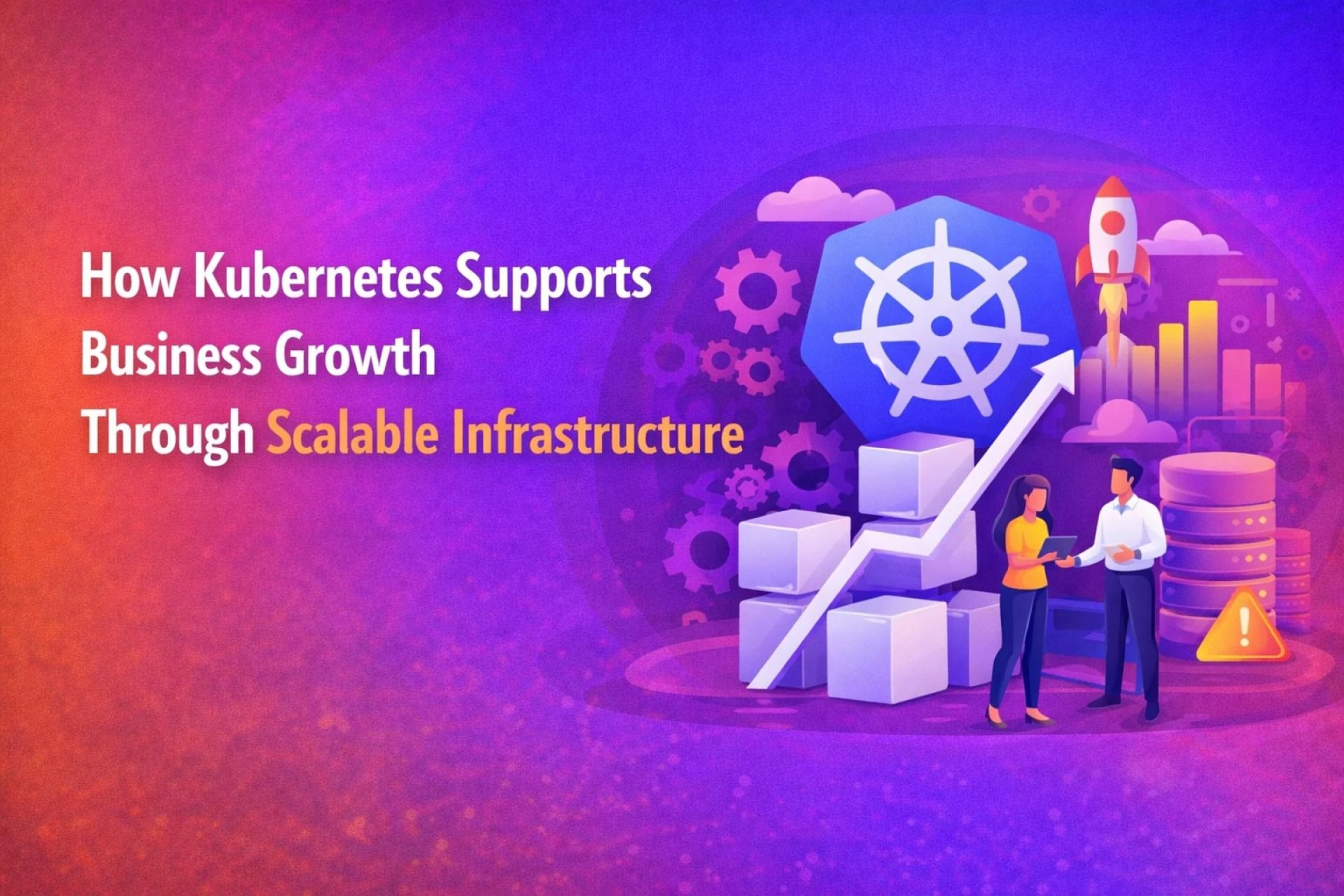

Business growth today is rarely linear. Customer demand fluctuates, markets evolve quickly, and digital products must scale without warning. Traditional infrastructure models-rigid servers, manual provisioning, and siloed environments-struggle to keep pace with this reality.
This is where Kubernetes has quietly become a growth enabler rather than just an infrastructure tool. Beyond container orchestration, Kubernetes provides the foundation for scalable, resilient systems that support innovation, speed, and long-term expansion. When paired with the right Kubernetes development services, it allows organizations to build platforms that grow alongside the business rather than limiting it.
This article explores how Kubernetes supports business growth through scalable infrastructure, with real-world insights and practical context for enterprises and growing organizations.
Why Scalable Infrastructure Matters for Business Growth
Growth introduces complexity. As businesses expand, they must handle higher traffic volumes, more users, distributed teams, and evolving application architectures. Infrastructure that cannot scale smoothly often becomes a bottleneck.
Scalable infrastructure allows businesses to respond to demand without service disruptions or excessive cost. Kubernetes enables this by abstracting infrastructure complexity and providing automation at scale. Instead of managing individual servers, teams manage workloads declaratively-making growth predictable and controlled.
For organizations focused on Kubernetes business growth, this shift reduces operational friction and creates room for faster innovation.
Kubernetes as a Foundation for Modern Enterprise Architecture
Kubernetes was designed to support distributed, containerized applications, making it ideal for modern enterprise environments. It standardizes how applications are deployed, scaled, and managed across environments-on-premises, cloud, or hybrid setups.
This consistency is critical for enterprises managing multiple products or regions. Kubernetes enterprise solutions help organizations eliminate environment-specific issues that slow down releases and increase risk. Teams gain confidence knowing that applications behave the same way in development, testing, and production.
As a result, Kubernetes becomes a platform for stability rather than experimentation alone.
How Kubernetes Supports Business Growth in Real Terms
The value of Kubernetes is best understood through its operational impact. It directly supports growth by enabling systems to scale efficiently while maintaining reliability.
Key ways Kubernetes enables growth include:
- Automatic scaling of applications based on demand
- High availability through self-healing mechanisms
- Faster deployment cycles with reduced downtime
- Better resource utilization, lowering infrastructure waste
For growing businesses, these capabilities translate into consistent customer experiences even during traffic spikes or expansion into new markets.
A SaaS company experiencing rapid user adoption, for example, can use Kubernetes autoscaling to handle peak usage without overprovisioning resources year-round. This balance between performance and cost is a core benefit of Kubernetes for business growth.
Supporting Digital Transformation with Kubernetes
Digital transformation is not just about adopting new tools-it’s about changing how software is built, deployed, and evolved. Kubernetes plays a central role in this shift by enabling cloud-native architectures and microservices.
With Kubernetes for digital transformation, organizations move away from monolithic systems toward modular services that can be developed and scaled independently. This accelerates innovation and reduces the risk associated with changes.
Enterprises adopting Kubernetes often report shorter release cycles and improved collaboration between development and operations teams. Infrastructure becomes an enabler of transformation rather than a constraint.
Kubernetes for Growing Businesses: Balancing Speed and Control
Growth-stage companies face a unique challenge: they need speed without losing control. Kubernetes offers a structured yet flexible platform that supports both.
Instead of manually managing environments, teams define infrastructure as code. Kubernetes then ensures the desired state is maintained. This reduces human error and operational overhead as systems grow more complex.
For startups transitioning into mid-sized organizations, Kubernetes for growing businesses provides a path to scale without repeatedly re-architecting infrastructure. It creates continuity from early growth stages to enterprise maturity.
Cost Efficiency and Resource Optimization at Scale
One often overlooked benefit of Kubernetes is its impact on cost efficiency. Scaling infrastructure traditionally meant provisioning for peak demand, leading to underutilized resources.
Kubernetes optimizes resource usage by scheduling workloads dynamically and scaling them only when needed. This helps businesses control infrastructure spend while supporting growth.
In one retail technology case, migrating to Kubernetes reduced infrastructure costs by consolidating workloads across clusters while maintaining performance during seasonal traffic spikes. This balance of cost and scalability is a key reason many organizations adopt Kubernetes enterprise solutions.
The Role of Kubernetes Development Services in Successful Adoption
While Kubernetes offers powerful capabilities, its value depends on how well it is implemented. Architecture design, workload modeling, and operational practices determine whether Kubernetes supports growth or adds complexity.
This is where experienced Kubernetes development services become critical. Proper implementation ensures that clusters are secure, scalable, and aligned with business goals-not just technically functional.
Midway through many Kubernetes journeys, organizations realize that tooling alone is not enough. Governance, observability, and CI/CD integration are equally important for sustaining growth.
Reliability, Resilience, and Business Continuity
Downtime has a direct impact on revenue and customer trust. Kubernetes enhances reliability through self-healing features that automatically restart failed containers and reschedule workloads when nodes go down.
For businesses operating at scale, this resilience supports uninterrupted service delivery. Applications remain available even during infrastructure failures, making Kubernetes a foundation for mission-critical systems.
This reliability is especially valuable for enterprises expanding globally, where infrastructure failures in one region should not disrupt the entire platform.
Conclusion: Kubernetes as a Growth Enabler, Not Just Infrastructure
Kubernetes has evolved from a technical platform into a strategic enabler of business growth. By providing scalable infrastructure, operational resilience, and flexibility, it allows organizations to grow without repeatedly rebuilding their foundations.
Whether supporting startups, mid-sized companies, or large enterprises, Kubernetes enables faster innovation, better cost control, and improved reliability. When combined with expert Kubernetes Consulting Services, businesses can design platforms that align technology decisions with long-term growth strategies.
For organizations focused on Kubernetes for business growth, the question is no longer if Kubernetes fits-but how well it is implemented to support where the business is headed next.






























Sign in to leave a comment.