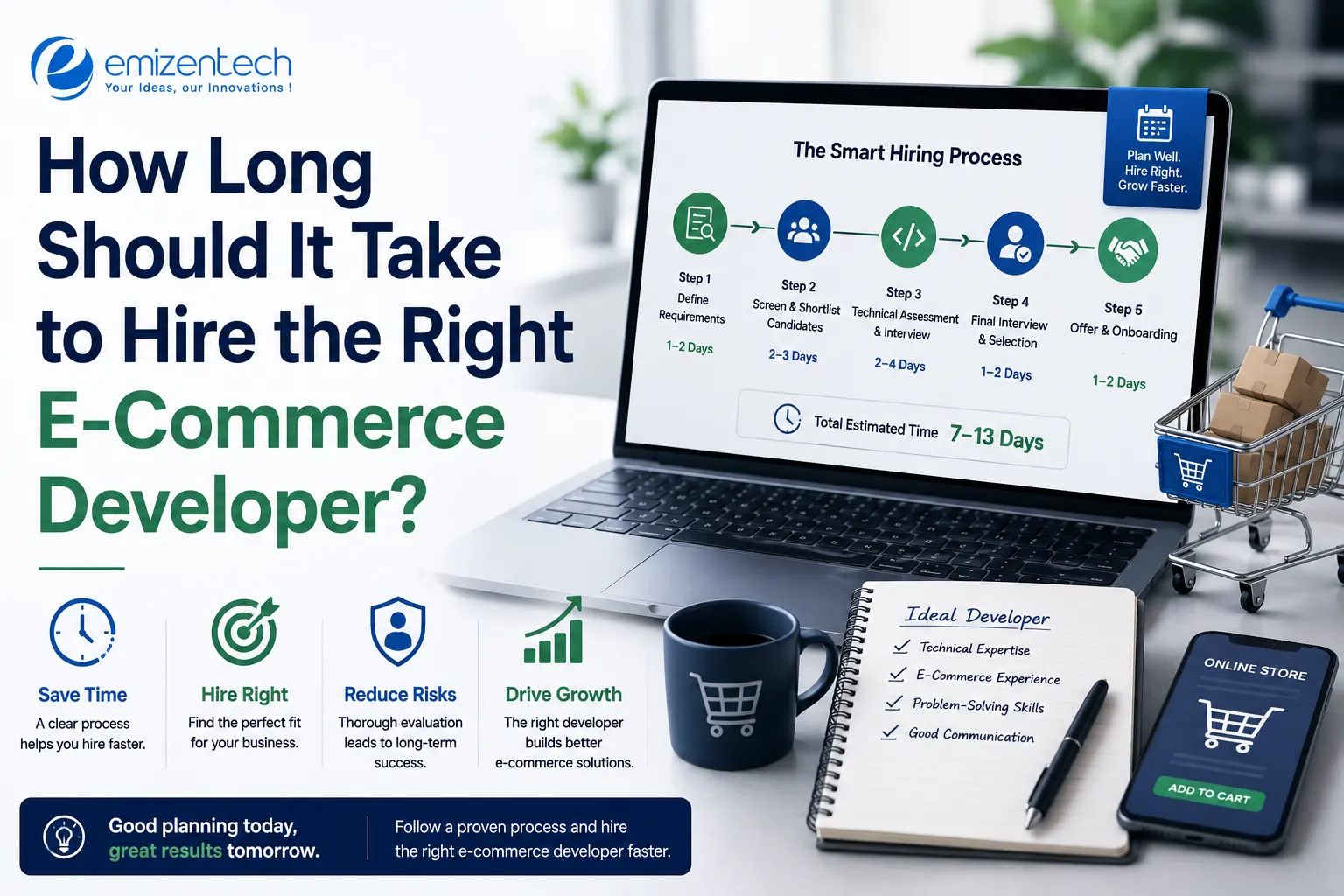

There's no single correct answer to this, but there is a wrong one, and it's "as fast as possible." A rushed hire almost always costs more time later than it saves upfront, once you're three weeks into a project realizing the person you picked can't actually do what the interview suggested they could.
That said, "it depends" isn't a useful answer either. Most businesses hiring an e-commerce developer, whether freelance or full-time, are looking at somewhere between four and eight weeks from posting the role to someone actually starting work. Knowing what happens inside that window, and what stretches or shrinks it, makes the whole process feel a lot less like guesswork.
What a Realistic Timeline Actually Looks Like
Break the process down and it roughly follows four stages. The first one or two weeks usually go toward writing the role clearly and getting it in front of the right people, then sorting through whoever applies or gets sourced. The next stretch, another week or two, is spent on quick screening calls, just enough to confirm someone's background matches what they claim before investing more time.
After that comes the part most people underestimate: actual skills testing, usually a coding task or a platform-specific exercise if you're hiring for something like Shopify or Magento work, which tends to take about a week to run and review properly. The final two to three weeks cover deeper interviews, checking references from past work, then negotiating and finalizing the offer once you've picked someone.
Add it up and eight weeks isn't unusual for a careful process. Four weeks is possible too, but usually only when the role is narrow and well-defined from the start.
Why Some Hires Move Faster Than Others
A few things push that timeline in either direction, and it's worth knowing which ones apply to your situation before you set expectations.
Platform familiarity matters more than people expect. If you need someone who knows a widely used tool, there's a large enough talent pool that sourcing and screening move quickly. If you need deep expertise in a custom-built or less common system, the pool shrinks fast, and so does your negotiating leverage on timeline.
How you're hiring changes things too. A freelancer can often start within days if you're not picky about long-term commitment. Bringing someone on as a dedicated, longer-term resource takes more vetting, and rightly so, since you're investing in a relationship, not just a task.
And budget does what budget always does. Competitive pay and flexible arrangements tend to shorten the search, because strong candidates aren't waiting around indefinitely. A search that's underpriced for the market tends to drag, not because good developers don't exist, but because they've already been hired somewhere else by the time you get to them.
Is Moving Fast Actually a Red Flag?
It's a fair question, and the honest answer is: sometimes, but not always. Speed on its own isn't the problem. What matters is what got skipped to get there.
A team that can show you real past work, confirm availability quickly, and start within a defined window because their process is genuinely efficient isn't cutting corners, they've just done this enough times to have it down. The concern is when speed comes from skipping reference checks, skipping any kind of skills verification, or being vague about who's actually going to be doing the work. If you can't get a straight answer about who you're hiring and why they're qualified, that's the actual red flag, not the calendar.
What Protects You If the Fit Turns Out Wrong
Even a careful process doesn't guarantee the right fit every time. Sometimes the mismatch only becomes obvious once real work starts, which is exactly why it's worth asking upfront what recourse you'd have if that happens.
Some companies build this directly into how they structure hiring, letting businesses hire eCommerce developers with a 14-day money-back guarantee rather than leaving buyers to figure out the fallback plan on their own. It's a useful thing to have in place, though it's only as good as the specific terms sitting behind it, which is worth digging into separately before treating it as a done deal.
Money Back Guarantee Terms and Conditions
This is where a lot of buyers stop reading, right when the details actually start to matter. A guarantee sounds reassuring as a headline. What it covers in practice depends entirely on the fine print.
Checking the actual money back guarantee terms and conditions tells you whether the promise is something you could realistically use, or just a phrase on a landing page. Look for a clearly defined evaluation window with a specific start date, conditions that are objective rather than based on vague satisfaction, and clarity on what's excluded, like a simple change of mind partway through. Terms that spell all of this out plainly usually belong to a company that's actually thought through how the policy works in practice, not just how it sounds in a pitch.
Checking the Claim Somewhere Independent
A company writing about its own guarantee on its own website is one thing. Seeing that same commitment show up somewhere the company doesn't control is a different, more useful kind of evidence.
This is where a badge like the Clutch Guarantee is worth checking for. When a company's promise appears on a third-party platform alongside independently collected reviews, it's harder to dismiss as marketing language alone. It's not a substitute for reading the terms yourself, but it's a reasonable second data point before you commit to anything.
Conclusion
A good hire takes long enough to actually verify fit, but not so long that momentum dies waiting for a perfect answer that doesn't exist. EmizenTech, a mobile app development company, structures its e-commerce developer hiring process around exactly that balance, pairing a clear timeline with documented terms so businesses aren't left guessing at either end of the decision. You can browse examples of that work directly on EmizenTech's e-commerce development portfolio.
FAQs
How can I speed up hiring without cutting corners?
Get specific about the role before you post it. Vague job descriptions attract vague applicants and slow everything down, because you end up screening people who were never a real fit to begin with.
Is a fast hiring process always a red flag?
Not by itself. It's a concern only when speed comes at the cost of skipping references, skills checks, or clarity on who's actually doing the work.
Will AI change how businesses hire e-commerce developers?
It's already changing parts of the process, like initial screening and code review, but judgment about fit, communication, and ownership still comes down to human evaluation.
What's a reasonable amount of time to give a hiring decision before worrying?
If a search stretches well past two months with no strong candidates, it's usually worth revisiting the role description, the budget, or the platform you're posting on, since one of those is probably the bottleneck.



























Sign in to leave a comment.