
When a software project needs more people, businesses do not always need to hire permanent employees. Sometimes they need a few extra developers for a few months. In other cases, they may prefer to hand the entire project over to an outside team.
This is where staff augmentation and outsourcing come in.
Both involve working with people outside the company, but the way the work is handled is quite different. The main difference comes down to who manages the team, who makes day-to-day decisions, and how much responsibility stays with the business.
What Is Staff Augmentation?
Staff augmentation means bringing external developers into your existing team for a specific period.
The developers work with your employees and follow your project's processes. Your managers can assign their tasks, set priorities, review their work, and communicate with them directly.
For instance, suppose your team is building an application and suddenly needs another React developer. Instead of hiring a full-time employee for a temporary need, you can add an experienced developer to the team for the required period.
The important point is that the external developer works as part of your team. You still have control over what they work on and how the project moves forward.
What Is Outsourcing?
Outsourcing works differently. Instead of adding individual developers to your existing team, you give a project or a defined part of it to an external company.
The outside team usually handles the development work, manages its developers, and takes care of the agreed responsibilities. Your team provides the requirements, discusses progress, gives feedback, and checks whether the expected results are being delivered.
This can be useful when you don't have enough technical resources internally or simply don't want your own team spending time managing another development project.
What Is the Main Difference?
The simplest way to look at it is this:
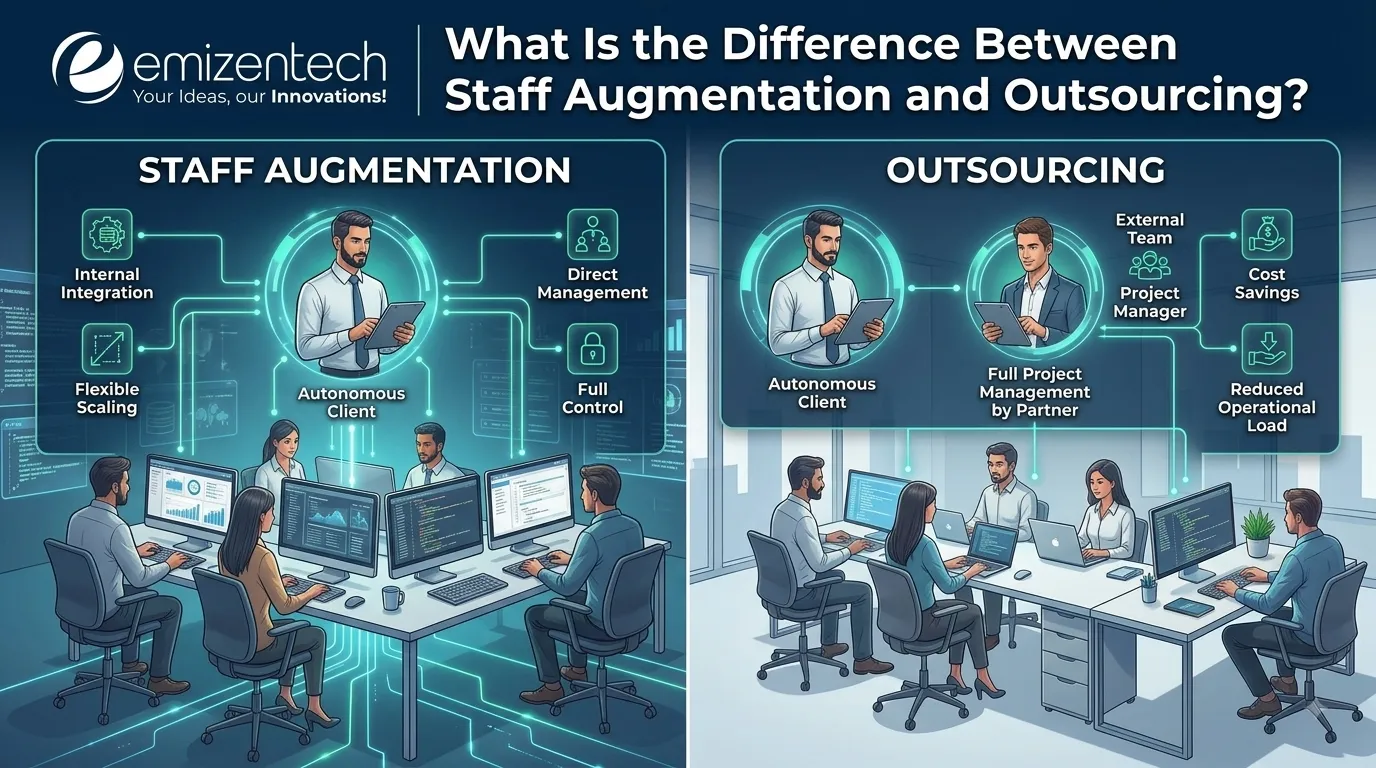
Staff augmentation adds people to your team. Outsourcing gives work to another team.
With staff augmentation, you remain closely involved in the development process. You decide what the developers work on and can adjust their priorities as the project changes.
With outsourcing, the external provider has more responsibility for managing the work. You are generally more focused on requirements, deadlines, communication, and the final result.
Here are the main differences:
- Team management: With staff augmentation, your internal team usually manages the external developers. With outsourcing, the service provider generally manages its own team.
- Control: Staff augmentation gives you more direct control over daily development activities.
- Responsibilities: Outsourcing moves more of the development responsibility to the external provider.
- Team flexibility: Staff augmentation makes it easier to add or reduce specific technical skills as project needs change.
- Project involvement: An augmented developer works closely with your existing team, while an outsourced team can work more independently.
Staff Augmentation vs Outsourcing: Which One Should You Use?
It depends on what you actually need from the external team.
Staff augmentation can make sense when:
- You already have an internal development team.
- Your team is missing a particular technical skill.
- You want to manage developers directly.
- You expect project requirements to change.
- You need extra developers for a limited period.
Outsourcing can make more sense when:
- You want another team to handle most of the development work.
- Your internal team does not have enough technical resources.
- The project requirements are reasonably clear.
- You want to reduce the amount of day-to-day development management.
- You are comfortable giving an external provider responsibility for delivery.
Neither model is automatically better. A company with a strong internal technical team may prefer staff augmentation because it can keep control of the development process. A company without enough internal resources may find outsourcing more practical.
If you want to look at the two models in more detail, this guide on Staff Augmentation vs Outsourcing explains how they differ in terms of control, flexibility, cost, and responsibilities.
Conclusion
The difference between staff augmentation and outsourcing is mainly about how the external team fits into your project.
Staff augmentation brings additional developers into your existing team, while outsourcing gives an external provider responsibility for a project or specific development work.
Before deciding, look at your current team, the skills you are missing, how much control you want, and how much project responsibility you are comfortable handing over. There is no universal answer. The better model is the one that fits the way your team actually works.
EmizenTech publishes practical resources to help businesses understand different development and team engagement models before making these decisions.
FAQs
1. What is the main difference between staff augmentation and outsourcing?
Staff augmentation adds external developers to your existing team, while outsourcing gives an external team responsibility for a project or specific development work.
2. Is staff augmentation better than outsourcing?
Not necessarily. Staff augmentation can work better when you want direct control over developers, while outsourcing can be a better fit when you want to delegate more of the development work.
3. Who manages developers in staff augmentation?
In staff augmentation, the client usually manages the external developers, including their tasks, priorities, communication, and day-to-day work.
4. Who manages the team in outsourcing?
With outsourcing, the external service provider generally manages its development team and handles the assigned work based on the agreed requirements.
5. When should a business use staff augmentation?
Staff augmentation can be useful when a business already has an internal development team but needs additional developers or specific technical skills for a project.
6. When is outsourcing a better option?
Outsourcing can make sense when a business wants an external team to take responsibility for developing a project or a defined part of it, especially when internal technical resources are limited.
7. Can staff augmentation be used for short-term projects?
Yes. Businesses can use staff augmentation to bring in developers for a specific period and reduce or change the team when project requirements change.






















Sign in to leave a comment.