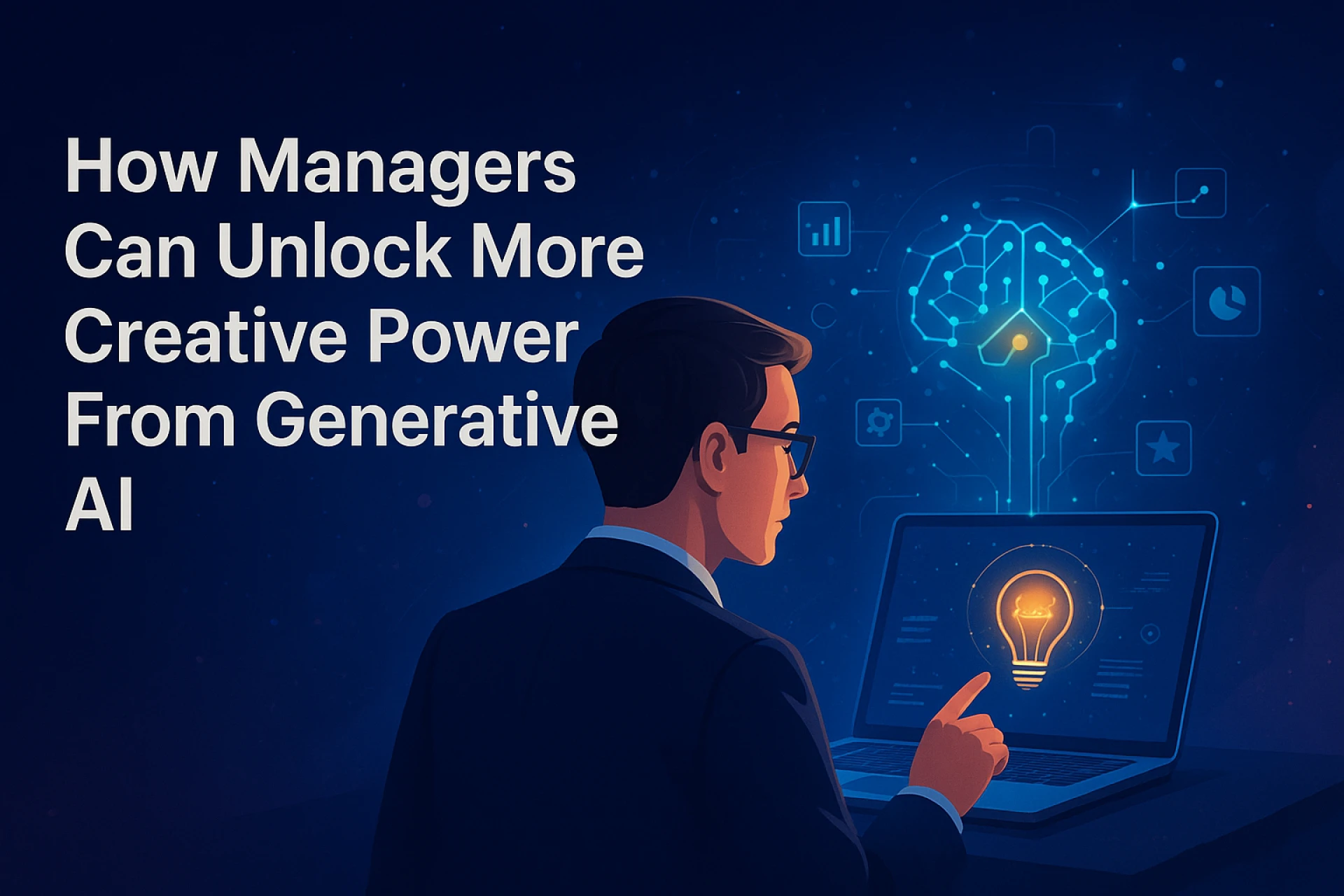

Managers are often told that AI will 'do the creative work' for them. However, the reality is more complex. When they try a popular tool, they might receive a bland slide deck or a generic campaign idea, leaving them with a quiet sense of disappointment. But the potential of AI to significantly enhance creativity is vast and inspiring.
In many cases, the problem isn't the model. It's the way people use it. With a bit of structure, the creativity you can pull out of these systems jumps dramatically.
That's precisely why a focused Generative AI course for managers is becoming less of a nice-to-have and more of a survival skill. When leaders understand how to brief, guide, and evaluate AI, they gain control over the outputs, moving from average ideas to ones they can actually ship.
Below are practical techniques managers can apply today, plus how Gen AI training and agent-style workflows fit into the bigger picture.
1. Treat AI like a junior teammate, not a vending machine
Most people interact with AI the way they do with a search bar: type a short request, hit enter, and accept whatever comes out. That is the fastest route to generic content.
Instead, treat the system as a junior team member who needs context, direction, and feedback.
A well-designed Gen AI course for managers spends a surprising amount of time on this mental shift. Rather than "Write a campaign for our new product," a trained manager might say:
- "You are a junior copywriter at an education brand targeting working professionals."
- "Here's our audience: mid-career managers in tech and operations."
- "Here is an example of a past campaign that worked well."
- "Give me three rough ideas, don't overpolish them yet.”
That extra framing completely changes the outcome. It also mirrors how good leaders brief humans. Generative AI training programs that emphasize contextual prompting, role assignment, and stepwise refinement help managers elicit more original thinking from the model rather than settling for surface-level answers.
Over time, leaders start to build prompting habits and reusable templates that feel natural to them, not forced or scripted.
2. Use constraints and “creative tension” to spark better ideas
It sounds counterintuitive, but creativity often improves when you add constraints. AI tools respond the same way.
Vague requests like “write something creative” usually flop. Specific limitations create what designers sometimes call “creative tension.”
Here are a few constraint styles you can apply:
- Format constraints: “Give me only taglines under eight words.”
- Audience constraints: “Assume the reader is a skeptical CFO.”
- Channel constraints: “Design this as a WhatsApp message, not an email.”
Well-structured Generative AI training programs walk managers through these levers using live exercises: rewriting a dry product description into three formats, or pushing the model to argue against its own idea and then improve it. Through repetition, managers notice how agent-like behavior emerges as the system juggles goals, constraints, and feedback.
This is where Agentic AI frameworks start to become relevant. You know, it actually works better when you don’t try to do everything at once. Maybe start just tossing around some ideas, then take a step back and see what stands out. After that, tweak things here and there, and keep in mind who’ll be reading it. Funny thing is, if you let different people (or “agents”) handle each part, you end up with content that feels much more alive—not that flat, copy-paste vibe you sometimes get from AI.
3. Build simple agent workflows, even if you’re not technical
The word “agentic” can sound like something out of a research lab, but at a practical level, it just means giving AI a bit more autonomy and structure.
An agentic AI course does not require managers to code. Instead, it shows them how to chain tasks and set up processes that run with light supervision.
For example, imagine a marketing manager’s typical workflow going something like this:
- A “research agent” spends time digging through recent articles and customer feedback to identify interesting trends or common themes.
- Then a “strategy agent” uses those findings to develop three or four fresh campaign ideas.
- A “creative agent” generates hooks, visuals, or messaging for each angle.
- A “review agent” highlights risks, clichés, and areas needing a human touch.
When Gen AI for managers is taught in this way, leaders begin to view AI as a small virtual team rather than a single box on their screen. That shift is crucial for improving creative output.
Agentic AI frameworks help standardize these workflows so they’re not reinvented from scratch every time. Over a few weeks, a team can evolve its own library of mini-agents and playbooks tailored to the business, which is precisely the sort of material often covered in a modern Generative AI course for managers.
4. Mix human taste with AI speed for stronger results
Even the best system cannot replace human taste and judgment. The most successful managers treat AI as a rapid idea generator and then rely on their own instincts to decide what’s actually worth using.
This blend is where Gen AI for managers becomes a strategic advantage instead of a novelty.
Here are a few habits that elevate quality:
- Always ask for multiple options and mash them up. Instead of taking the “best” of three ideas, steal strong pieces from each and combine them.
- Encourage disagreement. Ask the model to play devil’s advocate against its own suggestion. That friction often reveals sharper angles.
- Use real customer language. Feed it email snippets, chat transcripts, or support tickets so the tone feels grounded rather than robotic.
A good agentic AI course often puts as much emphasis on these review skills as it does on the prompting side. Participants learn how to critique AI work, identify when it uses buzzwords, and bring it back into the brand voice. When managers learn to listen for authenticity instead of polish, AI outputs start to sound more human and less like they were made.
Agentic AI frameworks support this by separating ideation from editing. An agent can come up with a lot of ideas, but a second agent's job is to cut them down, make them easier to understand, and ensure they align with what the customer wants.
Conclusion: Creativity grows when managers learn to direct AI
Generative tools alone do not guarantee fresh ideas. What makes the difference is how managers guide them, the constraints they set, and the review habits they build over time.
A generative AI course for managers can really help leaders move beyond just typing in one-off commands. It teaches how to work hand in hand with AI through organized teamwork, breaking tasks into smaller parts, and carefully reviewing and improving what the AI produces.
As Generative AI training programs mature, the most valuable ones will likely blend strategic thinking with hands-on exercises in Gen AI for managers and practical use of Agentic AI frameworks. Managers who lean into these skills now will not just keep up with automation—they’ll learn to shape it, and in the process, unlock a level of day-to-day creativity that might have felt out of reach a few years ago.




























Sign in to leave a comment.