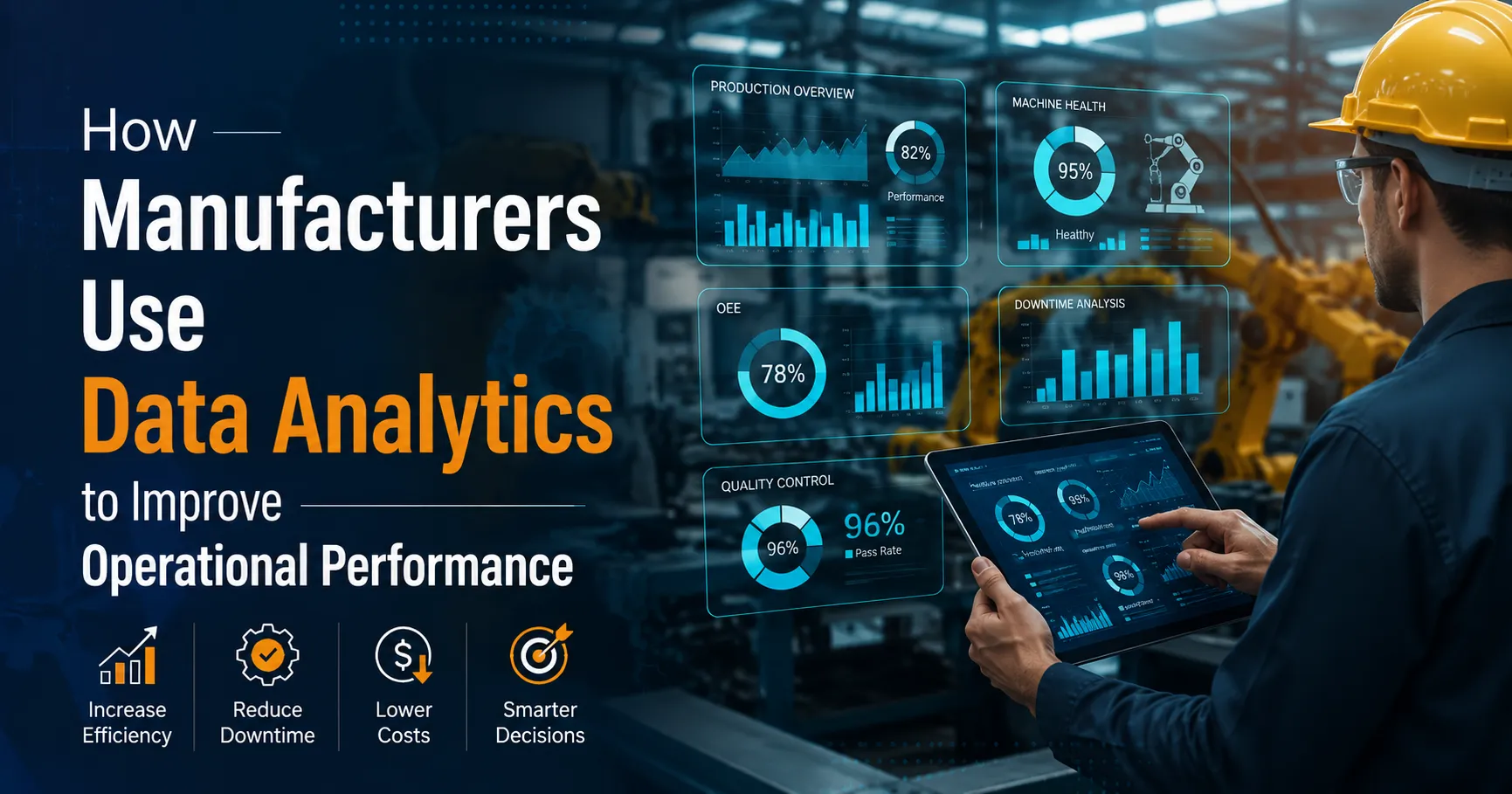

Manufacturing is undergoing a remarkable transformation. With the rise of Industry 4.0, Industrial Internet of Things (IIoT), artificial intelligence (AI), and cloud computing, manufacturers are no longer relying solely on experience and manual processes to run their operations. Instead, they are embracing manufacturing data analytics to gain actionable insights, optimize production, reduce costs, and improve overall operational performance.
Today, every machine, production line, sensor, and enterprise system generates valuable data. When analyzed effectively, this data enables manufacturers to identify inefficiencies, predict equipment failures, enhance product quality, and make informed business decisions.
What Is Manufacturing Data Analytics?
Manufacturing data analytics is the process of collecting, organizing, analyzing, and interpreting data generated across manufacturing operations. The goal is to transform raw operational data into meaningful insights that help improve productivity, efficiency, quality, and profitability.
Data can be collected from various sources, including:
- Production machines
- IoT sensors
- PLCs (Programmable Logic Controllers)
- SCADA systems
- ERP software
- MES (Manufacturing Execution Systems)
- Supply chain platforms
- Quality inspection systems
- Maintenance logs
- Warehouse management systems
By combining information from these sources, manufacturers gain complete visibility into their operations.
Why Data Analytics Matters in Manufacturing
Modern manufacturing facilities produce enormous amounts of data every second. Without analytics, most of this information remains unused.
Data analytics enables manufacturers to:
- Monitor production performance in real time
- Identify bottlenecks quickly
- Predict machine failures
- Improve product quality
- Optimize inventory
- Reduce waste
- Increase equipment utilization
- Lower operational costs
- Improve customer satisfaction
Rather than reacting to problems after they occur, manufacturers can proactively prevent them.
Types of Manufacturing Data Analytics
1. Descriptive Analytics
This type explains what has already happened.
Examples include:
- Production reports
- Machine utilization
- Daily output
- Downtime history
- Quality reports
It provides historical insights for better understanding.
2. Diagnostic Analytics
Diagnostic analytics explains why something happened.
Examples include:
- Root cause analysis
- Failure investigations
- Downtime analysis
- Quality defect analysis
This helps identify the underlying causes of operational issues.
3. Predictive Analytics
Predictive analytics uses historical data and machine learning to forecast future events.
Applications include:
- Predictive maintenance
- Demand forecasting
- Equipment failure prediction
- Inventory planning
- Production scheduling
This reduces uncertainty and enables proactive decision-making.
4. Prescriptive Analytics
Prescriptive analytics recommends the best course of action.
Examples include:
- Optimal production schedules
- Inventory recommendations
- Maintenance planning
- Workforce allocation
- Energy optimization
This helps manufacturers make smarter operational decisions.
Key Areas Where Manufacturers Use Data Analytics
1. Predictive Maintenance
Unexpected machine failures are one of the biggest causes of production downtime.
Instead of waiting for equipment to fail, manufacturers analyze:
- Temperature
- Vibration
- Pressure
- Motor current
- Oil condition
- Machine runtime
Analytics identifies patterns that indicate potential failures before they happen.
Benefits
- Reduced downtime
- Lower maintenance costs
- Longer equipment lifespan
- Increased production efficiency
- Improved worker safety
2. Production Performance Monitoring
Manufacturers continuously monitor production metrics such as:
- Production output
- Cycle time
- Equipment utilization
- Overall Equipment Effectiveness (OEE)
- Machine availability
- Operator performance
Real-time dashboards help managers identify production issues immediately.
This enables faster decision-making.
3. Quality Control
Quality defects increase costs and damage customer trust.
Analytics helps manufacturers monitor:
- Defect rates
- Product dimensions
- Process parameters
- Inspection results
- Customer returns
By identifying quality trends early, manufacturers can prevent defective products from reaching customers.
4. Process Optimization
Manufacturing involves hundreds of interconnected processes.
Analytics identifies:
- Inefficient workflows
- Production bottlenecks
- Resource waste
- Machine idle time
- Process variations
Optimizing these processes leads to:
- Faster production
- Reduced costs
- Higher throughput
- Better resource utilization
5. Inventory Management
Poor inventory management creates unnecessary expenses.
Too much inventory increases storage costs.
Too little inventory delays production.
Data analytics helps manufacturers:
- Forecast demand
- Track inventory levels
- Predict material shortages
- Optimize procurement
- Improve warehouse efficiency
The result is lower inventory costs and improved production continuity.
6. Supply Chain Optimization
Manufacturers rely on suppliers, logistics providers, distributors, and warehouses.
Data analytics improves supply chain operations by:
- Tracking supplier performance
- Predicting delivery delays
- Optimizing transportation routes
- Monitoring inventory movement
- Forecasting demand
This creates a more resilient and responsive supply chain.
7. Energy Management
Energy represents a significant operational expense.
Analytics helps monitor:
- Electricity consumption
- Machine energy usage
- Peak demand
- Utility costs
- Energy waste
Manufacturers can identify opportunities to reduce consumption without affecting production.
8. Workforce Productivity
Analytics isn't limited to machines.
Manufacturers also analyze workforce data.
Examples include:
- Labor productivity
- Shift performance
- Training effectiveness
- Safety incidents
- Attendance trends
Managers can optimize staffing and improve workforce efficiency.
Data Sources Used in Manufacturing Analytics
Manufacturing analytics combines data from multiple systems.
Common data sources include:
Machine Data
- CNC machines
- Robots
- Assembly lines
- PLC controllers
Sensor Data
- Temperature sensors
- Pressure sensors
- Flow meters
- Vibration sensors
- Humidity sensors
Production Systems
- MES
- ERP
- SCADA
- CMMS
Business Data
- Sales
- Procurement
- Finance
- Customer orders
Combining operational and business data provides a complete picture of manufacturing performance.
Technologies Powering Manufacturing Data Analytics
Several advanced technologies enable modern manufacturing analytics.
Industrial IoT (IIoT)
IIoT devices continuously collect operational data from connected equipment.
Benefits include:
- Real-time monitoring
- Remote diagnostics
- Automated alerts
- Continuous data collection
Artificial Intelligence
AI identifies patterns that humans may overlook.
Applications include:
- Predictive maintenance
- Defect detection
- Process optimization
- Production forecasting
Machine Learning
Machine learning improves prediction accuracy over time.
It enables:
- Failure prediction
- Quality prediction
- Inventory forecasting
- Demand forecasting
Cloud Computing
Cloud platforms provide:
- Scalable storage
- Centralized data access
- Remote collaboration
- Faster analytics
Edge Computing
Edge computing processes data near production equipment.
Advantages include:
- Lower latency
- Faster decision-making
- Reduced bandwidth usage
- Improved reliability
Digital Twins
A digital twin is a virtual representation of a physical asset or production line.
Manufacturers use digital twins to:
- Simulate production
- Test improvements
- Predict failures
- Optimize operations
Benefits of Manufacturing Data Analytics
Organizations implementing manufacturing analytics often experience significant improvements across multiple areas.
Improved Operational Efficiency
Real-time insights reduce delays and improve resource utilization.
Reduced Downtime
Predictive maintenance minimizes unexpected equipment failures.
Higher Product Quality
Continuous monitoring ensures consistent production standards.
Lower Manufacturing Costs
Analytics helps eliminate waste, optimize inventory, and reduce maintenance expenses.
Better Decision-Making
Managers gain access to accurate, real-time operational insights instead of relying on assumptions.
Faster Production
Optimized workflows increase throughput without sacrificing quality.
Enhanced Customer Satisfaction
Better quality and timely deliveries improve customer trust and retention.
Increased Profitability
Lower costs and improved productivity directly contribute to higher profit margins.
Real-World Use Cases
Automotive Manufacturing
Automotive companies use analytics to:
- Monitor robotic assembly lines
- Predict equipment failures
- Improve welding quality
- Reduce production delays
Food and Beverage Manufacturing
Analytics helps monitor:
- Product freshness
- Temperature control
- Packaging quality
- Inventory management
Pharmaceutical Manufacturing
Manufacturers analyze production data to ensure:
- Regulatory compliance
- Product consistency
- Batch traceability
- Equipment performance
Electronics Manufacturing
Electronics manufacturers use analytics for:
- Yield optimization
- Component traceability
- Automated quality inspection
- Process improvement
Challenges in Implementing Manufacturing Data Analytics
Despite its advantages, manufacturers may encounter challenges such as:
- Legacy equipment with limited connectivity
- Data silos across departments
- Poor data quality
- Integration complexities
- Cybersecurity concerns
- Skills shortages
- High initial investment
A phased implementation strategy can help overcome these obstacles.
Best Practices for Successful Implementation
To maximize the value of manufacturing data analytics:
- Define clear business objectives.
- Integrate data from all critical systems.
- Invest in reliable data governance.
- Use scalable cloud and edge technologies.
- Implement real-time dashboards.
- Train employees to interpret analytics.
- Continuously monitor and refine analytics models.
- Prioritize cybersecurity and compliance.
- Start with pilot projects before scaling.
- Measure outcomes using key performance indicators (KPIs).
Future Trends in Manufacturing Data Analytics
The future of manufacturing analytics is being shaped by several emerging trends:
- AI-powered autonomous factories
- Advanced digital twins
- Generative AI for operational insights
- Real-time edge analytics
- Hyperautomation
- Sustainable manufacturing analytics
- Computer vision for quality inspection
- Collaborative robots (cobots) integrated with analytics
- Self-optimizing production systems
- Predictive supply chain intelligence
As these technologies mature, manufacturers will gain even greater agility, efficiency, and resilience.
Conclusion
Manufacturing data analytics has become a cornerstone of modern industrial operations. By collecting and analyzing data from machines, production systems, supply chains, and business applications, manufacturers can uncover valuable insights that drive operational excellence.
From predictive maintenance and quality control to process optimization, inventory management, and workforce productivity, data analytics empowers manufacturers to make faster, smarter, and more informed decisions. The result is reduced costs, increased efficiency, improved product quality, and stronger competitiveness in an increasingly digital marketplace.
As Industry 4.0 continues to evolve, manufacturers that invest in robust data analytics capabilities will be better positioned to innovate, adapt to changing market demands, and achieve sustainable long-term growth. Embracing data-driven decision-making today is not just an operational advantage—it's a strategic necessity for the future of manufacturing.





























Sign in to leave a comment.