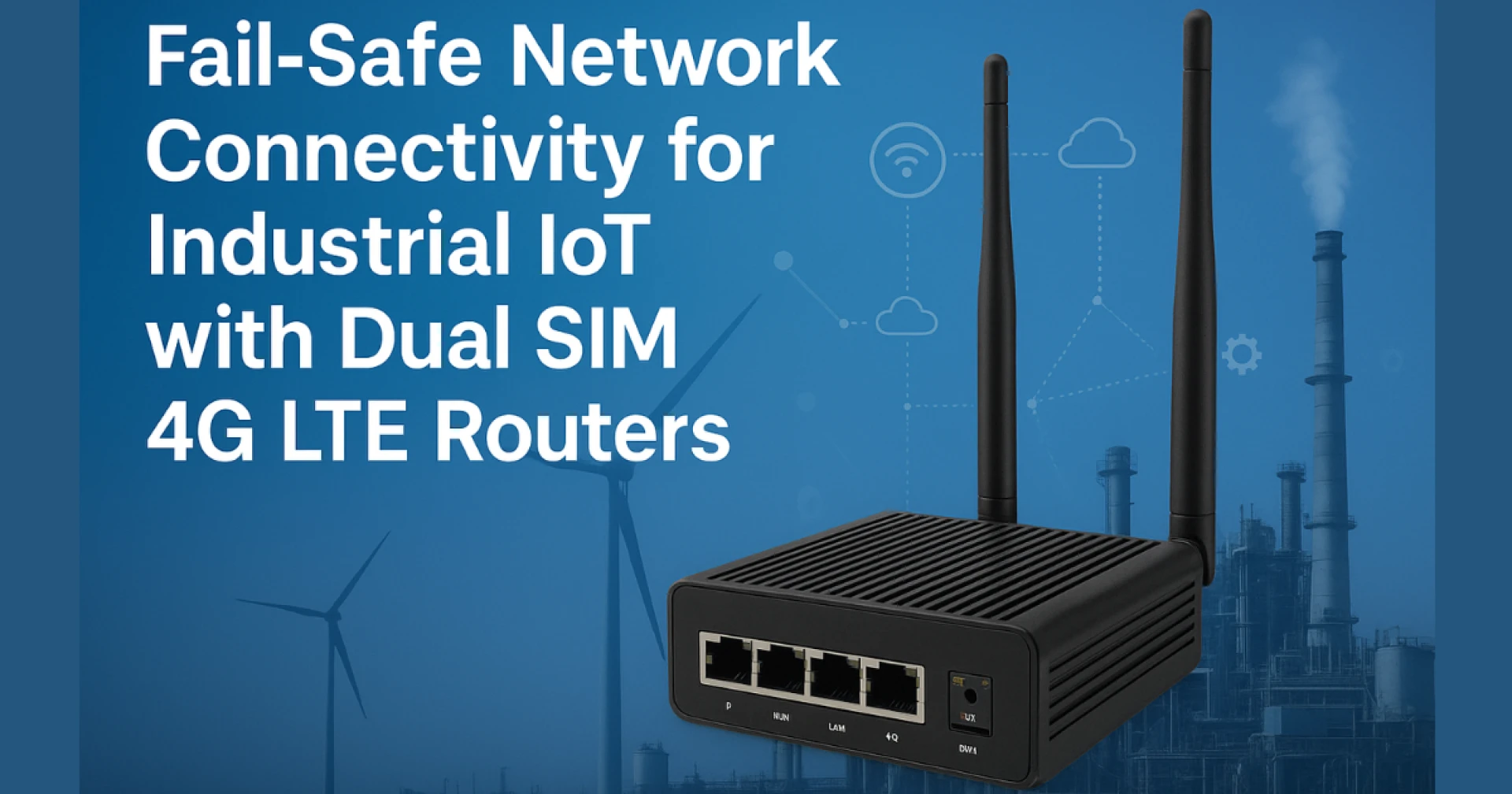

In today’s industrial landscape, Industrial IoT (IIoT) systems are no longer optional—they’re mission-critical. From remote monitoring of pipelines and water treatment plants to real-time production data collection in factories, IoT devices form the backbone of modern industrial operations. However, these systems depend entirely on reliable network connectivity. Any network downtime can lead to halted operations, lost data, safety hazards, and significant financial losses.
This is where Dual SIM 4G LTE Industrial Routers shine, delivering fail-safe connectivity even in challenging industrial environments.
Why Connectivity is a Critical Challenge in Industrial IoT
Industrial networks face multiple connectivity challenges:
1. Remote Locations – Many industrial sites are located far from urban centers, where network coverage can be weak or inconsistent.
2. Harsh Environments – Factories, oil fields, mines, and water treatment plants often have extreme temperatures, dust, vibration, and electromagnetic interference that impact network stability.
3. Mission-Critical Applications – Applications like predictive maintenance, SCADA systems, and real-time analytics depend on uninterrupted data streams. A single network failure can cause production downtime or compromise safety protocols.
4. Network Congestion – Heavy industrial operations or simultaneous IoT device communications can overload networks, slowing down critical data transfer.
5. Single-Point Failures – Relying on one network provider or one SIM card leaves systems vulnerable to service disruptions, which is unacceptable in high-stakes industrial operations.
How Dual SIM 4G LTE Industrial Routers Ensure Fail-Safe Connectivity
Dual SIM 4G LTE Industrial Routers are engineered to overcome these challenges:
1. Redundant Network Paths – With two SIM cards installed, routers can switch automatically between networks. If the primary SIM loses signal, the secondary SIM immediately takes over, ensuring zero downtime.
2. Automatic Failover – Unlike manual switching, modern dual SIM routers detect network outages in real time and seamlessly redirect traffic without interrupting ongoing IoT operations.
3. Load Balancing Capabilities – Advanced dual SIM routers can distribute traffic between both SIMs, optimizing bandwidth and reducing congestion for data-intensive industrial applications.
4. Remote Monitoring and Configuration – Industrial operators can monitor router health, configure network settings, and perform firmware updates remotely, minimizing on-site maintenance.
5. Protocol Compatibility – These routers are compatible with industrial protocols like Modbus, MQTT, OPC UA, and Ethernet/IP, ensuring smooth integration with existing IoT devices, SCADA systems, and cloud platforms.
6. Enhanced Security – Dual SIM routers often come with VPN support, firewalls, and end-to-end encryption, safeguarding sensitive industrial data from cyber threats.
Real-World Industrial Benefits
1. Continuous Data Flow – With automatic failover, IIoT devices transmit data reliably, allowing operations teams to make informed decisions in real time.
2. Reduced Production Downtime – Network disruptions no longer halt production lines or compromise monitoring, saving significant operational costs.
3. Remote Operations Enablement – Sites in remote or offshore locations can maintain stable connectivity, enabling centralized control centers to monitor and manage multiple locations effectively.
4. Operational Cost Savings – Avoiding network downtime reduces emergency maintenance costs, unplanned labor, and lost production.
5. Scalable & Future-Ready – Dual SIM routers can be upgraded to support 5G, LTE-M, or NB-IoT, making them suitable for evolving IIoT requirements.
6. Improved IoT Device Utilization – Reliable connectivity ensures sensors, meters, and machines work continuously, maximizing ROI on IIoT investments.
Implementation Tips for Maximum Reliability
1. Choose Complementary Carriers – Select SIM cards from providers with overlapping but independent network coverage to maximize redundancy.
2. Regularly Monitor Network Performance – Use routers with dashboards to proactively track signal strength, data usage, and failover events.
3. Secure Your Industrial Network – Enable VPNs, firewalls, and data encryption to prevent cyber intrusions on critical systems.
4. Plan for Traffic Growth – Industrial IoT networks may expand quickly. Ensure routers support high device counts and increased bandwidth requirements.
5. Integrate Seamlessly with Existing Systems – Verify compatibility with SCADA, PLCs, and other industrial protocols to prevent operational disruptions.
6. Test Failover Scenarios – Conduct regular drills to ensure automatic failover works correctly and data transmission continues uninterrupted.
Case Study: Real-World Application
A water treatment facility deployed a network of sensors to monitor water quality, chemical levels, and pump performance. Initially, the facility relied on a single SIM 4G router, and occasional network outages caused delays in alert notifications, risking non-compliance with safety standards.
After switching to a Dual SIM 4G LTE Industrial Router, the facility achieved:
- 100% uptime for sensor data transmission
- Immediate alerts for critical events without delay
- Remote monitoring from a central control room, reducing on-site labor
- Seamless failover between carriers, even during adverse weather conditions
This simple upgrade prevented potential operational hazards, reduced downtime, and improved overall efficiency.
Conclusion
Reliable connectivity is the backbone of Industrial IoT. Dual SIM 4G LTE Industrial Routers provide a fail-safe solution by ensuring uninterrupted data flow, seamless failover, and robust network performance even in the most challenging environments. Investing in these routers helps industrial operators:
- Maintain continuous operations
- Protect critical data and assets
- Reduce operational costs
- Enable scalable, future-ready IoT deployments
For industries where downtime is not an option, Dual SIM 4G LTE routers are no longer just a convenience - they’re essential infrastructure.
FAQs
1. What is a Dual SIM 4G LTE Industrial Router?
An industrial-grade router with two SIM cards for redundant cellular connectivity, ensuring failover and continuous data transmission.
2. How does automatic failover work?
If the primary network fails, the router instantly switches to the secondary SIM, maintaining uninterrupted communication.
3. Are these routers suitable for harsh environments?
Yes, they are designed for extreme temperatures, dust, vibration, and industrial electromagnetic interference.
4. Do they support industrial IoT protocols?
Yes, most dual SIM routers support protocols like Modbus, MQTT, OPC UA, and Ethernet/IP.
5. Can they be remotely managed?
Yes, they allow monitoring, configuration, and firmware updates remotely, reducing the need for on-site visits.
6. Can these routers handle multiple IoT devices?
Modern dual SIM industrial routers are built to handle high device counts, heavy data traffic, and scalable IIoT deployments.


























Sign in to leave a comment.