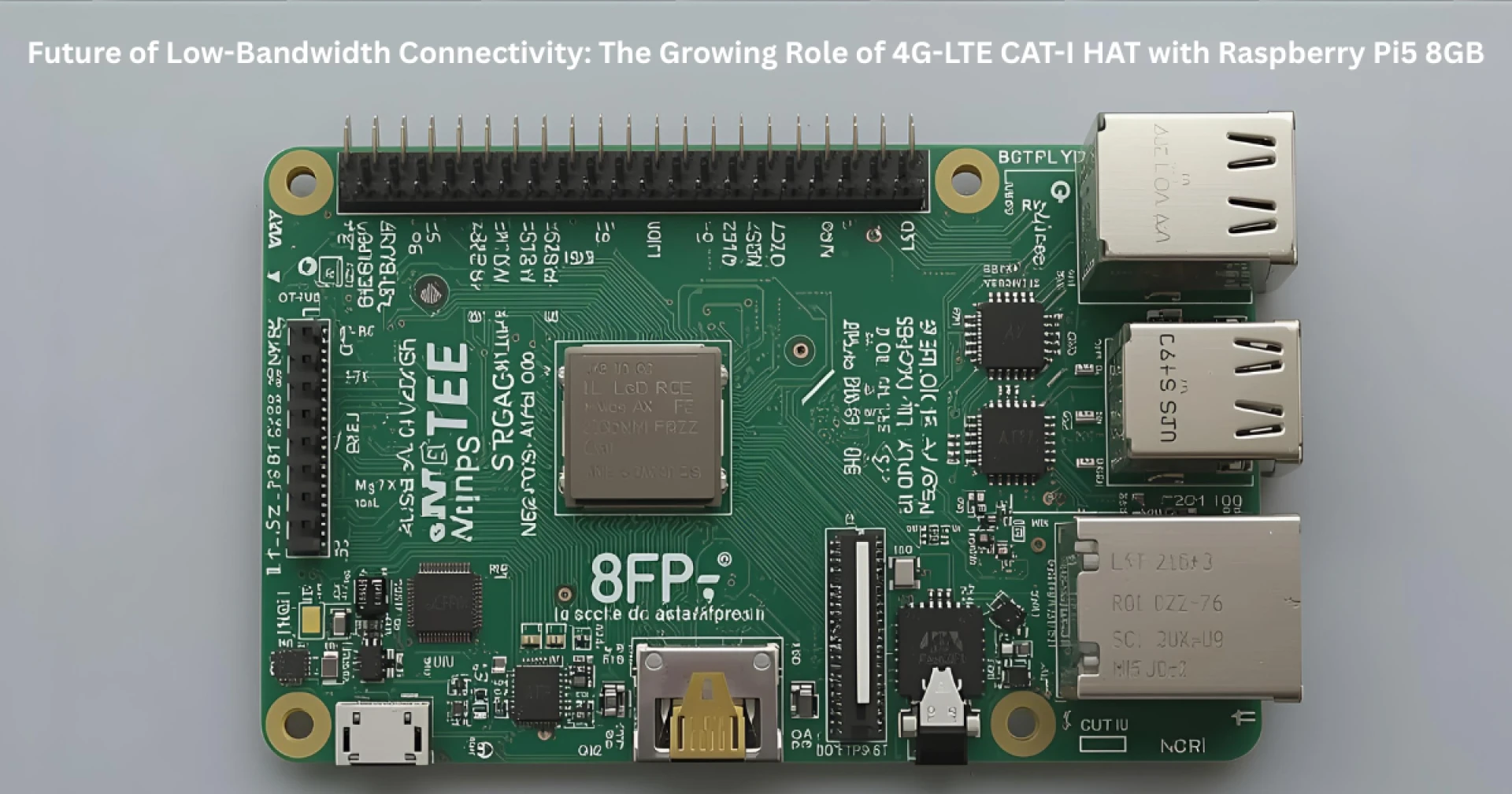

The rapid growth of IoT ecosystems has shifted industry attention from pure high-speed networks to low-bandwidth, energy-efficient, and scalable communication technologies. While 4G and 5G promise high data throughput, the majority of IoT devices operate on lightweight and periodic data exchanges, making these high-speed networks unnecessary and expensive for widespread deployment.
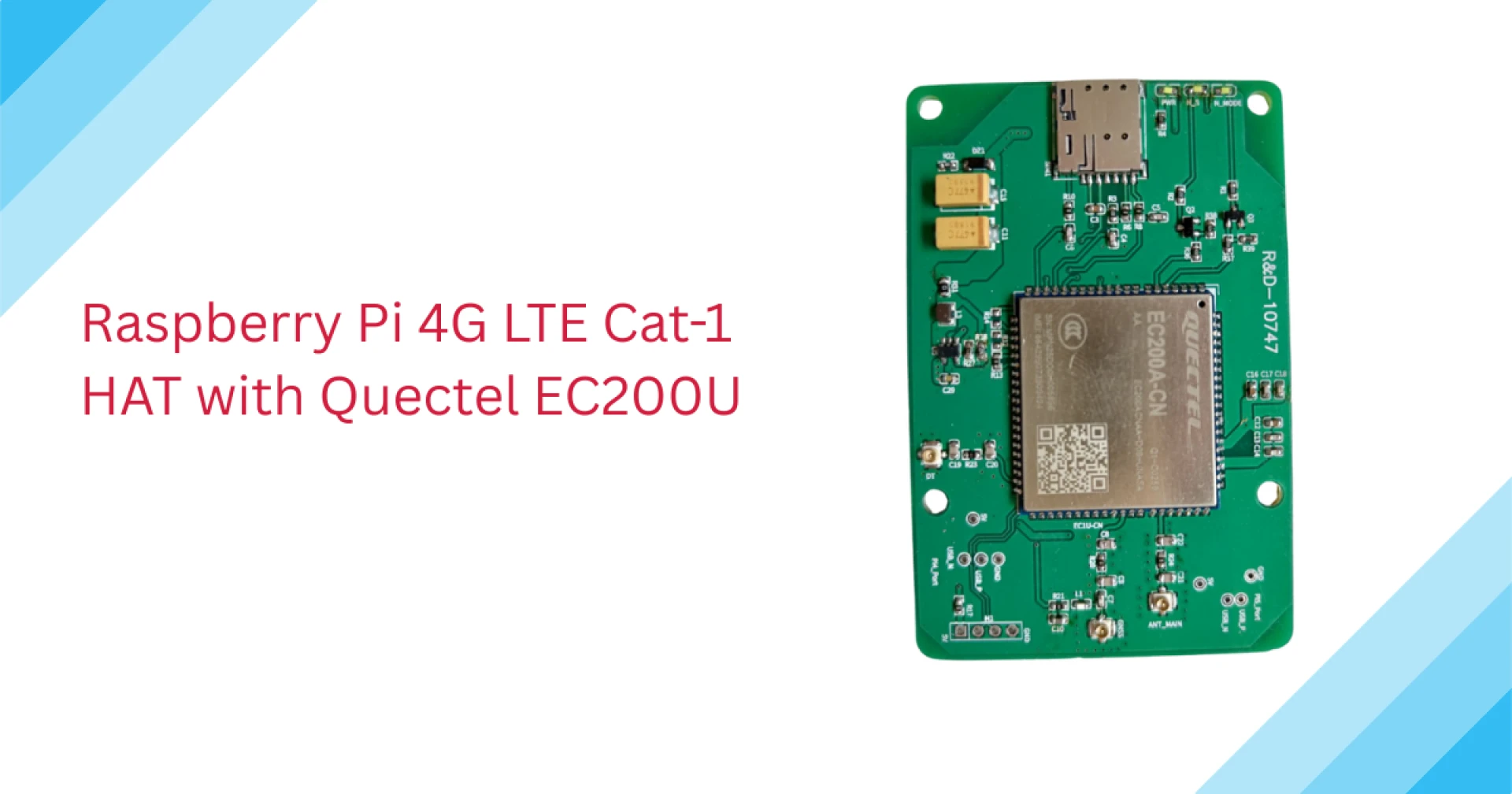
This shift has pushed 4G-LTE CAT-I forward as one of the most reliable and cost-effective cellular technologies for IoT. When integrated with the computational power of the Raspberry Pi5 8GB, the 4G-LTE CAT-I HAT becomes a robust, future-ready solution for industries aiming to deploy low-power, always-on, and cost-efficient IoT systems.
Below is an in-depth, detailed exploration of how CAT-I and Raspberry Pi5 redefine low-bandwidth connectivity.
1. The Shift Toward Low-Bandwidth, Energy-Efficient IoT Solutions
1.1 Real-World IoT Requires Stability, Not Speed
Most IoT deployments—especially those in industrial, agricultural, and utility sectors—do not demand high-speed internet. Their core requirements are:
- Consistent long-term operation instead of peak speed
- Low energy consumption to enable battery and solar-powered devices
- Minimal data transmission, often measured in kilobytes
- Long-range and wide-area connectivity across diverse terrains
For example, a water pipeline monitoring node may only send:
- Pressure values
- Flow rate
- Valve status
- Fault alerts
This data does not require 5G or even CAT-4 speeds. A more efficient network like CAT-I provides stable, long-range communication without complexity or high operational cost.
1.2 IoT Deployments Are Shifting to Remote and Harsh Environments
Modern IoT nodes are increasingly installed in:
- Rural farms
- Industrial plants
- Underground utilities
- Remote environmental zones
In such environments, network reach, penetration, and reliability matter more than bandwidth. CAT-I excels here because it:
- Penetrates deep indoor or underground locations
- Maintains signal strength across wide geographic regions
- Offers consistent performance even with weak network coverage
1.3 Need for Cost-Efficient and Scalable Connectivity
Scalability is a major factor in IoT adoption. CAT-I reduces:
- Hardware cost
- Operational network cost
- Deployment complexity
- Lifecycle maintenance burden
This lowers the barrier for scaling from hundreds to thousands of connected devices.
2. What Makes 4G-LTE CAT-I Ideal for Low-Bandwidth IoT?
2.1 Built Specifically for Low-Data, Continuous Connectivity
CAT-I networks are optimized for applications that send:
- Sensor telemetry snapshots
- Control signals
- Device status updates
- Event-driven alerts
The technology provides just the right bandwidth—sufficient for IoT data while keeping power usage extremely low.
2.2 High Signal Strength and Extended Coverage
CAT-I networks provide:
- Better signal penetration inside buildings and machinery rooms
- Longer coverage range, especially important in rural or industrial zones
- Reduced latency for applications that demand near-real-time control
This makes CAT-I suitable for:
- Utility grids
- Industrial automation floors
- Parking lots and terminals
- Mines and construction sites
2.3 Affordable Hardware and Network Plans
CAT-I modules are less expensive than high-speed LTE categories. Additionally:
- SIM plans for CAT-I are cheaper
- Network stability reduces maintenance cost
- Lower power usage extends device battery life
Together, this creates a highly efficient ecosystem for long-term IoT deployments.
3. Raspberry Pi5 8GB: A New Benchmark for Edge Computing
3.1 High-Performance Processing for Lightweight Edge AI
With a 2.4 GHz quad-core CPU, the Raspberry Pi5 delivers a significant performance leap. It enables:
- Local data processing
- Basic AI/ML inference
- Efficient rule-based automation
- Protocol translation between sensors and cloud
This reduces cloud dependency and helps build self-reliant, intelligent IoT nodes.
3.2 8GB RAM for Smooth Multi-Task Operation
The 8GB LPDDR4X memory expands possibilities by supporting:
- Complex edge applications
- High-efficiency data logging
- Local dashboards
- Secure storage and encryption functions
3.3 Enhanced I/O and Connectivity
The Pi5 offers:
- PCIe 2.0 interface
- Faster GPIO performance
- Dual 4K display support
- Improved USB 3.0 speeds
This positions the Pi5 not just as a microcontroller but as a full-scale industrial edge gateway.
4. Why the 4G-LTE CAT-I HAT and Raspberry Pi5 8GB Make a Perfect Pair
4.1 Reliable Edge Connectivity Anywhere
With CAT-I HAT attached directly to Pi5:
- Data can be transmitted in real time
- Devices remain online even in remote zones
- Gateways continue working during Wi-Fi failure
This ensures zero downtime, a critical requirement for industrial operations.
4.2 Low Power Consumption for Long-Life Deployments
CAT-I is optimized for:
- Solar-powered IoT nodes
- Battery-operated edge devices
- Temporary or mobile installations
Pairing CAT-I with the Pi5’s improved power management results in longer field operational life.
4.3 Ideal for Industrial and Outdoor IoT Conditions
Industries benefit because:
- Cellular connectivity avoids Wi-Fi interference
- CAT-I modules are more stable in harsh environments
- Pi5 provides processing power for protocol support (MQTT, Modbus, CAN, OPC-UA)
This makes the combination suitable for:
- RTUs
- IIoT gateways
- Smart meters
- Automated control panels
5. Key Applications Shaping the Future of Low-Bandwidth IoT
5.1 Smart Agriculture Automation
CAT-I + Pi5 enables:
- Remote soil moisture monitoring
- Automated irrigation based on sensor insights
- Long-range livestock tracking
- Farm equipment monitoring via solar nodes
Low-bandwidth networks align perfectly with agriculture's distributed and remote nature.
5.2 Utility & Infrastructure Monitoring
Common use cases include:
- Smart water and gas meters
- Pipeline pressure monitoring
- Utility grid fault detection
- Streetlight automation
Because utility systems require reliability over speed, CAT-I becomes the ideal connectivity layer.
5.3 Environmental Monitoring & Early Warning Systems
Applications include:
- Air pollution level monitoring
- River overflow alarms
- Weather station data logging
- Forest fire temperature sensors
The combination is rugged and efficient for long-term environmental deployments.
5.4 Industrial Automation & Smart Manufacturing
Key uses:
- Machine health telemetry
- PLC gateway communication
- Remote SCADA data transmission
- Predictive maintenance systems
Industrial telemetry often involves small packets of data, making CAT-I perfectly suitable.
6. The Future of Low-Bandwidth IoT: Why CAT-I Will Continue to Grow
6.1 Billions of Devices Will Not Need High-Speed Networks
Most IoT devices are “talkative sensors,” not video streamers. Their growth will be driven by:
- Low-power operations
- Budget-friendly hardware
- Strong coverage networks
CAT-I sits exactly at this intersection.
6.2 Telecom Operators Will Continue Supporting LTE for Many Years
Even as 5G expands, telecom providers will not abandon LTE soon because:
- It has wide global coverage
- Billions of devices rely on it
- IoT cannot shift to 5G overnight
CAT-I remains a long-term, stable investment.
6.3 Edge Computing Will Reduce Dependency on Cloud
With the Pi5 delivering more computational power, future IoT systems will:
- Make decisions locally
- Reduce cloud costs
- Improve reliability during network drops
CAT-I becomes the communication backbone—not for heavy uploads, but for consistent small packets.
Conclusion
The partnership of 4G-LTE CAT-I HAT with Raspberry Pi5 8GB represents a major evolution in low-bandwidth IoT connectivity. It focuses on what IoT truly needs: stability, efficiency, remote accessibility, and cost-effectiveness, rather than sheer speed. As industries continue to deploy millions of sensors and smart devices across wide geographies, CAT-I will remain a critical cellular technology powering the future of IoT.
Low-bandwidth connectivity isn’t just relevant—it is the backbone of tomorrow’s smart and sustainable IoT world.




















Sign in to leave a comment.