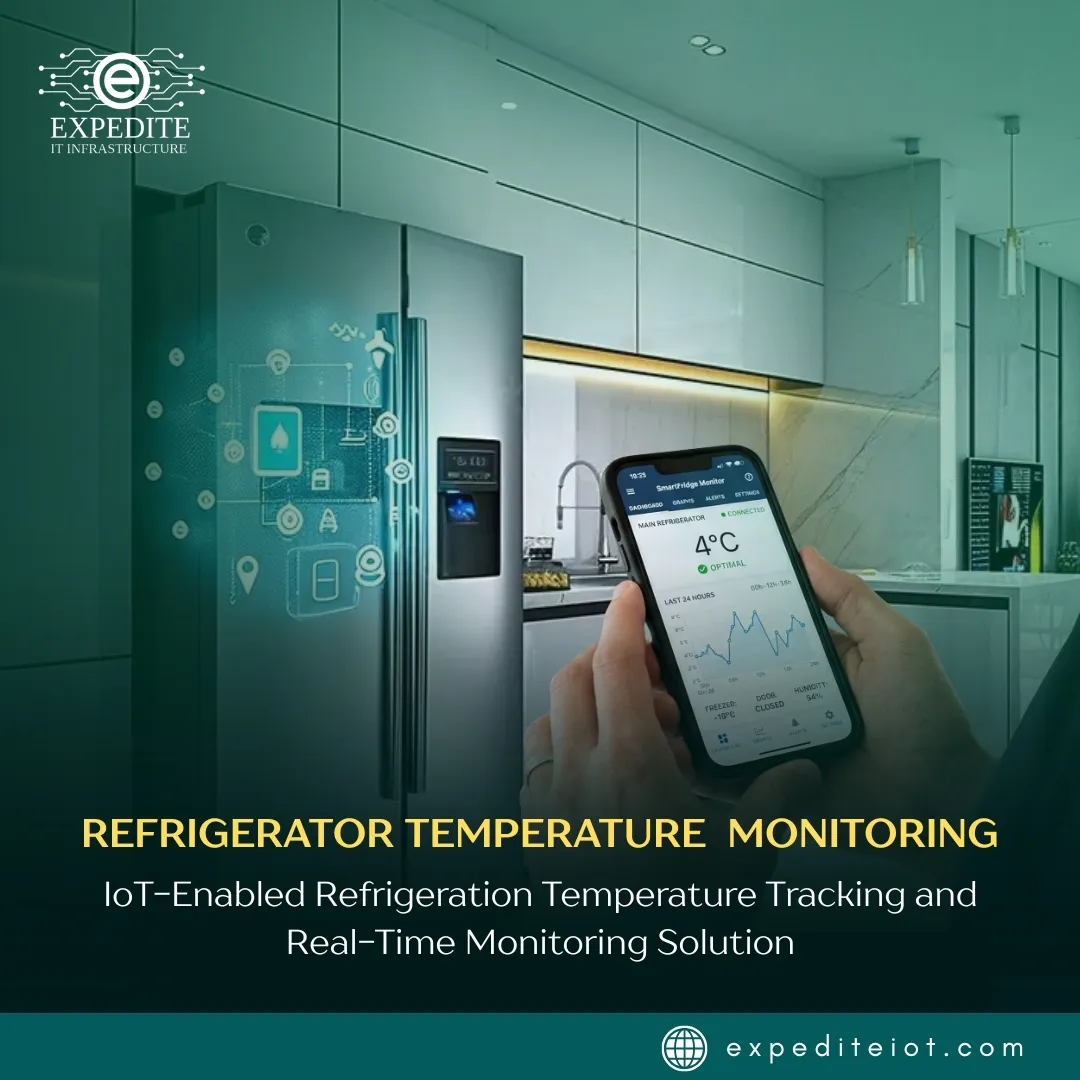

Effective Refrigerator Monitoring is no longer optional for Kuwait clinics — it is a patient-safety imperative and a regulatory requirement. Vaccines, insulin, blood samples, and specialty biologicals lose potency or become hazardous the moment cold-chain integrity fails. A single compressor fault, power cut, or accidental door-left-open event can silently destroy thousands of dinars worth of medicines. This article explores how IoT-driven cold-chain technology is transforming healthcare refrigeration across Kuwait City, Hawalli, Ahmadi, and Farwaniya — keeping medicines safe from storage to administration.
Why Cold-Chain Integrity Is Critical in Kuwait's Healthcare Sector
Kuwait's Ministry of Health enforces strict vaccine storage protocols aligned with WHO cold-chain guidelines. With outdoor temperatures regularly surpassing 45 °C in summer, refrigeration equipment is under constant thermal stress. Clinics must demonstrate continuous temperature compliance for licensing, accreditation, and insurance purposes. Manual log-book recording — still prevalent in smaller polyclinics — creates dangerous documentation gaps during night shifts, weekends, and public holidays. The answer lies in automated, always-on Temperature Monitoring Solutions that capture, store, and alert staff in real time.
What Happens When Temperature Control Fails
Vaccines including MMR, Hepatitis B, Polio (IPV), and COVID-19 boosters require storage between 2 °C and 8 °C. Excursions outside this band — even brief ones — trigger WHO vaccine vial monitor colour changes, signalling product compromise. The consequences cascade quickly:
- Financial loss from wasted vaccine stock and emergency restocking costs
- Patient harm resulting from administration of degraded or destabilised biologicals
- Regulatory penalties, suspension of cold-chain certifications, and reputational damage
- Insurance claim disputes driven by the absence of auditable, continuous temperature records
Automated Temperature Data Loggers eliminate these risks by providing uninterrupted, tamper-proof records that satisfy both internal quality audits and external regulatory inspections.
How Modern Refrigerator Monitoring Works: IoT Architecture Explained
Contemporary Remote Temperature Monitoring platforms are built on a three-layer IoT architecture combining hardware sensing, wireless connectivity, and cloud analytics.
Layer 1 – Smart Sensors inside the Refrigerator
Precision-calibrated Smart Sensors placed inside vaccine refrigerators, freezers, and cold rooms measure temperature — and optionally relative humidity — at configurable intervals of 1 to 5 minutes. Rated to ±0.1 °C accuracy with IP67 environmental protection, they buffer readings internally so data is never lost during connectivity interruptions. Communication options include Wi-Fi, Zigbee, LoRaWAN, and 4G LTE, covering everything from urban hospitals to remote health centres across Kuwait.
Layer 2 – Connectivity Gateway with 4G/LTE Failover
A local IoT gateway aggregates data from all sensors across the facility and transmits it via TLS-encrypted channels to the cloud. Redundant SIM-based 4G failover activates automatically when broadband drops — crucial during Kuwait's summer sandstorms and infrastructure maintenance windows.
Layer 3 – Cloud Dashboard and Analytics
All sensor data flows into a cloud platform where facility managers can view real-time temperatures, historical trend graphs, and exportable compliance reports from any device — desktop, tablet, or smartphone. Role-based access control ensures pharmacists, nurses, and compliance officers each see only the data relevant to their responsibilities.
Temperature Alerts: The First Line of Defence for Vaccine Safety
The most operationally critical feature of any monitoring platform is its alert engine. Configurable Temperature Alerts notify the right personnel — via SMS, email, WhatsApp, or in-app push notification — the moment a reading breaches a defined threshold. Multi-tier escalation ensures that if a first responder does not acknowledge an alert within a set window, it automatically escalates to supervisors or on-call engineers.
Kuwait clinics commonly configure the following alert scenarios:
- High-temperature excursion above 8 °C for standard vaccine refrigerators
- Low-temperature excursion below 2 °C risking freezing of sensitive biologicals
- Power outage detection with predicted time-to-breach modelling
- Door-open alerts triggered after a configurable timeout period
- Sensor offline or battery-low notifications for preventive maintenance scheduling
This proactive architecture transforms clinic staff from reactive problem-solvers into preventive guardians of cold-chain integrity.
Temperature Data Loggers: Building an Audit-Ready Compliance Record
Regulatory and accreditation bodies — including CBAHI and JCI — require continuous, unalterable temperature logs. Enterprise-grade Temperature Data Loggers embedded in IoT platforms automatically produce:
- PDF and CSV compliance reports for any date range, exportable in one click
- Mean Kinetic Temperature (MKT) calculations to quantify cumulative thermal stress
- Calibration certificates and sensor health logs for equipment audit trails
- Excursion event reports with timestamps, duration, and corrective-action fields
For Kuwait facilities preparing for JCI or ISO 15189 accreditation, automated documentation dramatically reduces administrative burden and eliminates the risk of falsified or lost paper records.
Refrigerator Monitoring Kuwait: Key Use Cases across Healthcare Settings
The demand for dedicated Refrigerator Monitoring Kuwait deployments spans a wide spectrum of healthcare and life-science settings:
Government Polyclinics and PHCC Centres
Kuwait's Primary Health Care Corporation operates dozens of health centres distributing childhood immunisation schedules. Centralised remote monitoring allows PHCC administrators to supervise cold-chain compliance across all governorates from a single dashboard, enabling rapid response to equipment failures without requiring on-site inspectors.
Private Hospitals and Specialist Clinics
High-volume private hospitals store premium oncology biologicals, monoclonal antibodies, and custom compounded drugs that far exceed standard vaccine costs. Continuous sensor oversight protects these inventories and provides insurers with the loss-prevention records required for cold-storage coverage.
Retail Pharmacies and Cold-Room Warehouses
Kuwait's robust retail pharmacy network stocks insulin, GLP-1 agonists, and specialty biologicals in walk-in cold rooms, display refrigerators, and automated dispensing units. Multi-zone sensor deployments cover all assets simultaneously, giving store managers a single operational view.
Clinical Laboratories and Blood Banks
Blood products, PCR reagents, and immunoassay kits demand ultra-precise temperature windows. Dual-redundant sensors with alarm failover protect these assets around the clock — including during scheduled maintenance and equipment servicing.
Remote Temperature Monitoring: 24/7 Oversight without Physical Presence
One of the most transformative capabilities IoT brings to Kuwaiti healthcare is complete cold-chain visibility from any location. Remote Temperature Monitoring means a facility manager can verify the status of every refrigerator across every branch — whether at home during Eid, travelling abroad, or working from headquarters — via a secure smartphone app. This capability is particularly valuable for:
- Multi-branch clinic chains needing centralised oversight without additional headcount
- Facility managers responsible for after-hours temperature compliance
- Ministry of Health inspectors requesting live data access during regulatory audits
- Equipment service contractors receiving predictive maintenance alerts before failures occur
Why Expedite IoT Is the Trusted Partner for Cold-Chain Monitoring in Kuwait
Expedite IoT delivers purpose-built Temperature Monitoring Solutions across the GCC region, with deep experience serving healthcare clients in Kuwait, Saudi Arabia, Qatar, and Oman. The platform is designed specifically for Middle Eastern regulatory environments, Arabic-language support, and Gulf healthcare infrastructure realities.
- Expert Engineering: In-house sensor hardware team ensuring ±0.1 °C calibration accuracy certified to ISO/IEC 17025 standards
- Experience: Deployed across 200+ healthcare facilities in the GCC, including government-mandated cold-chain upgrade programmes
- Authoritativeness: Technology validated against WHO PQS cold-chain performance benchmarks
- Trustworthiness: End-to-end AES-256 encrypted data transmission and GDPR-aligned data governance policies
Selecting the Right Temperature Monitoring Solution for Your Kuwait Facility
When evaluating platforms, Kuwait healthcare procurement teams should assess:
- Regulatory Compliance: Does the solution generate MKT reports and CBAHI/JCI-compatible audit logs?
- Connectivity Resilience: Is there 4G/LTE failover to handle broadband outages?
- Alert Customisation: Can thresholds and escalation paths be configured per refrigerator unit type?
- Scalability: Can the system grow from a single refrigerator to a multi-site enterprise deployment?
- Local Support: Is there Arabic-speaking technical support and same-day on-site service in Kuwait?
- Integration: Does the platform connect with LIMS, ERP, or Building Management Systems via API?
Cold-Chain Compliance, Healthcare IoT, and Kuwait Vision 2035
Kuwait Vision 2035 explicitly targets digital transformation of public services, including healthcare. The Ministry of Health's e-Health strategy promotes connected medical infrastructure, predictive maintenance, and data-driven decision-making — objectives perfectly aligned with IoT cold-chain monitoring adoption. Supporting technology pillars include MQTT and REST API protocols for interoperability with hospital information systems, edge computing nodes for sub-second local alarm processing, digital twin models for predictive refrigerator maintenance, and blockchain-anchored audit logs for immutable regulatory proof.
Conclusion
Kuwait clinics can no longer afford the risks of manual temperature tracking in an era of complex biologicals, stringent accreditation standards, and extreme ambient climate. Purpose-built Refrigerator Monitoring systems powered by calibrated Smart Sensors, always-on Temperature Alerts, and automated Temperature Data Loggers deliver the continuous, audit-ready oversight that patients and regulators demand. Combined with Remote Temperature Monitoring capabilities, healthcare facilities gain 24/7 visibility, cost savings through waste prevention, and a defensible compliance posture.
Expedite IoT's end-to-end Temperature Monitoring Solutions have already protected cold chains across Saudi Arabia, Qatar, Oman, and — increasingly — Kuwait. Whether you manage a single polyclinic, a multi-branch hospital network, or a central vaccine warehouse, the path to cold-chain confidence begins with deploying the right monitoring infrastructure today.
FAQs
1. What temperature range must vaccine refrigerators maintain in Kuwait clinics? WHO and Kuwait Ministry of Health guidelines require most vaccines to be stored between 2 °C and 8 °C. Certain formulations — such as varicella and some influenza vaccines — require freezer storage at −15 °C to −25 °C. Automated Smart Sensors continuously validate these ranges and trigger Temperature Alerts the moment a deviation is detected, giving staff time to act before product integrity is compromised.
2. How does Remote Temperature Monitoring work during power outages in Kuwait? A resilient Refrigerator Monitoring platform uses battery-backed sensors and SIM-based 4G/LTE gateways that activate automatically when mains power fails. Alerts are instantly dispatched to facility managers and on-call engineers, while the system models predicted time-to-breach so corrective action — such as transferring stock to a backup unit — can be prioritised accordingly.
3. Can Temperature Data Loggers generate reports for JCI or CBAHI accreditation audits? Yes. Modern Temperature Data Loggers embedded in IoT platforms automatically produce formatted PDF and CSV compliance reports covering any date range, MKT calculations, calibration records, and excursion event logs structured to meet JCI, CBAHI, and ISO 15189 audit requirements — significantly reducing administrative preparation time.
4. Are Temperature Monitoring Solutions scalable for multi-branch clinic networks across Kuwait? Absolutely. Enterprise-grade Temperature Monitoring Solutions are built on cloud architectures that scale from a single refrigerator to hundreds of monitored assets across multiple governorates, with a centralised dashboard aggregating all data in real time — enabling headquarters teams to oversee every branch without local IT infrastructure at each site.
5. How quickly can Expedite IoT deploy a Refrigerator Monitoring Kuwait solution? For standard clinic deployments, Expedite IoT typically completes hardware installation, network configuration, and staff training within two to three business days. The platform is pre-configured with Kuwait-specific Temperature Alerts thresholds and Arabic-language notifications, ensuring teams are operationally ready from day one.
Contact Us:
+966 5021 04086























Sign in to leave a comment.