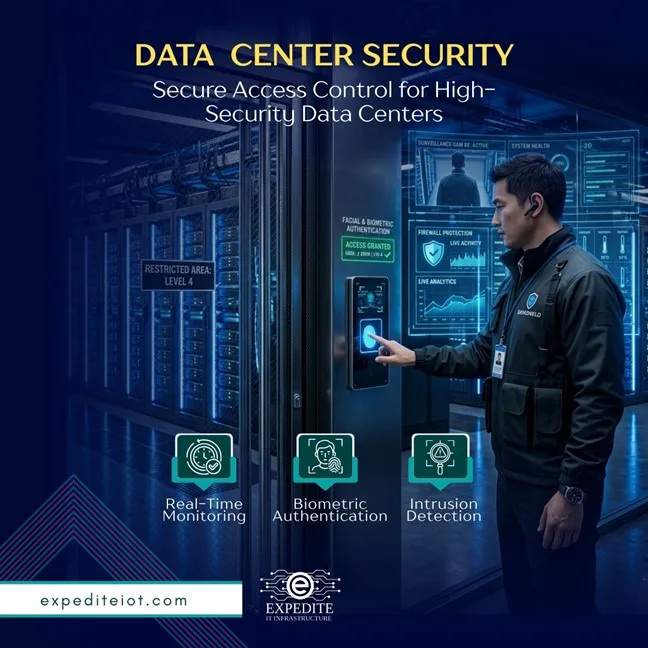

Data Center Security in Kuwait has become a mission-critical priority as the country accelerates its digital transformation agenda under Kuwait Vision 2035. With rapidly expanding cloud infrastructure, government digitization initiatives, and growing enterprise IT investments, organizations across Kuwait must adopt robust, layered Data Center Security Solutions to protect their most valuable digital assets from evolving cyber and physical threats.
This authoritative guide — designed for IT directors, facility managers, compliance officers, and security architects operating in Kuwait — examines every critical dimension of modern data center protection: from physical perimeter controls and advanced surveillance to intelligent intrusion detection, network firewalls, and enterprise-grade encryption. Whether you manage a Tier III co-location facility in Kuwait City or an on-premise server room for a government ministry, this resource equips you with the knowledge to build a comprehensive, future-proof security posture.
1. The State of Data Center Security in Kuwait
Kuwait’s digital economy is growing at an accelerated pace. The Communications and Information Technology Regulatory Authority (CITRA) has made significant strides in establishing a regulatory framework for data governance and cybersecurity. However, this rapid expansion introduces equally rapid growth in threat vectors — both cyber and physical.
Organizations managing Data Center Security Kuwait operations today face a multi-dimensional threat landscape that includes unauthorized physical access, insider threats, advanced persistent threats (APTs), ransomware, DDoS attacks, and compliance-related risks. A single breach can cost an organization millions of Kuwaiti Dinars in regulatory fines, reputational damage, and business continuity losses.
The Kuwait National Cybersecurity Strategy emphasizes the protection of critical information infrastructure — and data centers sit at the very heart of this mandate. Enterprises, telecom providers, banking institutions, and government agencies in Kuwait are now expected to implement internationally recognized security frameworks such as ISO/IEC 27001, NIST SP 800–53, and PCI DSS, all of which place data center physical and logical security at the forefront.
Why Kuwait Businesses Are Prioritizing Data Center Investment
• Vision 2035 digitalization mandating cloud-first government services
• Rising adoption of IoT, AI, and edge computing across industrial sectors
• Growing financial services sector with strict CBKW data residency requirements
• Expanding co-location market attracting regional and international enterprises
• Increased geopolitical cyber-risk across the GCC requiring resilient infrastructure protection
2. Physical Data Center Access Control: The First Line of Defense
Data Center Access Control refers to the policies, technologies, and procedures that regulate who can enter physical data center facilities and when. Physical breaches remain one of the most underestimated threat vectors — and in Kuwait’s mixed-use commercial and government environments, access control is foundational.
A multi-layered access control architecture for data centers in Kuwait should include the following components:
Multi-Factor Authentication (MFA) at Entry Points
Modern facilities must enforce MFA using a combination of credentials — such as smart cards, biometric scanners (fingerprint or iris recognition), and PIN-based keypads — at every access point. Single-factor badge systems are no longer sufficient for Tier III and Tier IV data centers operating in compliance-sensitive environments.
Role-Based Access Control (RBAC)
Kuwait’s enterprise data centers should implement RBAC policies that grant personnel access only to the zones they require for their specific operational roles. A network engineer does not need access to a power distribution room; a facilities technician does not need access to server cages. Principle of least privilege should govern every access decision.
Mantrap and Airlock Vestibule Systems
For high-security zones such as primary server halls and storage vaults, mantrap systems — interlocked dual-door chambers that allow only one person to pass at a time after authentication — provide a critical physical anti-tailgating control. These are standard practice in leading Kuwaiti banking and government data centers.
Visitor and Contractor Management
All non-permanent personnel must be registered, badged, escorted, and logged in real time. Digital visitor management systems integrated with access control platforms provide an auditable chain of custody for every individual entering the facility.
3. Data Center Surveillance: Eyes on Every Corner
Data Center Surveillance systems provide continuous visual monitoring of all physical spaces — from server aisles and loading docks to parking areas and mechanical rooms. For Kuwait data centers, a surveillance architecture must be both comprehensive and intelligent.
IP-Based Closed-Circuit Television (CCTV)
High-definition IP cameras deployed across all critical zones — including server rooms, cage corridors, entry/exit points, and raised-floor spaces — provide the visual audit trail necessary for incident investigation and compliance reporting. Cameras should be rated for the thermal conditions found in active data center environments (often 15–27°C ambient).
AI-Powered Video Analytics
Next-generation surveillance platforms deployed in Kuwait’s advanced data centers use artificial intelligence and machine learning to analyze live video feeds in real time. These systems can automatically detect:
• Unauthorized personnel loitering in restricted zones
• Tailgating and piggybacking attempts at secured doors
• Unattended bags or equipment left in sensitive areas
• Personnel without visible badges or identification
• Unusual activity during non-business hours
Retention and Secure Storage of Footage
Surveillance footage in Kuwaiti facilities must be retained for a minimum period (often 90 days, per regulatory guidance) and stored in tamper-proof, encrypted storage systems. Access to footage must itself be access-controlled and audited.
4. Data Center Threat Detection: Identifying Risks Before They Escalate
Data Center Threat Detection encompasses both environmental monitoring and cybersecurity-oriented behavioural analytics. A holistic threat detection strategy integrates physical sensor networks with logical security information and event management (SIEM) platforms.
Environmental Threat Sensors
Kuwait’s hot and humid climate creates unique environmental risks for data centers. Comprehensive sensor networks should continuously monitor:
• Temperature and humidity: Rack-level sensors detecting hot spots before equipment failure
• Smoke and fire detection: VESDA (Very Early Smoke Detection Apparatus) systems for pre-combustion alerting
• Water/leak detection: Under-floor sensors in cooling and plumbing zones
• Power quality monitoring: Detecting voltage anomalies that signal UPS or generator issues
Behavioural and Anomaly Detection
Integrating physical access logs, badge data, and video analytics into a unified security operations platform enables behavioural anomaly detection. When an employee accesses a zone, they have never visited at 2 AM, the system flags the anomaly for review — combining physical and logical intelligence for true holistic protection.
Security Operations Center (SOC) Integration
Leading Kuwaiti organizations are moving toward 24/7 Security Operations Center models where physical and cyber threat intelligence is correlated in a single dashboard. This converged approach dramatically reduces mean time to detect (MTTD) and mean time to respond (MTTR) to incidents.
5. Data Center Intrusion Detection: Defending the Perimeter and Beyond
Data Center Intrusion Detection operates at both the physical and network layers, and a mature Kuwait data center security program must address both dimensions simultaneously.
Physical Intrusion Detection Systems (PIDS)
Perimeter intrusion detection for data centers in Kuwait includes:
• Passive infrared (PIR) motion sensors in server halls and corridors
• Glass break detectors and door/window contact sensors
• Vibration sensors on raised floors and wall panels
• Microwave and dual-technology perimeter sensors for outdoor facilities
• Fiber-optic perimeter fencing with tension and cut detection
Network Intrusion Detection Systems (NIDS)
On the cyber side, Network Intrusion Detection Systems continuously analyze traffic flowing in and out of the data center fabric. Signature-based detection identifies known attack patterns such as port scans, SQL injection attempts, and brute-force login sequences. Anomaly-based detection identifies deviations from established traffic baselines — essential for catching zero-day exploits and insider data exfiltration.
Intrusion Prevention Systems (IPS)
While IDS systems alert on threats, Intrusion Prevention Systems go further by automatically blocking or quarantining malicious traffic in real time — a critical capability for data centers supporting mission-critical Kuwaiti government and financial services workloads.
6. Data Center Firewalls: Building Logical Walls Around Critical Assets
Data Center Firewalls are the cornerstone of network-layer security. In modern Kuwaiti data centers — particularly those supporting multi-tenant co-location or hybrid cloud environments — firewall architectures have evolved well beyond traditional perimeter models.
Next-Generation Firewalls (NGFW)
NGFWs provide deep packet inspection (DPI), application-layer visibility, SSL/TLS inspection, and integrated threat intelligence feeds. For Kuwait enterprises, NGFWs deployed at the data center edge can enforce granular policies based on user identity, application type, and risk score — far beyond simple IP and port filtering.
Micro-Segmentation and Zero Trust Architecture
The Zero Trust security model — “never trust, always verify” — is gaining significant adoption among Kuwait’s banking sector and government agencies. In a data center context, micro-segmentation creates isolated network zones for different workload types (PCI DSS environments, development servers, backup systems), ensuring that a breach in one segment cannot propagate laterally to another.
Web Application Firewalls (WAF)
For data centers hosting public-facing applications and APIs, Web Application Firewalls provide targeted protection against OWASP Top 10 vulnerabilities including SQL injection, cross-site scripting (XSS), and CSRF attacks — categories responsible for the majority of application-layer breaches targeting Kuwait’s e-government and banking platforms.
7. Data Center Encryption: Making Stolen Data Worthless
Data Center Encryption ensures that even if physical or logical security controls fail and data is exfiltrated, the stolen information remains cryptographically unreadable without the appropriate decryption keys. In Kuwait’s regulatory environment — particularly under CITRA guidelines and Central Bank of Kuwait (CBK) directives — encryption is not optional; it is mandated.
Encryption at Rest
All sensitive data stored on physical drives, SAN/NAS arrays, and backup tapes must be encrypted using AES-256 or equivalent standards. Hardware Security Modules (HSMs) provide tamper-resistant key management and should be standard in any Tier III+ Kuwaiti data center handling financial, health, or government data.
Encryption in Transit
Data traversing internal data center networks, inter-facility replication links, and external connections must be protected using TLS 1.3, MACsec for LAN encryption, or IPsec for site-to-site VPN tunnels. Man-in-the-middle attacks targeting unencrypted inter-rack communication are an underappreciated risk in multi-tenant co-location environments.
Key Management and Lifecycle Governance
Encryption is only as strong as the key management behind it. Kuwait data centers must implement formal cryptographic key management policies covering key generation, rotation schedules, storage (preferably in HSMs), access controls, and secure disposal — aligned with NIST SP 800–57 guidance.
8. Integrated Data Center Solutions for Kuwait: A Unified Approach
Data Center Solutions that address security in isolation — a camera system here, a firewall there — no longer meet the demands of Kuwait’s complex digital infrastructure. Organizations leading in security maturity are adopting converged, platform-based approaches that unify physical security, network security, and operational intelligence.
Physical Security Information Management (PSIM)
PSIM platforms aggregate data from access control, CCTV, environmental monitoring, intrusion detection, and fire systems into a single operational view. For Kuwait data centers with distributed sites (primary facility, disaster recovery site, and edge nodes), PSIM provides consolidated situational awareness.
Security Information and Event Management (SIEM)
SIEM platforms collect, correlate, and analyze log data from firewalls, intrusion detection systems, servers, storage devices, and network infrastructure. Properly tuned SIEM systems dramatically reduce alert fatigue while surfacing the highest-priority threats for human review.
Disaster Recovery and Business Continuity Planning
No security program is complete without a tested disaster recovery (DR) plan. Kuwait data centers must maintain documented and regularly exercised DR playbooks that address ransomware recovery, physical breach scenarios, fire suppression events, and power outage scenarios — with defined recovery time objectives (RTOs) and recovery point objectives (RPOs) for every critical workload.
Compliance and Audit Readiness
Kuwait data centers serving regulated industries must maintain continuous compliance with applicable frameworks. Expedite IoT’s Data Center Perimeter Security Solutions are engineered to support ISO 27001, PCI DSS, SOC 2 Type II, and local CITRA regulatory requirements — providing the audit trails, access logs, and documentation necessary for successful compliance reviews.
9. Choosing the Right Data Center Security Partner in Kuwait
Selecting a security technology partner for your Kuwait data center requires rigorous evaluation across several dimensions:
• Regional Expertise: Does the provider understand Kuwait’s regulatory environment, climate challenges, and local threat landscape?
• Integration Capability: Can their solutions interoperate with your existing IT infrastructure, SCADA systems, and building management systems?
• Scalability: Can the platform scale as your data center footprint grows from a single site to a distributed multi-site architecture?
• Support and SLA: Is 24/7 local support available with defined response time commitments?
• Proven Track Record: Do they have documented deployments in GCC data center environments with verifiable case studies?
Expedite IoT brings deep GCC expertise in delivering end-to-end data center perimeter and interior security solutions — integrating access control, surveillance, intrusion detection, and network security into cohesive, compliance-ready platforms for Kuwait and the broader Middle East region.
10. Building a Security Vocabulary for Kuwait’s Data Centers
To aid security architects and compliance professionals in building comprehensive programs, the following complementary concepts are essential within the Kuwait data center security ecosystem:
• Perimeter Security: Outer fence lines, vehicle barriers, and anti-ram bollards protecting facility boundaries
• Co-location Security Standards: Third-party audit requirements for shared data center environments
• Physical Security Convergence: Unifying IT and physical security under a single governance framework
• Biometric Authentication: Fingerprint, iris, and facial recognition for high-assurance access control
• Critical Infrastructure Protection (CIP): National frameworks governing the security of essential services
• Cloud Security Posture Management (CSPM): Continuous compliance monitoring for hybrid cloud workloads
• Network Access Control (NAC): Policy enforcement for devices connecting to the data center network fabric
• Security Baseline Configuration: Hardened server and network device configurations reducing attack surface
Conclusion
Kuwait’s digital transformation is accelerating — and with it, the stakes for Data Center Security have never been higher. Organizations operating data center infrastructure in Kuwait must adopt a holistic, layered security strategy that encompasses robust Data Center Access Control, intelligent Data Center Surveillance, proactive Data Center Threat Detection, physical and logical Data Center Intrusion Detection, enterprise-grade Data Center Firewalls, and comprehensive Data Center Encryption.
The most effective Data Center Solutions are those that converge physical and cyber security into unified platforms — providing not only real-time protection but also the audit-ready documentation that Kuwait’s regulatory environment demands. As the region’s threat landscape continues to evolve, the organizations that invest in mature, integrated security architectures today will be best positioned to protect their critical digital infrastructure tomorrow.
FAQs
FAQ 1: What are the most critical components of Data Center Security in Kuwait?
The most critical components include multi-layer Data Center Access Control (biometrics, RBAC, mantrap systems), comprehensive Data Center Surveillance with AI-powered analytics, physical and network Data Center Intrusion Detection, next-generation Data Center Firewalls with micro-segmentation, and end-to-end Data Center Encryption at rest and in transit. These layers work together to create a defense-in-depth posture aligned with Kuwait regulatory requirements.
FAQ 2: How does Data Center Threat Detection differ from Intrusion Detection?
While Data Center Threat Detection is a broader discipline encompassing environmental sensors, behavioural analytics, SIEM correlation, and SOC monitoring — Data Center Intrusion Detection is a specific subset focused on identifying unauthorized physical or network-layer access attempts. Both are essential and complementary; intrusion detection feeds data into the broader threat detection and response ecosystem.
FAQ 3: Is Data Center Encryption mandatory for Kuwait businesses?
Yes. For organizations operating in regulated sectors — banking (CBK), government (CITRA), telecommunications, and healthcare — Data Center Encryption is effectively mandated through applicable regulatory frameworks and international compliance standards. AES-256 encryption for data at rest and TLS 1.3 for data in transit are the accepted minimum standards for Kuwait’s critical information infrastructure.
FAQ 4: How should Kuwait organizations approach Data Center Access Control for third-party vendors?
Third-party vendors and contractors should be managed through a formal Vendor Access Management program that includes background verification, just-in-time access provisioning (access granted only for the duration of approved work), mandatory escort by authorized personnel in high-security zones, real-time digital visitor logging, and post-visit access revocation. This is a critical control for preventing supply-chain based physical breaches — a growing threat vector in GCC data center environments.
FAQ 5: What makes Expedite IoT’s approach to Data Center Security Kuwait-specific?
Expedite IoT’s Data Center Solutions are engineered for the unique demands of the GCC region — including Kuwait’s regulatory landscape (CITRA, CBK), extreme climate considerations affecting hardware and sensor deployment, Arabic/English bilingual security operations requirements, and the region’s specific threat intelligence profile. With proven deployments across the Middle East, Expedite IoT provides end-to-end security architecture, integration, implementation, and ongoing managed security services tailored to Kuwait’s critical infrastructure protection mandate.
For more information contact us on:
Expedite IT
+966 502104086































Sign in to leave a comment.