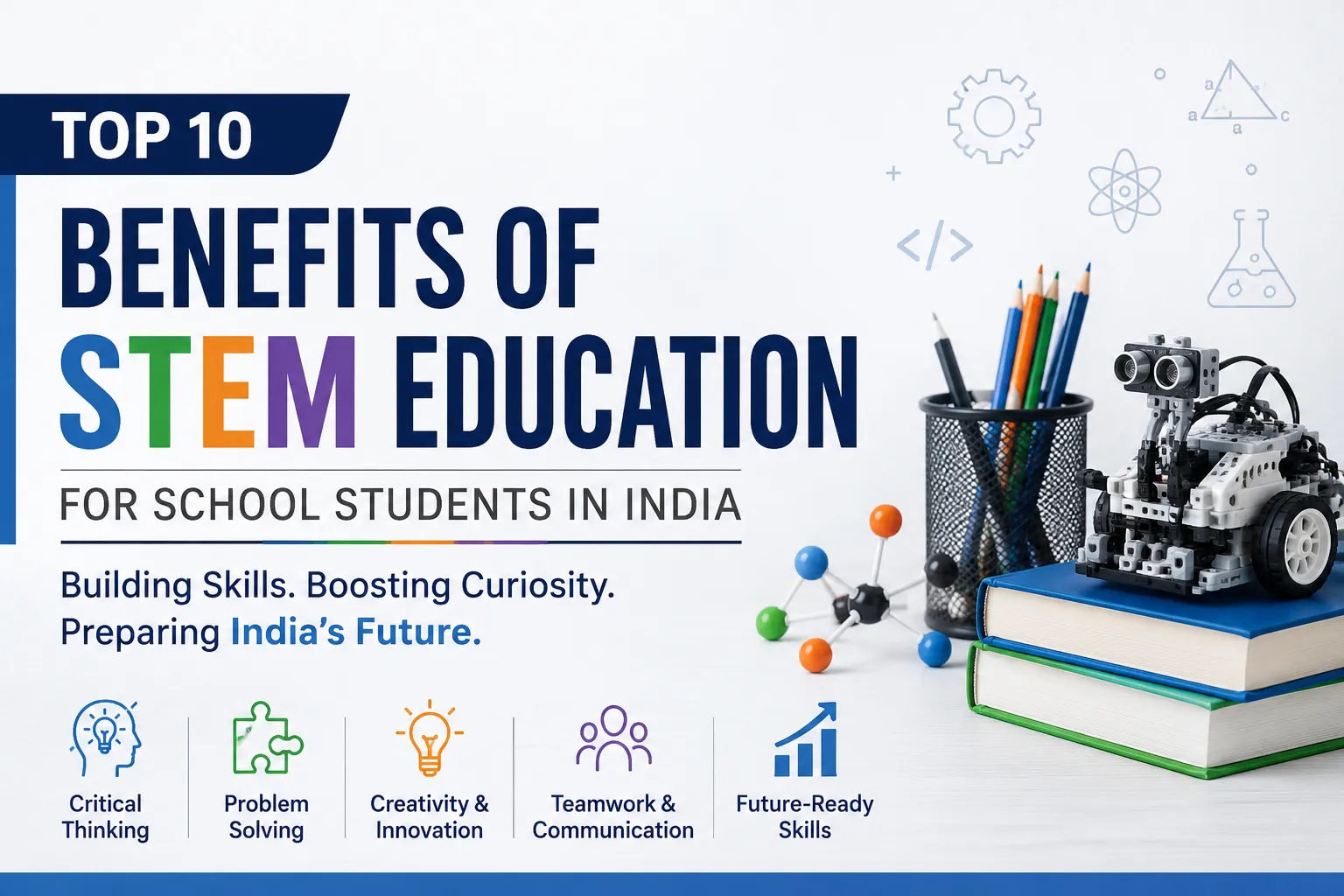

Introduction: Why India's Schools Cannot Afford to Ignore STEM Anymore
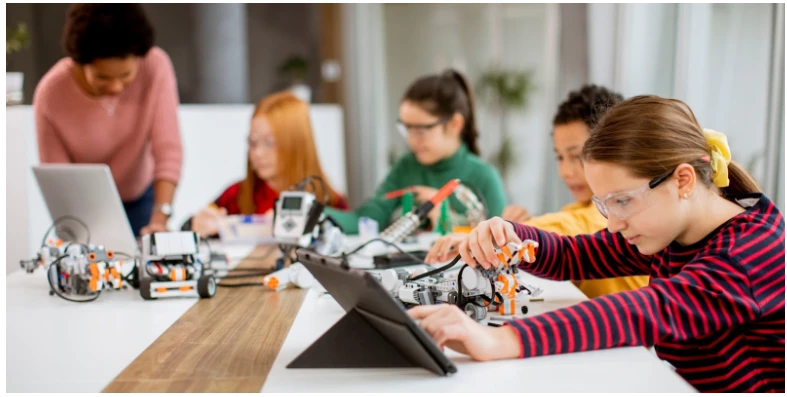
Walk into a well-equipped school in Bangalore or Pune today, and you will likely find students building circuits, coding robots, or designing small working machines, not sitting in rows copying notes from a blackboard. That shift is not accidental. It is the result of a growing recognition across India that the benefits of STEM education in India go far beyond scoring well in science and math exams.
Parents can see this. Principals in schools talk about this issue too. But what really makes it official is NEP 2020 from the government, which has stated that coding and computational skills should be taught to children in India from the very beginning.
But what exactly does STEM education do for a child? Not in theory, but in practice, in a real classroom, with real students? That is exactly what this blog is going to answer. Here are ten genuine, research-backed benefits of STEM learning that every Indian parent and school leader should understand before making decisions about their children's education.
Benefit 1: It Builds Critical Thinking That Goes Beyond the Classroom
The first and foremost impact of quality education in STEM subjects has been identified to be the development of critical thinking among students. It is not an educational fad at all.
It is evident from the research studies conducted in peer-reviewed journals that learners engaged in STEM projects tend to become better analyzers compared to learners using conventional methods of learning. In the instance where a child is told to create a model, as opposed to being made to learn about its operation, they are forced to think. It is because they will have to pose queries, experiment, make corrections, and analyze results.
For an Indian education system where rote learning was more valued than reasoning, this is truly revolutionary. When a student develops critical thinking skills during class five, they tackle any future challenge in a completely different manner. The student no longer looks for an answer from an external source but works towards finding the solution themselves.
Benefit 2: It Develops Real Problem-Solving Ability
There is a difference between solving a textbook problem and solving a real problem. Textbook problems have known answers at the back of the book. Real problems do not.
Education in STEM areas will always present a situation for the learner in which there is no guaranteed solution. For example, the learner can be asked to construct a structure that has the highest load-carrying capacity given limited resources. Or program a robot that would successfully traverse a maze. The learner has to identify the problem, brainstorm solutions, experiment, experience failure, learn, and repeat.
This iterative, hands-on process develops problem-solving muscles that stay with a child for life. And research backs this up. Design-based STEM learning approaches have been shown to improve problem-solving performance by up to 46 percent compared to traditional instruction methods.
It is especially important for India, where a large number of engineers have theoretical knowledge but fail at practical implementation, making it imperative that problem-solving be cultivated from an early age.
Benefit 3: It Makes Children Genuinely Curious - Not Just Compliant
One of the subtle but vital impacts that learning STEM subjects has on young people is its effect on their attitudes toward curiosity. The conventional approach to education usually involves conditioning children not to ask questions so that they can learn through listening and repeating.
When a child builds a circuit, and the bulb does not light up, the natural question is "why?" When their robot does not follow the expected path, they want to understand what went wrong. That spark of curiosity actively encouraged and rewarded in a STEM environment is one of the most valuable things a school can cultivate in a young mind.
Inquisitive minds turn into independent learners. They discover more than the subject entails. They search for information through Google outside the classroom. They conduct experiments during the weekend. They enter college and ultimately the working world with an attitude that always yearns for comprehension, which is precisely what India’s innovation economy requires.
Benefit 4: It Prepares Students for the Jobs That Will Actually Exist
Now, let’s speak in terms of figures. Jobs in STEM in India are expected to increase by as much as 30 to 40 percent in the coming decade, which is more than double the rate of other fields. According to WEF, 65 percent of the kids who are currently enrolling themselves into primary education will be working in jobs that do not even exist now.
There is a direct link between STEM education and career options, unlike any other type of academic stream. The child who learns robotics at the age of ten, programming at the age of twelve, and IoT at the age of fourteen will have practical knowledge when he joins college, which none of his classmates, who have studied everything theoretically, can possess. In engineering colleges and IT firms in Bangalore, Hyderabad, and Chennai, it is practical knowledge, not theoretical knowledge, that counts nowadays.
The investment in STEM education at the school level is, in a very real sense, an investment in career readiness made a decade before the career begins.
Benefit 5: It Builds Teamwork and Communication Alongside Technical Skills
What tends to be frequently forgotten when discussing STEM education is that STEM learning is typically never a solo pursuit. In most cases, students are involved in STEM in groups. They allocate tasks among themselves, discuss strategies for doing things, integrate their views, and then share the results collectively.
It means that STEM students learn not only technical skills but also skills in communication, leadership, and teamwork. They learn to articulate their ideas to other people. They learn to accept another idea and consider it objectively. They learn to work toward a common objective.
These are exactly the qualities that employers across every industry consistently identify as lacking in fresh graduates, and STEM education builds them naturally, without a separate course in "soft skills."
Benefit 6: It Sparks Creativity in Ways That Surprise Most People
However, there is still a myth out there about the opposing nature of STEM and creativity; that is, that the sciences are only suitable for analytical people and the arts for those who think more creatively. However, studies have repeatedly disproved this myth.
STEM tasks involve imagining ideas that do not currently exist—imagining what can be created without ever existing. Looking at a familiar issue through a fresh and innovative perspective. It is how creativity is used systematically to accomplish a specific goal. Studies indicate significant improvements in creativity among students through STEM projects, especially STEAM projects.
In fact, some of the most creative industries in the world, product design, architecture, game development and film technology, sit precisely at the intersection of technical knowledge and creative thinking. STEM education builds the technical foundation. The creativity, it turns out, comes along for the ride.
Benefit 7: It Gives Students Confidence Through Achievement
There is something powerful that happens when a child builds something that actually works. A robot that moves. A code that runs. A model that solves the problem it was designed to solve. That moment of successful creation does something to a child's self-perception that no exam score can replicate.
Hands-on STEM learning in India is increasingly being recognized not just for its academic outcomes but for its impact on student confidence and self-belief. When children see that their ideas can become real things — that they can make something function through their own knowledge and effort, they begin to see themselves differently. They start to think of themselves as people who can figure things out.
That identity shift, "I am someone who can solve problems," is one of the most durable and valuable outcomes of quality STEM education. It travels with a student into every classroom, exam room, and workplace they enter for the rest of their lives.
Benefit 8: It Connects Classroom Learning to the Real World
One of the most common complaints students have about traditional education is that it feels disconnected from reality. "When will I ever use this?" is a question that follows algebra, chemistry, and physics through most of Indian schooling.
The answer to this question lies in STEM education itself. The moment students work on creating an example of a house automation model incorporating IoT, it becomes clear how electronics and programming relate to all these smart technologies surrounding us. Similarly, physics becomes meaningful in students' minds when they are required to make a construction capable of enduring a simulated earthquake. It is how robotics and artificial intelligence become relevant for students through education.
The practical link is not only more interesting for students but also more effective. When students comprehend the relevance of what they learn and actually apply it, the knowledge stays with them longer.
Benefit 9: It Aligns Perfectly With What India's National Education Policy Is Asking For
The National Education Policy 2020 is arguably the most significant reform in Indian education in decades. And its vision for STEM could not be more aligned with what progressive schools are already discovering on the ground.
STEM Education Requirements in NEP 2020 include coding and Robotic or computing teaching starting from grade 3, moving away from rote learning methods towards an inquiry-based and experiential mode of learning, and integrating technology, design thinking, and project work into all subject areas from the very basic level. The policy emphasizes the use of Atal Tinkering Laboratories and maker spaces as key components of schooling.
For example, while evaluating their curriculum approach vis-à-vis the NEP 2020, this exercise is more than just ticking off compliance-related boxes. It presents an opportunity for themselves to future-proof themselves and improve their students' performance.
Benefit 10: It Builds the Foundation for India's Innovation Future
It is perhaps the biggest benefit and the one that goes beyond any individual student.
India is the third-largest startup ecosystem in the world. It is a global leader in software services. It is rapidly expanding into semiconductors, space technology, electric vehicles, and artificial intelligence. Every single one of those sectors depends on a steady supply of people who understand science, technology, engineering, and mathematics at a deep, applicable level.
The importance of STEM education in India is not just about preparing individual students for individual careers. It is about building the collective human capital that will allow India to lead rather than follow in the global technology economy of the next thirty years.
The children sitting in school classrooms today are not passive observers of that future. With the right education starting now, starting early, starting with STEM, they are its builders.
Conclusion: The Time to Invest in STEM Is Right Now
Every benefit described in this blog, critical thinking, problem-solving confidence, creativity, career readiness, real-world relevance, compounds over time. A student who encounters quality STEM education at age eight arrives at age eighteen with ten years of capability-building behind them. A student who encounters it at age fifteen has far less time to close the gap.
The Indian schooling system, parents, and decision makers within the realm of education have become well aware of this truth. It is not even a matter of whether STEM education is important or not. It’s a matter of how fast we can bring about its implementation across all classrooms and not only the well-funded urban centers.
If you are looking for a trusted, experienced partner to bring genuine STEM education to your school or to enroll your child in a program that delivers real outcomes, STEM-Xpert has spent over seven years doing exactly that, with more than 50,000 students across India as living proof of what this kind of education can do.
FAQ
Q1. What are the top benefits of STEM education for school students in India?
STEM education helps students develop critical thinking, problem-solving, creativity, teamwork, and digital skills. It also prepares them for future careers in technology, AI, engineering, and robotics.
Q2. Why is STEM education important for Indian students in 2026?
STEM education is important because future careers in India are increasingly connected to AI, automation, engineering, and technology. Early STEM learning helps students build future-ready skills.
Q3. How does STEM education help children develop critical thinking skills?
STEM learning encourages students to analyze problems, test ideas, and find solutions through hands-on projects instead of memorizing answers.
Q4. What does NEP 2020 say about STEM education in Indian schools?
NEP 2020 promotes coding, computational thinking, experiential learning, and project-based education from early classes in Indian schools.
Q5. At what age should children start STEM education in India?
Children can begin basic STEM learning through play and activities from ages 5–6, while coding and robotics can start around ages 7–8.
Q6. How does hands-on STEM learning improve student performance in schools?
Hands-on STEM learning improves understanding by connecting theory with practical activities like coding, robotics, experiments, and model building.
Q7. What career opportunities does STEM education open up for students in India?
STEM education opens career opportunities in AI, robotics, software development, data science, cybersecurity, engineering, and many technology-driven industries.
Q8. How is robotics education beneficial for school students?
Robotics education helps students improve logical thinking, coding skills, creativity, teamwork, and real-world problem-solving through practical learning experiences.

























Sign in to leave a comment.