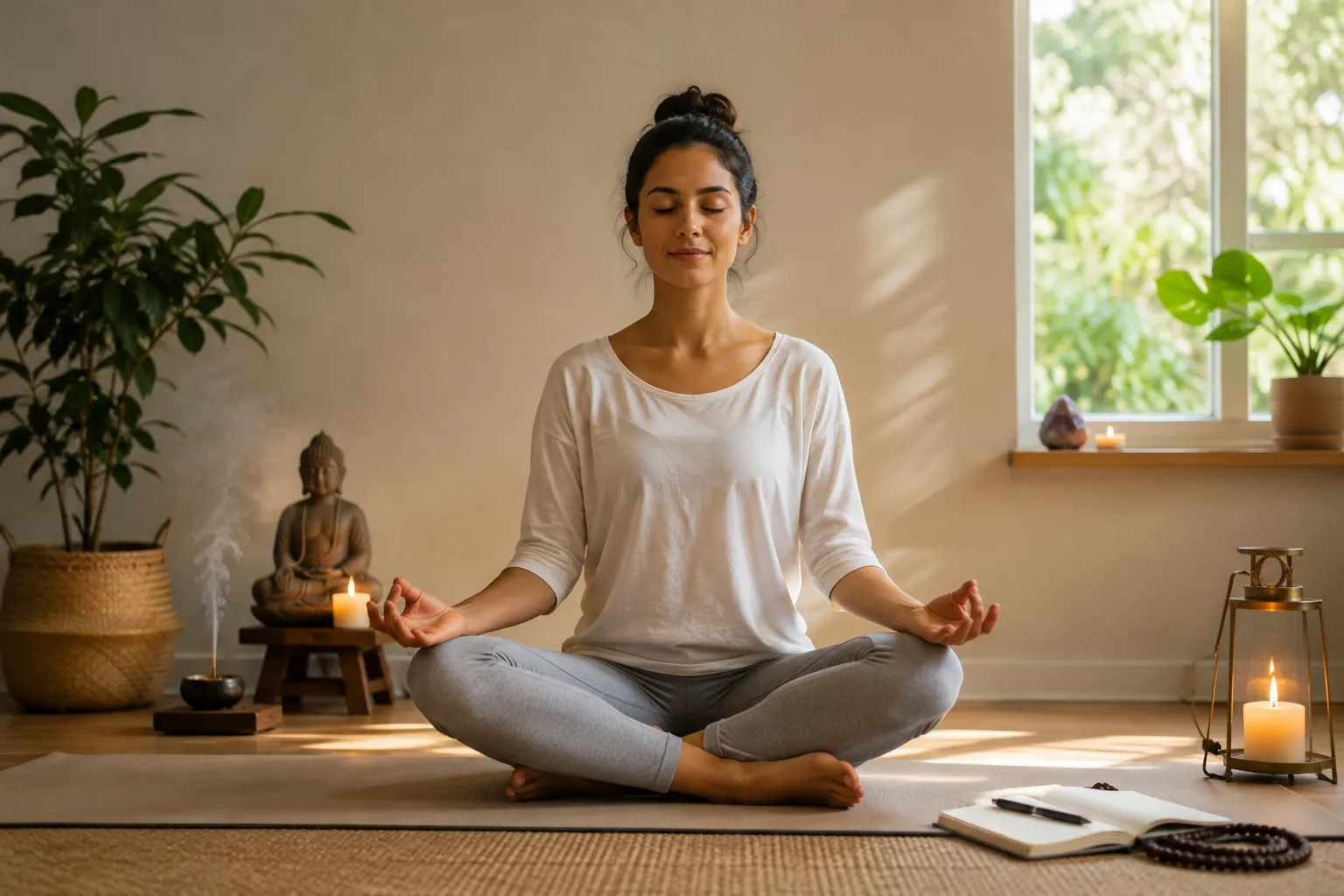

Mindfulness meditation can help you become more aware of your thoughts, emotions, body sensations, and surroundings without immediately reacting to them. By repeatedly bringing attention back to the present moment—often through the breath—you can reduce mental distraction and become more engaged with everyday experiences. Research suggests mindfulness practices may also support stress management, sleep quality, and emotional wellbeing.
What Does It Mean to Be Present?
Being present does not mean clearing your mind or never thinking about the past or future. It means noticing what is happening right now rather than automatically getting carried away by thoughts.
Think about having a conversation while mentally planning tomorrow's schedule. You may hear the other person speaking, but your attention is somewhere else. Mindfulness creates an opportunity to notice that distraction and gently return your attention to the conversation.
This simple skill can change how you experience ordinary moments.
Mindfulness involves:
- Paying attention to current experiences
- Noticing thoughts without immediately following them
- Recognizing emotions without judging yourself
- Becoming aware of physical sensations
- Returning attention when the mind wanders
The American Psychological Association describes mindfulness as awareness of internal states and surroundings, with an emphasis on observing experiences without automatically judging or reacting to them.
How Mindfulness Meditation Builds Present-Moment Awareness

A typical mindfulness meditation practice may look very simple. You sit comfortably, bring attention to your breathing, notice sensations as they arise, and return your attention when your mind wanders.
The important part is not whether your mind wanders. It will.
The practice happens when you notice the distraction and return.
For example:
- Sit comfortably and relax your shoulders.
- Notice the natural rhythm of your breathing.
- Feel the movement of your abdomen or chest.
- Notice thoughts when they appear.
- Avoid judging yourself for having them.
- Bring attention gently back to your breath.
Each return is an opportunity to practice attention.
Over time, this can make it easier to recognize when your attention has drifted during work, conversations, meals, exercise, or other daily activities.
The Connection Between Mindfulness and Mental Clarity
A busy mind can make even quiet moments feel crowded. You may replay an uncomfortable conversation, worry about tomorrow, or move from one task to another without fully experiencing any of them.
Mindfulness does not promise to eliminate these thoughts. Instead, it changes your relationship with them.
Rather than automatically treating every thought as something that needs immediate attention, you learn to observe it.
This can create a useful pause between having a thought and reacting to it.
That pause may help you:
- Recognize emotional reactions earlier
- Concentrate more deliberately on one activity
- Respond instead of reacting automatically
- Notice physical signs of tension
- Approach difficult thoughts with greater awareness
Research on mindfulness is encouraging, although results vary by practice, person, and outcome. Evidence reviewed by the National Center for Complementary and Integrative Health suggests mindfulness meditation may help with stress, anxiety, depression symptoms, and sleep quality.
Mindfulness Can Make Ordinary Activities Feel Different
You do not have to spend an hour meditating to practice being present.
Everyday activities can become opportunities for mindful awareness.
Try mindful eating
Instead of eating while scrolling through your phone, notice the food's smell, texture, temperature, and flavor. Pay attention to your chewing and your body's signals.
Practice mindful walking
During a walk, notice your feet touching the ground, the movement of your legs, your breathing, and sounds around you.
Be present during conversations
Put distractions aside and listen without planning your response while the other person is still speaking.
Take mindful pauses
Before moving from one task to another, stop for three slow breaths. Notice how your body feels and what is occupying your mind.
These small practices can make mindfulness feel practical rather than like another item on a busy schedule.
A Simple 5-Minute Mindfulness Meditation
If you are new to meditation, start small.
Minute 1: Settle
Sit comfortably. Allow your body to become still without forcing a particular posture.
Minutes 2–3: Follow the breath
Notice inhalation and exhalation. You do not need to change your breathing.
Minute 4: Observe
Notice sounds, sensations, thoughts, or emotions. Let them come and go without chasing them.
Minute 5: Return
Bring your attention back to your breath and gradually become aware of the room around you.
You may find that five minutes feels more sustainable than immediately committing to a long daily practice.
From Personal Practice to Teaching Mindfulness
For someone who wants to move beyond personal practice, structured education can provide a deeper understanding of meditation methods, teaching skills, sequencing, breath awareness, and how to guide others safely.
Those interested in developing professional teaching skills can explore an online meditation teacher training by Arhanta Yoga to learn how meditation can be approached as a structured practice rather than simply a relaxation exercise.
How Long Does It Take to Feel More Present?
There is no fixed timeline.
Some people notice greater awareness during their first few sessions, while meaningful changes in attention and daily habits usually require consistent practice. The goal should not be to measure whether you are becoming “perfectly mindful.”
Instead, look for practical changes:
- You notice distractions sooner.
- You listen more carefully.
- You recognize stress before it builds.
- You catch automatic reactions.
- You return to the present more easily.
Consistency matters more than trying to achieve a particular meditation experience.
What If Your Mind Keeps Wandering?
This is one of the most common concerns among beginners.
A wandering mind does not mean you are bad at meditation. Thinking is part of being human. The practice is learning to notice where your attention has gone and return without unnecessary frustration.
Instead of saying, “I can't meditate because I keep thinking,” try asking, “Can I notice the thought and come back?”
That shift makes the practice much more approachable.
Mindfulness, Stress, and Everyday Life
Modern life provides endless opportunities for divided attention. Notifications, deadlines, family responsibilities, work, social media, and constant information can keep the mind moving from one subject to another.
Mindfulness offers a deliberate counterbalance.
It gives you time to notice what is happening before immediately moving toward the next task. Research from NCCIH notes that mindfulness practices may help reduce symptoms associated with stress and may improve sleep, although evidence differs across specific conditions and meditation approaches.
For someone dealing with persistent mental health symptoms, meditation should not be treated as a replacement for professional care.
Final Thoughts
Feeling present is less about controlling every thought and more about noticing where your attention is going. Mindfulness meditation gives you a practical way to practice that skill.
Start with a few quiet minutes. Follow your breath. Notice when your mind wanders. Come back.
Then take that same awareness into ordinary moments, your morning coffee, a conversation, a walk, a meal, or a few breaths before starting work. With regular practice, being present can become less of something you remember to do and more of a way you experience your day.
Frequently Asked Questions
1. What is mindfulness meditation?
Mindfulness meditation is a practice of intentionally paying attention to present-moment experiences, such as breathing, sensations, thoughts, or sounds, while observing them without immediate judgment or reaction.
2. Can mindfulness meditation help me feel more present?
Yes. Its central purpose is to train present-moment awareness. When your attention wanders, repeatedly bringing it back to the breath or another chosen focus provides practice in returning to what is happening now.
3. How long should beginners meditate?
There is no universal requirement. Starting with five minutes can be practical for beginners. Once the practice becomes comfortable, you can gradually increase the duration according to your needs and schedule.
4. What should I do when my mind wanders?
Notice that your attention has wandered, acknowledge the thought without criticizing yourself, and gently return your attention to your breath or chosen meditation object.
5. Can mindfulness help with stress?
Research suggests mindfulness-based practices may help reduce perceived stress and symptoms of anxiety and depression for some people. Results vary, so mindfulness should be viewed as one possible tool rather than a guaranteed treatment.
6. Can I practice mindfulness without sitting meditation?
Yes. Mindfulness can be practiced while walking, eating, listening, working, or performing everyday activities. The key is intentionally bringing awareness to the experience happening in the present.
7. Is mindfulness meditation suitable for everyone?
Meditation is generally considered to have few risks, but some people experience uncomfortable effects, including increased anxiety or low mood. If meditation causes significant distress, stop the practice and consider discussing it with an appropriate healthcare professional.


























Sign in to leave a comment.