

Healthcare organizations are sitting on mountains of data - but most of it is stuck. EHRs, lab systems, billing tools, and pharmacy records each hold their own version of the truth, and none of them talk to each other reliably. The result? Physicians treat patients without the full picture. Operations teams work from numbers that are already hours old. Finance departments reconcile reports that don't match the clinical record.
The cost is real. Studies point to duplicate patient records in 8 to 14 percent of hospital systems, direct links between data gaps and medical errors, and billions lost each year to poor data quality. Here's a quick look at what healthcare teams are dealing with every day:
- Scattered patient records across disconnected systems
- Decisions made without complete or current information
- Duplicate records inflate costs and risk care quality
- HIPAA compliance gaps from poor access controls
- Reports that take hours instead of seconds
- Legacy systems too critical to replace, too outdated to scale
In this article, we'll walk through how Snowflake helps healthcare organizations tackle these challenges head-on, from unifying fragmented data to enabling real-time decisions.
How Snowflake Solves Healthcare's Data Problem
Snowflake brings together everything a healthcare organization needs in one governed, scalable platform. Whether the challenge is data fragmentation, poor quality, security, slow analytics, or risky modernization, there's a practical path forward. Let's break down each one.
Data Fragmentation and Its Impact
Every system in a hospital was built to do one job well. The EHR captures clinical notes. The lab platform holds test results. Billing software tracks revenue. Each does its job. None were designed to share data with the others in a reliable, real-time way.
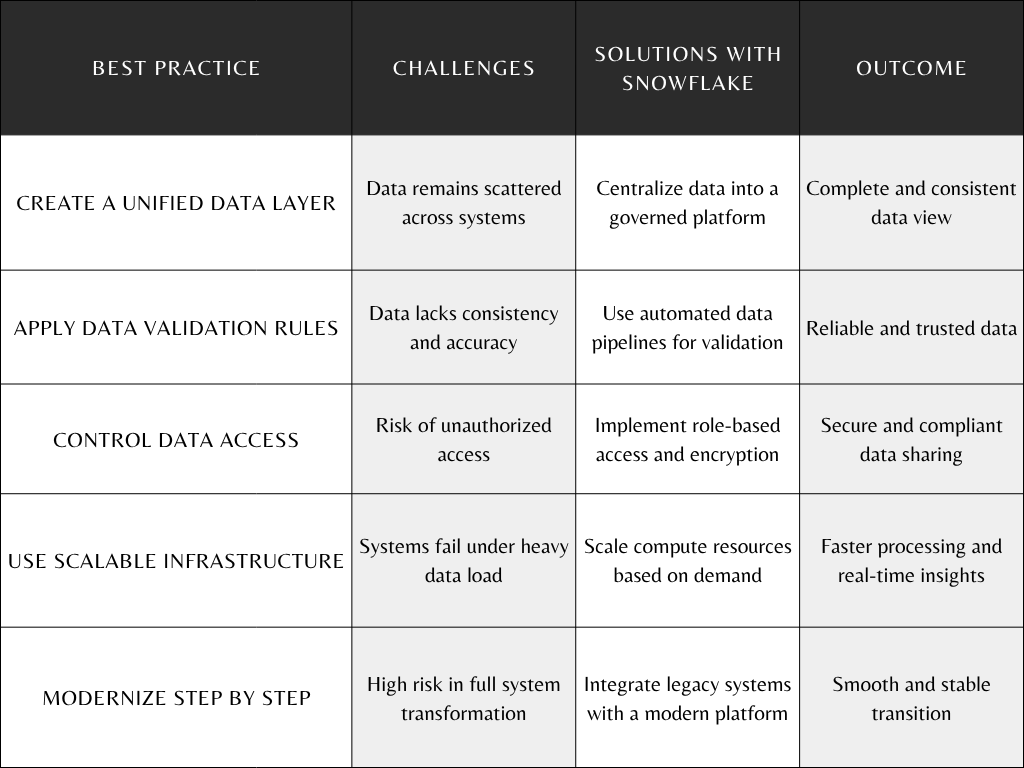
Snowflake addresses this with a unified data layer. Structured data, like patient demographics, and semi-structured data, like HL7 FHIR messages, can coexist in one governed environment. Doctors see a complete record. Operations teams get a single source of truth. Coordination across departments becomes practical rather than a goal that never quite gets reached.
Complete Patient View: Clinicians see a full record, not just what one system holds.
Faster Access: Data retrieval that once took hours is reduced to seconds.
Department Coordination: Finance, clinical, and operations teams work from the same data.
Data Quality and Trust
Inconsistent data does not just slow things down. It breaks trust. When a physician sees conflicting medication lists or a missing lab value, the default response is to stop relying on the system and start cross-checking by hand. That consumes time and introduces its own errors.
With Snowflake, data moves through controlled pipelines where rules are applied at the point of entry. Duplicates get flagged. Formats get standardized. Conflicts get resolved before they reach a clinician or analyst. What arrives on screen is clean, validated, and reliable.
Clean Datasets: Automated validation at entry removes duplicates and enforces standards.
Reliable Reports: Executives and compliance teams work from data they can trust.
Better Decisions: Accurate data gives clinicians the confidence to act without hesitation.
Secure Data Collaboration
Healthcare data must stay protected, and it must also move. Payers need clinical data to process claims. Researchers need records to advance treatments. Public health teams need aggregate data to track outbreaks. The traditional answer was complex point-to-point integrations or slow batch file transfers. Neither worked well at scale.
Snowflake enables secure data collaboration without physical data movement. Access is granted at the account level. Every event is logged. Permissions can be revoked at any moment. A hospital network can share anonymized outcome data with a research institution without a file transfer or a new integration project.
HIPAA-Ready Controls: Role-based access, encryption, and full audit logs protect patient data end to end.
Faster Research: De-identified data reaches researchers sooner, which shortens the path from data to discovery.
Network Collaboration: Providers, payers, and public health teams share data without duplication or delay.
Real-Time Analytics
Healthcare decisions depend on time. A sepsis alert that arrives an hour late is not useful. A bed capacity report from yesterday does not help a patient who needs a room today. Traditional data warehouses were built for overnight batch jobs, not live operational needs.
Cloud-native platforms like Snowflake separate compute from storage. Resources scale up when demand rises and fall back when it eases. There is no hardware to provision, and no IT approval is needed to handle a surge. The result is consistent performance whether the query runs at 2 am or in the middle of peak hours.
Operational Visibility: Leadership sees bed availability, staffing, and throughput data in real time.
Critical Response: Alerts for sepsis or patient deterioration reach the right person within seconds.
Scalable Performance: Query speed holds steady as data volumes grow. Compute expands to meet demand.
Modernization Without Risk
The systems that need modernization most are often the ones an organization depends on completely. A failed migration can disrupt care delivery for days. That risk is why so many healthcare IT modernization projects stall before they start.
The better path is gradual. Snowflake connects to legacy infrastructure through ETL pipelines without forcing those systems to change. Over time, the platform absorbs more of the analytical workload. Legacy systems phase out on a schedule the organization controls, not one forced by a single risky cutover.
Phased Migration: Legacy systems stay live while modern infrastructure is built alongside them.
Lower Risk: Each phase is validated before the next begins. No single point of failure.
Continuous Improvement: New capabilities are added to the platform without downtime or full redeployment.
Best Practices with Platform-Driven Solutions
Conclusion
Healthcare data challenges connect with each other. Fragmentation leads to poor quality. Poor quality reduces trust. Lack of trust slows decisions. Platforms like Snowflake address these challenges at the core. hire snowflake developers for better results, who know how to solve the problem. They unify data, improve reliability, secure access, and support timely insights. This shift helps healthcare organizations move toward better decisions, stronger operations, and improved patient outcomes









Sign in to leave a comment.