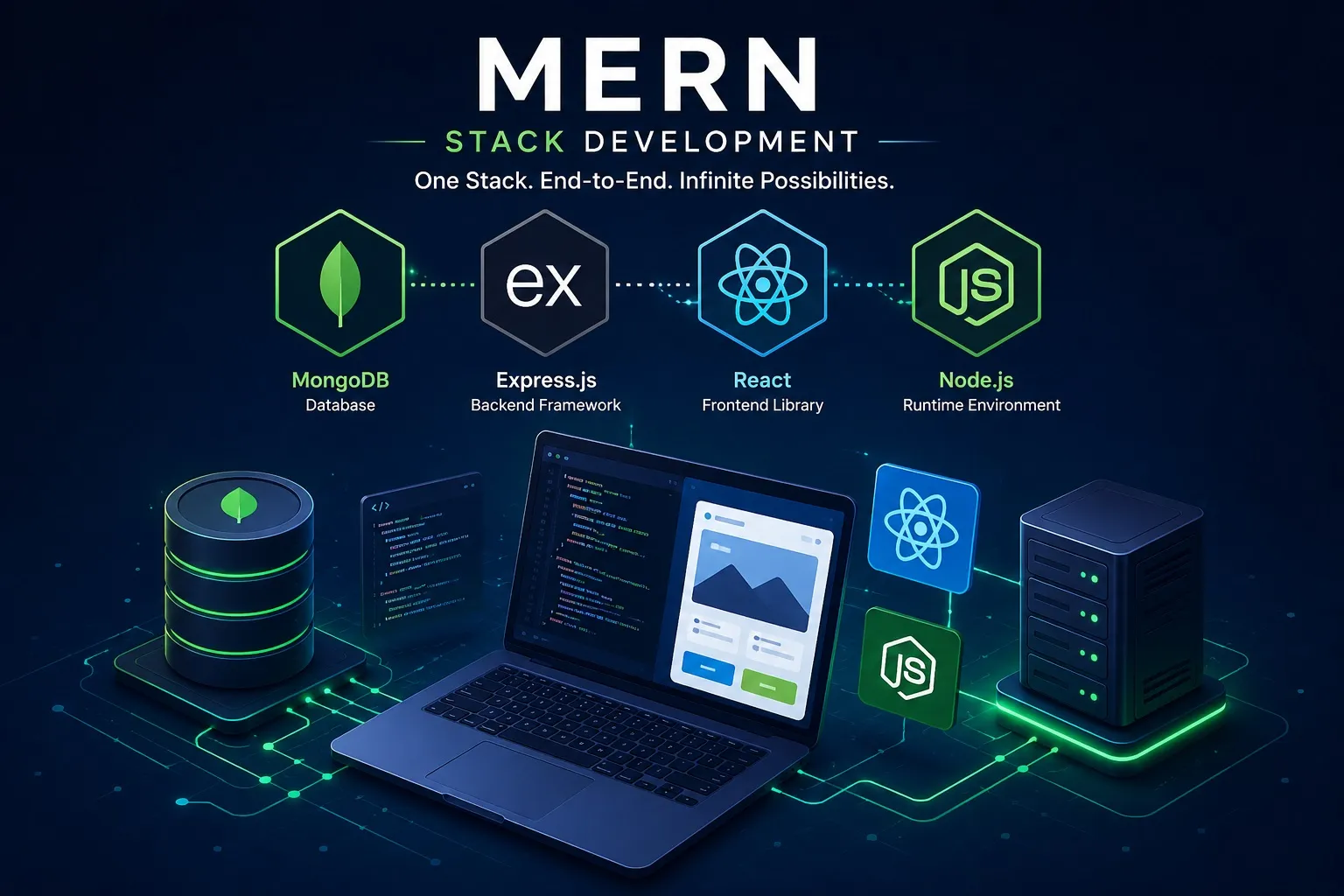

Ninety percent. That’s roughly how much of the backend web now runs on Node.js, according to recent developer surveys. Pair that with React sitting near the top of every frontend framework ranking — usage estimates run anywhere from 45% to a startling 83.6% depending on how you slice the data — and you get a JavaScript stack enterprises can no longer file under “good enough for startups.” The MERN stack for enterprise applications has quietly become a serious contender for the systems banks, logistics firms, and healthcare platforms run every single day.
Here’s the thing most CTOs miss: MERN didn’t get enterprise-ready by accident. It got there because MongoDB, Express, React, and Node.js each solved a problem enterprises were already stuck on, and they solved it in the same language, top to bottom.
Node.js Still Owns the Backend, And That’s Not Slowing Down
Node.js shows up at or near number one in nearly every “most used technology” survey published this year, with usage hovering around 48 to 49% among professional developers. Backend-specific numbers are even sharper: close to 90% of teams building JavaScript-first products reach for Node.js as their runtime of choice.
Why does that matter for a CFO signing off on a rebuild? A few reasons:
- One language, one hiring pool. JavaScript on both ends means your backend and frontend engineers can read each other’s pull requests. That cuts onboarding time and code review friction on most teams scaling past 20 engineers.
- Non-blocking I/O built for real load. Unlike other applications such as dashboards, chat systems, and IoT telemetry pipelines that run at scale, Node does not create a thread for each connection, which is an actual benefit.
- Express is still doing the heavy lifting underneath. It remains one of the most widely deployed Node.js frameworks, and for good reason: it’s thin, unopinionated, and doesn’t fight you when you need to bolt on custom middleware for compliance logging or rate limiting.
- Package maturity matters more than people admit. A decade-plus of npm packages means most enterprise integrations — payment gateways, SSO providers, logging tools — already have a battle-tested Node.js client.
React Isn’t Losing Ground, It’s Consolidating It
React’s numbers vary by source — 45% here, 84% there — but every single measurement puts it at or near the top of frontend frameworks. That range isn’t noise. It reflects how deeply React has embedded itself across different kinds of teams, from three-person startups to thousand-engineer platforms building modern web application development pipelines.
Component Reuse at Enterprise Scale
A design system built once in React doesn’t just serve one product team. It can serve a dozen internal tools, customer portals, and admin dashboards without a rewrite. Enterprises running five or more product lines get the most mileage here: one component library, five different faces, and a fraction of the maintenance burden a fragmented stack would carry.
The TypeScript Layer Enterprises Actually Care About
Most serious React work in an enterprise context ships with TypeScript layered on top now, not as an afterthought. Fixing a prop type at compile time instead of in a customer's browser is the difference between a simple fix on Tuesday and a big problem on Friday night. Teams that skip this step always feel sorry about it by the time they reach their second production release.
MongoDB Atlas Is Turning NoSQL Into an AI Argument
MongoDB used to get dismissed by enterprise architects as fine for prototypes, risky for production. That argument doesn’t hold up anymore. MongoDB Atlas alone counts tens of thousands of paying customers, and its native Vector Search capability is pulling in teams that need to store embeddings for AI features right next to their operational data — no separate vector database, no extra pipeline to maintain.
For a modern web application development effort that includes AI-powered search, recommendation engines, or semantic lookup, that’s a real architectural simplification. You’re not stitching together three separate databases anymore. You’re running one, and your DevOps team will thank you for it at 2 a.m. during an incident.
A Quick Reality Check on What This Looks Like in Practice
Picture a mid-market logistics company running dispatch, billing, and driver tracking across three separate legacy systems, none of which talk to each other cleanly. That’s a familiar starting point for a lot of enterprise teams. The fix usually isn’t a full rip-and-replace. It’s rebuilding the shared layer first: a Node.js and Express API sitting in front of a MongoDB Atlas cluster, with a React frontend that pulls dispatch, billing, and tracking into one dashboard instead of three logins.
That kind of project usually has steps. The first step is to work on the Application Programming Interface and the data layer. This is because every other system will need these things to work. After that we make the customer-facing dashboard. The internal tools come last.
When teams try to do all of these things at the time they usually take a lot longer to finish. This is because the people working on the frontend have to wait for the backend people to finish their part. The backend people are still figuring some things out. The frontend people have to wait.
If we work on the Application Programming Interface first and not the user interface the project is more likely to be finished on time. This is the important thing to do if we want to rebuild something using the Model-View-Controller user interface pattern and we want to do it using the MERN stack and we want to finish it on schedule. The MERN rebuild will probably be, on time if we do it this way.
Read Also: MERN Stack Development: Is It Still Worth It for Modern Web Applications
What This Actually Costs, And Who You Need on the Team
Infographic to be placed here
This is where most conversations stall. Enterprises want the stack, but nobody’s given them real numbers.Rates for MERN talent vary sharply by region and seniority:
- Offshore teams across India, Eastern Europe, and Southeast Asia: roughly $25 to $45 per hour for mid-to-senior engineers.
- U.S. or Western European contractors: typically $80 to $150 per hour for the same seniority band.
- Dedicated remote teams through an established vendor: often priced monthly per engineer, which tends to undercut hourly freelance rates once management overhead is factored in.
The cost to hire MERN developers isn’t just about the hourly rate, though. It’s about ramp time.
A dedicated team that’s already worked together ships a production-ready module in weeks, not the two to three months it takes a freshly assembled group to find its rhythm. That gap is usually where the real budget gets won or lost.
If you’re comparing quotes, ask each vendor how many of their MERN stack developers have shipped enterprise-scale work, not MVP-scale work. That single question filters out most of the noise before a contract ever gets signed.
Where This Leaves Enterprise Teams
The MERN stack for enterprise applications isn’t a trend piece anymore; it’s a track record. Node.js and React sit at or near the top of nearly every developer survey for a reason, and MongoDB Atlas has closed the gap that used to keep NoSQL out of serious production systems.
If your team is weighing a rebuild or a new platform, the question isn’t whether MERN can handle enterprise load. It’s whether you’ve got the right engineers behind the build. When you hire MERN stack developers from Hidden Brains with proven enterprise experience, you eliminate technical risk and keep your roadmap on track.




















Sign in to leave a comment.