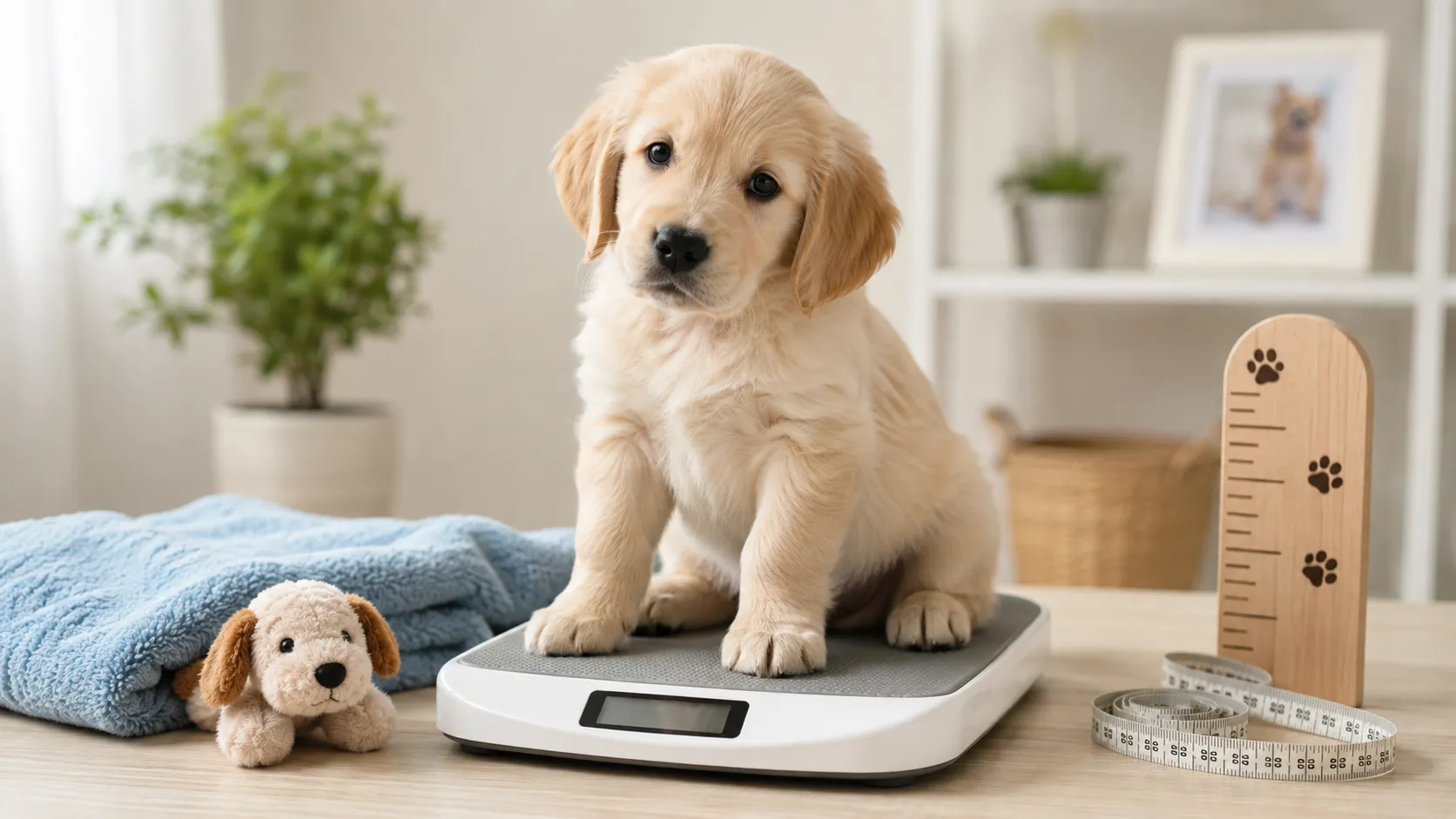

Most puppies gain about 5% to 10% of their body weight every week during their first few months, then slow down as they get closer to their adult size. The exact number depends on your puppy's breed size, since a Chihuahua and a Great Dane are on completely different growth clocks. If you want a faster way to check your own puppy's numbers, a puppy weight calculator can save you the math, but it's still worth knowing what's actually normal.
This guide is for anyone raising a puppy in their first year, whether you've got a purebred with a known adult weight or a mixed breed shelter pup where "adult size" is more of a guess. We'll cover how much weight should a puppy gain per week by size, a breed weight chart, a worked example, and the signs that mean it's time to call your vet.
How Puppy Weight Gain Actually Works
Puppies grow fastest in their first few months of life, then taper off as they approach adulthood. A puppy that's doubling its birth weight in the first week will not be doubling its weight every week by month six. Growth slows down on purpose.
Here's the general pattern:
- Birth to 8 weeks: Fast, steady gains, often 5-10% of body weight per week, sometimes more in the earliest weeks while nursing.
- 2 to 6 months: Still quick growth, usually in the 5-10% per week range for smaller breeds and a bit more variable for large ones.
- 6 to 12 months: Growth slows to roughly 2-5% per week as the puppy nears adult size.
- After 12 months (or later for giant breeds): Weight gain mostly stops, aside from normal filling out of muscle.
These percentages are estimates, not a strict formula. A puppy can have a slow week followed by a growth spurt and still be perfectly healthy. What matters more is the overall trend over several weeks, not any single weigh-in.
Why Size Class Matters More Than Breed Name
A 5-pound Chihuahua puppy gaining half an ounce a week is right on track. A 5-pound Labrador puppy gaining half an ounce a week would be a red flag. Size class (toy, small, medium, large, giant) tells you far more than breed alone, especially for mixed-breed dogs where you're estimating adult size from a guess.
Puppy Weekly Weight Gain by Size Class
This table gives a rough, non-exact range for how much weight a puppy should gain per week, sorted by the size the dog will be as an adult.
| Size Class | Adult Weight Range | Typical Weekly Gain | Time to Reach Adult Size |
|---|---|---|---|
| Toy (Chihuahua, Yorkie, Papillon) | Under 12 lbs | Around 2-5 oz | 8-10 months |
| Small (Pug, Dachshund, French Bulldog) | 12-25 lbs | Around 5-10 oz | 9-11 months |
| Medium (Border Collie, Cocker Spaniel, Corgi) | 25-50 lbs | Around 1-1.5 lbs | 10-12 months |
| Large (Labrador, German Shepherd) | 50-90 lbs | Around 1.5-2.5 lbs | 12-18 months |
| Giant (Great Dane, Mastiff, Saint Bernard) | 90+ lbs | Around 3-5 lbs | 18-24 months |
These figures are general guidelines pulled together from common veterinary growth references, not a lab-tested formula for your specific puppy. Individual dogs, even from the same litter, can land outside these ranges and still be healthy.
Breed Weight Chart: Approximate Adult Weights
Knowing your puppy's likely adult weight is the first step in figuring out how much weight gain per week actually makes sense. Here's a quick reference for common breeds.
| Breed | Approximate Adult Weight |
|---|---|
| Chihuahua | 3-6 lbs |
| Yorkshire Terrier | 4-7 lbs |
| Dachshund | 11-32 lbs |
| French Bulldog | 16-28 lbs |
| Beagle | 20-30 lbs |
| Border Collie | 30-45 lbs |
| Cocker Spaniel | 20-30 lbs |
| Labrador Retriever | 55-80 lbs |
| German Shepherd | 50-90 lbs |
| Golden Retriever | 55-75 lbs |
| Great Dane | 110-175 lbs |
| Saint Bernard | 120-180 lbs |
If your puppy is a mix of two or more of these breeds, expect the adult weight to land somewhere between the ranges, though it's really just an educated guess until your puppy is closer to full grown.
Example Calculation
Say you have a 10-week-old Labrador puppy who currently weighs 12 pounds. Using the 5-10% weekly range for a large breed puppy still in the fast-growth stage:
- Low end (5%): 12 lbs x 0.05 = 0.6 lbs gained that week
- High end (10%): 12 lbs x 0.10 = 1.2 lbs gained that week
So next week, a healthy weight would land somewhere between 12.6 and 13.2 pounds. If the puppy weighs 12.8 pounds at the next check-in, that's right in the normal range. If it's still 12 pounds flat, or dropped, that's worth a call to the vet, especially over two or more weeks in a row.
Common Myths About Puppy Growth
Myth: You can tell adult size just by looking at a puppy's paws. Big paws can be a clue that a puppy has more growing to do, but it's not reliable on its own. Some breeds naturally have larger paws relative to their body, so this trick is more folklore than science.
Myth: Mixed breed puppies can't be predicted at all. You can't get an exact number, but knowing the size of both parent breeds (or the closest guess from a shelter or a DNA test) gets you in the right ballpark. It just won't be as precise as a purebred estimate.
Myth: Getting a puppy spayed or neutered stunts their growth. Early spay or neuter can sometimes shift growth plate closure timing slightly, and vets often discuss the best age for larger breeds specifically. It does not stop a puppy from reaching a normal adult size.
Myth: A puppy that skips a week of gaining weight is automatically sick. One flat week, especially during teething or after a vaccine, usually isn't a big deal. It's a pattern over multiple weeks that actually matters, not one single number.
When Weight Gain Stalls
A short plateau isn't automatically a problem. Puppies can lose a little appetite during teething, after vaccinations, or during a stressful change like moving to a new home. Watch for the following signs that go beyond a normal pause:
- No weight gain for two or more weeks in a row
- Weight loss instead of a plateau
- Visible ribs or spine with no fat covering
- Low energy, vomiting, or diarrhea alongside the stall
- A puppy that seems significantly smaller or thinner than littermates
If you see any of these, it's time to talk to your vet rather than wait it out. A vet can check for parasites, dental pain, or an underlying illness that a home weight check can't diagnose on its own.
Feeding by Predicted Adult Weight
Puppy food portions are usually based on current weight and predicted adult size, not just current weight alone. A 12-pound Labrador puppy headed for 70 pounds needs a different feeding plan than a 12-pound adult Beagle that's already done growing.
A few practical tips:
- Follow the feeding guide on your puppy food bag as a starting point, then adjust based on body condition, not just the chart.
- Large and giant breed puppies often do better on food formulated specifically for large breeds, since it's built to support slower, steadier bone growth.
- Recheck portions every few weeks as your puppy gains weight. What was right at 10 weeks probably isn't right at 16 weeks.
- Always have fresh water available, and avoid free-feeding if you're trying to track weight gain closely.
Giant Breed Growth Timelines
Giant breeds like the Great Dane, Mastiff, and Saint Bernard are on their own schedule. They can keep growing until 18 to 24 months old, well past when smaller breeds have already stopped. Because of this longer growth window, sudden spurts and slower stretches are both normal and shouldn't cause panic on their own.
Rapid, uncontrolled growth in giant breed puppies is something vets do pay attention to, since it's been linked to joint and skeletal issues later in life. This is one more reason large and giant breed puppy foods are formulated with slightly different calcium and calorie levels than standard puppy formulas.
Final Thoughts
So, how much weight should a puppy gain per week? For most puppies, somewhere between 5% and 10% of body weight per week during the fast-growth months, tapering to 2-5% as they near adulthood. The exact number always comes back to size class, breed, and the individual puppy in front of you.
Weigh your puppy on the same scale, at roughly the same time of day, once a week if you can manage it. One offbeat number rarely means anything on its own. A pattern that doesn't match your puppy's size class, or a plateau that lasts a couple of weeks, is what's actually worth a vet visit.
Trusted Resources
If you want to go straight to the source instead of taking a blog's word for it, these are solid places to check:
- American Kennel Club: Breed Weight Chart — official adult weight ranges by breed.
- American Kennel Club: When Does My Puppy Finish Growing? — growth plate timelines from AKC's chief veterinarian.
- WSAVA Global Nutrition Guidelines — nutrition assessment tools used by veterinary professionals worldwide.
None of these replace an actual exam. If something about your puppy's weight or growth worries you, your own vet, who can see and feel your puppy in person, is still the best resource you have.
Frequently Asked Questions
How much weight should a puppy gain per week on average? Most puppies gain 5-10% of their body weight per week during the early growth months, then slow to about 2-5% per week as they approach their adult size. The exact number depends heavily on breed size.
Is the paw-size trick actually a reliable way to guess adult size? Not really. Big paws can hint that a puppy still has growing to do, but it's not consistent enough across breeds to count on. A breed weight chart or a vet's estimate is more accurate.
Can you predict a mixed breed puppy's adult weight? You can get a reasonable estimate if you know the size of both parent breeds, but it won't be exact. A DNA test or a vet's assessment at a few months old can narrow the range further.
Does spaying or neutering affect how much weight a puppy gains? Spaying or neutering doesn't stop a puppy from reaching a normal adult size, though timing can affect growth plate closure slightly, which is why vets often recommend waiting until a certain age for larger breeds. Talk to your vet about the right timing for your specific dog.
My puppy's weight gain stalled for a week. Should I worry? A single flat week, especially during teething or shortly after a vaccine, usually isn't a concern. If it stretches to two or more weeks, or comes with low energy or loss of appetite, check in with your vet.
Should I feed my puppy based on their current weight or their predicted adult weight? Both. Portion size is generally based on current weight, but the type of food, especially calcium and calorie levels, should match the puppy's predicted adult size, particularly for large and giant breeds.
How long do giant breed puppies keep gaining weight? Giant breeds like Great Danes and Saint Bernards can keep growing until 18 to 24 months old, much longer than small or medium breeds that typically finish growing by 10-12 months.




























Sign in to leave a comment.