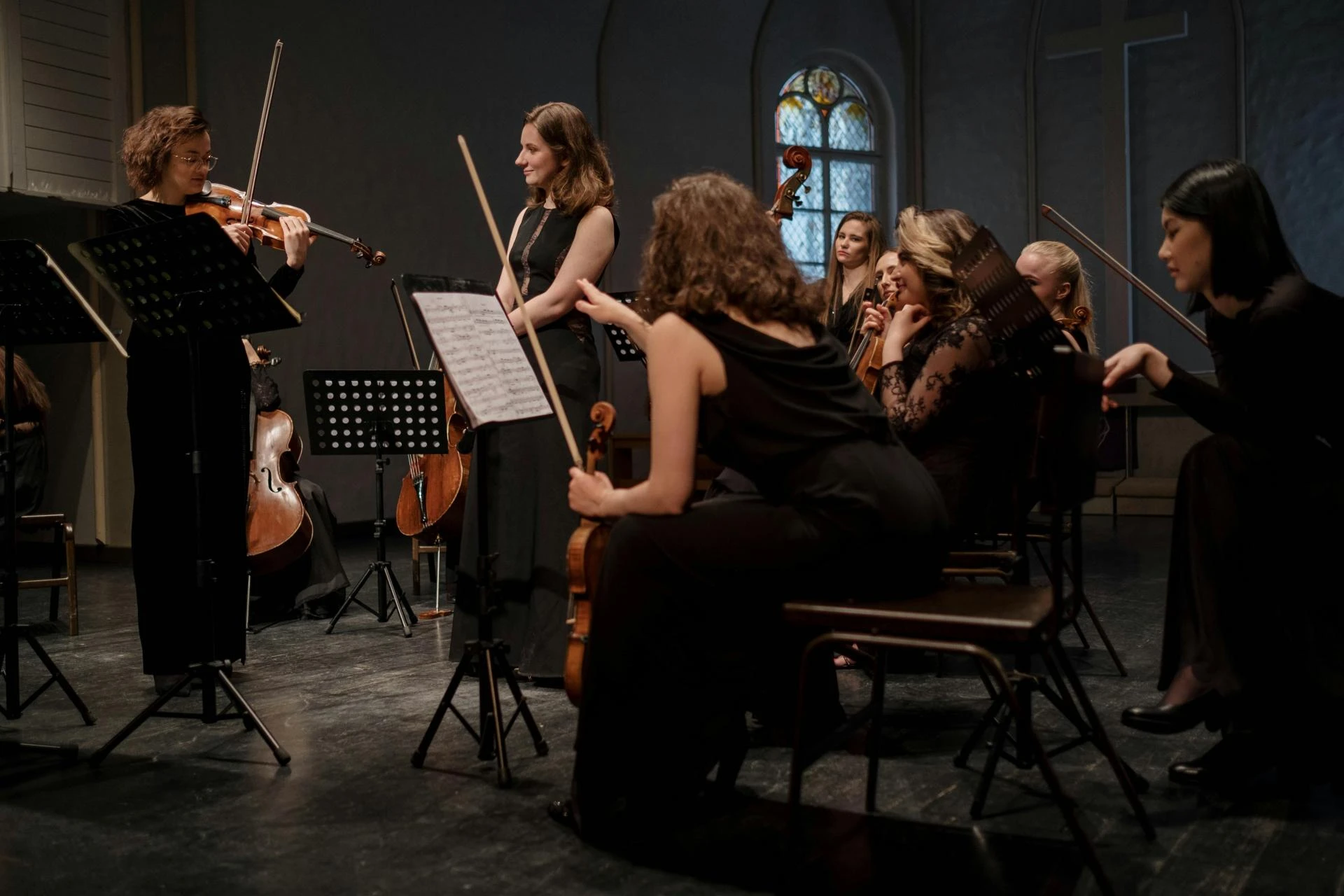

Music can change a scene of a movie to a deeply touching experience, and hardly any other art form is as emotionally impactful as orchestral music. The orchestral scores have been the go-to medium for centuries in the visual arts to summon the feelings of the audience, let them reactively follow the plot, and increase the narrative power of the image layer by way of melodies ranging from grand symphonies to the gentle melodies of a few strings.
The film industry, for instance, the designers of virtual worlds and content producers, can achieve the next level of the art of storytelling on the big screen by simply figuring out how to employ orchestral music.
The Power of Orchestral Music in Storytelling
An orchestra has a wide variety of different sounds, textures, and dynamics with which it can convey the story in a far more powerful way than most other music genres. Composers can create emotional background music with the four instrumental strings, brass, woodwinds, and percussion. As a dominant presence in film and theater, orchestral music is the most favored choice for these two art forms.
Emotional Background Music and Audience Engagement
In a movie plot, the emotional background music chosen rightly can differentiate a scene that is easily forgotten from a scene that really moves you. Orchestral music is the best in this respect because it can be the reflection or the intensification of the characters' moods.
Thus, a piano alone with soft string instruments can be the suggestion of the character's isolation, whereas a complete orchestra with increasing loudness can be the creation of the eagerness for the turning point of the story.
First of all, emotional background music to the visuals depicted establishes the bond with the psyche of the audience. Experiments have shown that the audience is more inclined to recall and be influenced by the scenes with the music that provoke their emotions.
To be very effective in leading the audiences' emotional response in a subtle yet powerful way, orchestral music should be the choice because of its elaborate harmonic relationships and its energetic changes.
Enhancing Cinematic Storytelling Through Themes and Motifs
Using the repeated themes and motifs is one of the main elements of the orchestral scoring. Composers link certain tunes and instruments to characters, locations, or concepts to help the audience and to elevate the visual storytelling.
Orchestral Music as a Bridge Between Reality and Emotion
Orchestral music is also very instrumental in lending a fictional character to an emotional story of fact through its capacity to confuse the border between the two—reality and imagination. Orchestral music adds an emotional dimension that goes beyond what is seen or heard to the story that is told through dialogues and visuals. It can work to lift a simple scene a look between characters, a silent moment in a park to a deep emotional experience.
Practical Tips for Using Orchestral Music
Creators who want to use orchestral music in their projects may find these tips useful:
Match the Mood: The music should be the emotional one of the scene
Use Dynamics Wisely: Changes in volume, most notably a crescendo, are the main tools to bring out the emotion of the scene.
Incorporate Motifs: Consistent musical themes can help not only the plot but also the characters' development.
Balance Music and Silence: Silence has always been able to be just as powerful as music
Conclusion
Orchestral music is not only a soundtrack; it’s a strong tool for storytelling . It can bring out emotions and fully involve the audience .
By including the orchestral music carefully, creators can use emotional background music to help them guide their feelings and improve cinematic storytelling.
Sweet symphonies and soft string passages make stories more powerful. Ordinary moments become unforgettable. Learning to use orchestral music well is important for anyone making emotional media. It acts as a bridge that connects directly to the audience’s heart.





Sign in to leave a comment.