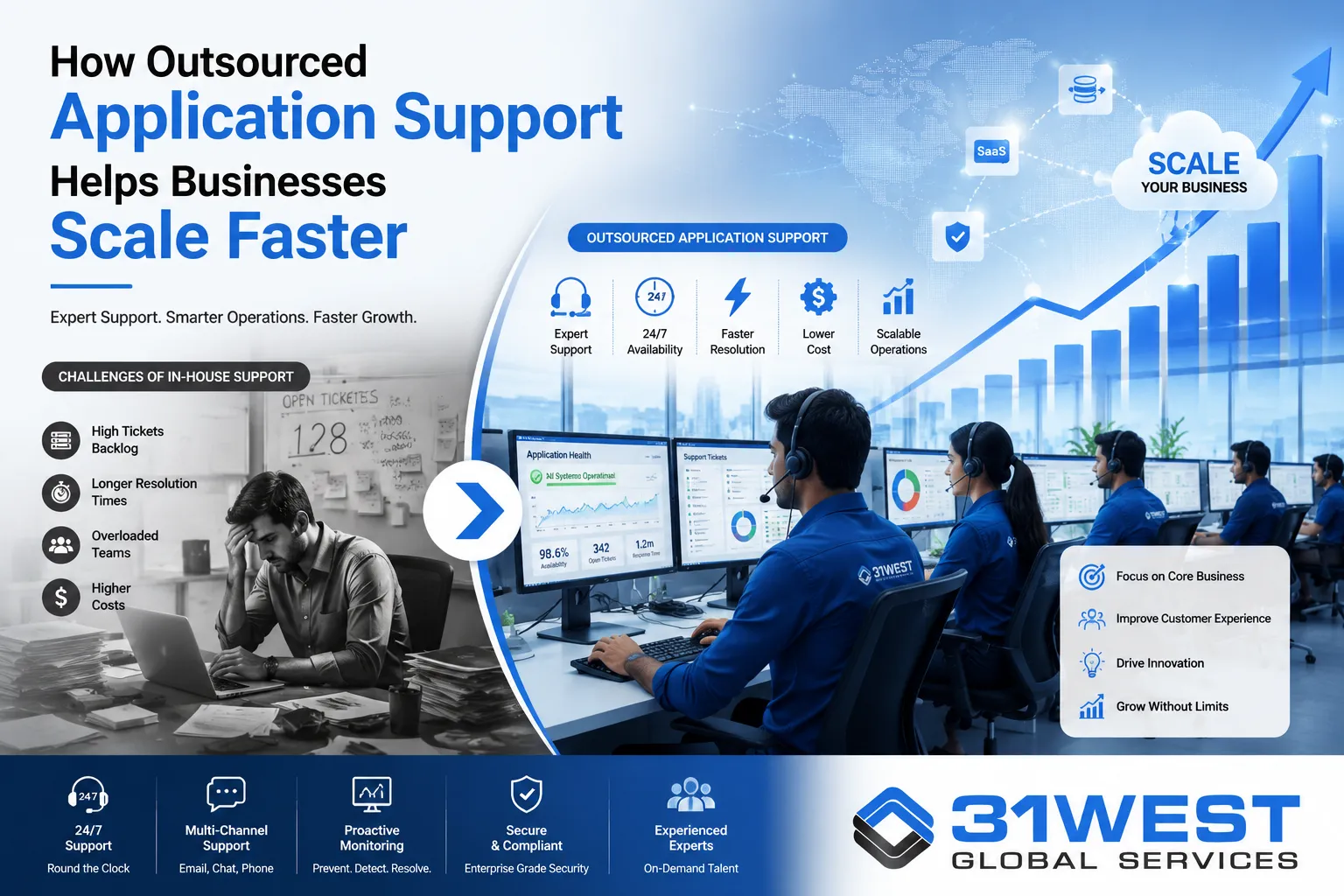

Unplanned application downtime costs businesses an average of $5,600 per minute (Source: Gartner, 2023). For companies trying to scale, every minute spent firefighting support issues is a minute not spent building products or serving customers. Outsource application support, and you shift that burden to a dedicated team so your engineers stay focused on growth.
This post explains how outsourced application support works, what it costs, how it compares to keeping support in-house, and what to look for in a provider.
What Is Outsourced Application Support?
Outsourced application support means hiring a third-party team to manage the ongoing maintenance, monitoring, and incident resolution of your business applications. The external team handles bug fixes, performance issues, user queries, and system updates under a defined Service Level Agreement (SLA). Your internal team stays free to focus on strategic work.
What Does an Outsourced Support Team Actually Do?
A typical outsourced application support team operates across three tiers. Tier 1 handles user queries and basic troubleshooting. Tier 2 covers functional issues and configuration changes. Tier 3 manages deep technical fixes, code-level defects, and database problems. Each tier has a defined response time written into the SLA.
The team uses ITSM frameworks such as ITIL to log, prioritise, and resolve tickets. This creates an auditable record of every incident useful for compliance and continuous improvement.
What Types of Applications Can Be Supported?
Outsourced teams support a wide range of applications: custom-built enterprise software, SaaS platforms, ERP systems, CRM tools, web applications, and mobile apps. The scope is defined at contract stage, so you know exactly what is covered before work begins.
How Does Outsourcing Application Support Help Businesses Scale?

Outsourcing application support removes a fixed operational cost and turns it into a variable one. You pay for the capacity you need, when you need it. As your user base grows, your support coverage scales with it without hiring, onboarding, or training new staff.
It Frees Internal Engineers for Product Work
When engineers spend time on support tickets, they are not shipping features. A 2022 McKinsey study found that IT teams spend up to 30% of their time on maintenance and support tasks that do not directly contribute to business value (Source: McKinsey & Company, 2022). Outsourcing those tasks returns that capacity to your roadmap.
It Provides 24/7 Coverage Without Overhead
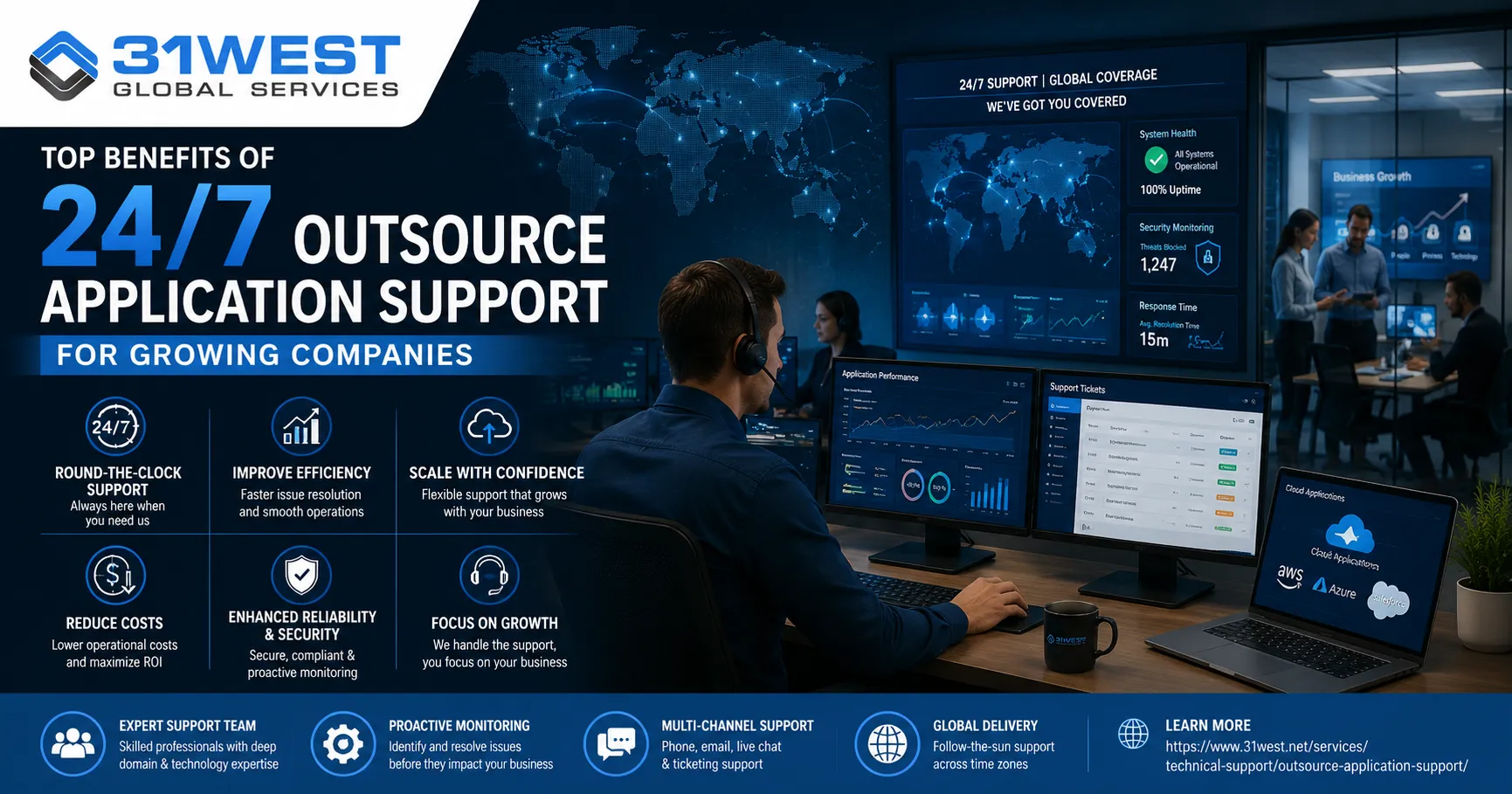
Scaling a product globally means supporting users across time zones. Building an in-house team to cover round-the-clock support requires multiple shifts, redundant headcount, and management overhead. An outsourced team delivers 24/7 application support coverage at a fraction of that cost, with SLAs that guarantee response times.
It Reduces Mean Time to Resolution (MTTR)
Specialist support teams resolve incidents faster because that is all they do. Dedicated application support providers measure performance against MTTR targets. According to Forrester Research, companies using managed application support reduced their average incident resolution time by 40% compared to in-house teams (Source: Forrester Research, 2022).
What Are the Key Benefits of Outsourcing Application Support?
The core benefits fall into three categories: cost, speed, and quality. Businesses that outsource application support consistently report lower operational costs, faster incident resolution, and higher application uptime. Here is what that looks like in practice.
Cost Savings
Hiring a full-time application support engineer in the US costs between $80,000 and $120,000 per year in salary alone, before benefits and training. Outsourcing delivers equivalent or better coverage at 30–60% lower total cost, depending on the scope and provider location.
Access to Specialist Skills
A good outsourced provider brings deep expertise across multiple technologies. You get access to specialists in your specific stack without paying to retain them full-time. This matters most when your application uses niche frameworks or legacy systems where in-house talent is hard to find.
Consistent SLA Performance
SLAs create accountability. Every incident is logged, prioritised, and tracked against agreed response and resolution targets. Regular reporting gives you visibility into support performance something informal in-house processes rarely provide. You can see trends, identify recurring issues, and use that data to improve application quality over time.
What Should You Look for in an Application Support Outsourcing Provider?
Not all providers are equal. The right partner has deep technical capability, a proven ITSM process, and clear contractual accountability. Before signing, verify these five things.
SLA Clarity and Penalty Structure
The SLA must define response time, resolution time, and uptime commitments for each ticket priority level. It must also state what happens when those commitments are missed. Vague SLAs are a risk. Ask the provider to show you a sample SLA before the contract stage.
Transition and Knowledge Transfer Process
A strong provider has a documented onboarding process. They will ask for system documentation, run a knowledge transfer period, and shadow your team before taking ownership. Budget four to eight weeks for a proper transition. Providers who promise to go live in days without documentation are cutting corners.
Security and Compliance Standards
Your applications hold sensitive data. The provider must demonstrate compliance with relevant standards ISO 27001, SOC 2, or GDPR depending on your industry and geography. Ask for certifications, not just assurances. Review how they handle access control, audit logs, and data residency.
Conclusion
Businesses that outsource application support reduce costs, improve uptime, and free their internal teams for higher-value work. The model works because it gives you specialist skills, structured processes, and measurable accountability at a cost that scales with your needs rather than your headcount. As applications become more complex and user expectations rise, the question is not whether to outsource application support, but how soon you can make the transition.

























Sign in to leave a comment.