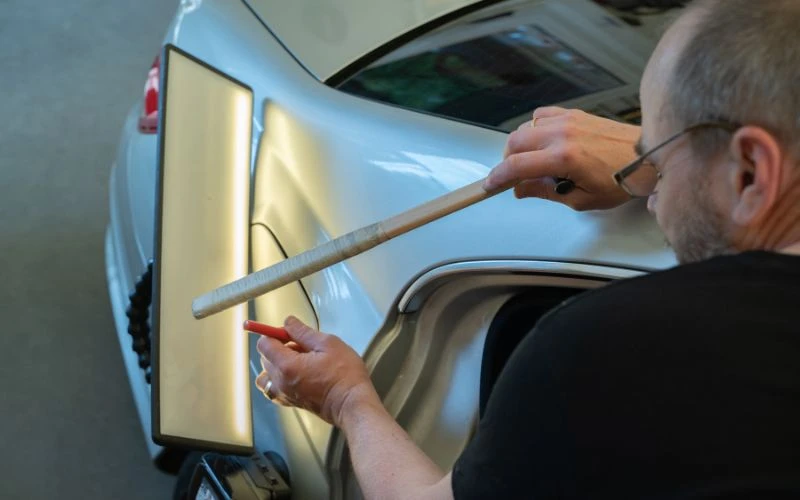

Dent detection is more rapid, thereby decreasing the turnaround time. Tiny dents, hail damage, and door dings might seem minor. But even small imperfections can completely change a car’s look. Vehicles in Melbourne are frequently subjected to hailstorms and congested city streets, resulting in dents being a prevalent issue.
Shadow reading has established itself as a fundamental technique for achieving precision in paintless dent restoration. It enables technicians to detect distortions invisible to the naked eye, ensuring repairs are executed flawlessly. Consider it similar to illuminating a darkened room—suddenly, every curve and indentation is rendered clearly visible.
For areas prone to unpredictable weather, especially when tackling hail damage repairs in Malvern, interpreting light reflections makes all the difference. Experts don’t just detect dents—they control the metal’s movement with millimetre-level precision. The result is a finish so flawless, it almost looks untouched.
Why Shadow Reading Is Critical in Paintless Dent Repair
Shadow reading involves projecting a controlled light source onto a panel to reveal surface irregularities. Experts analyse the way in which lines, reflections, and shadows are altered across the metallic surface. Even minor fractures caused by debris or slight impacts alter these patterns.
Precise Identification: Shallow and deep regions are quickly and clearly distinguishable.
Non-invasive Repairs: Panels are restored without the necessity of sanding or repainting.
Efficiency: Dents are detected promptly, thereby saving both time and labour.
Simultaneously, the use of illumination angles—such as slanted, off-centre, or oblique—serves to augment contrast. This ensures technicians can anticipate metal movement and avoid overcorrection or under-repair.
How Experts Read Shadows to Detect Dents
Professionals combine shadow reading with reflection boards and LED panels. Observing shadows as they shift highlights:
- Depth Variation: Whether a dent is shallow or deep.
- Shape Accuracy: Precise curves of damaged areas.
- Micro Dents: Imperfections from hail or minor collisions that are easy to miss.
Meanwhile, mobile setups allow these techniques to work anywhere—from home driveways to dealership lots—without compromising quality. Flexible lighting ensures every dent is detected and treated, even on metallic or dark-colored panels.
Tools That Enhance Shadow Reading
- LED Light Panels: Bright, low-heat lights with adjustable intensity.
- Reflection Boards: Make micro-dents stand out with gradient or line reflections.
- Line Boards: Offer high-contrast lines for precise depth and location mapping.
Interestingly, AI-assisted lighting is also emerging. These systems are capable of detecting dents in real-time and can also recommend appropriate tool pressure and positioning for multi-dent panels.
Benefits for Vehicle Owners
- Preserves the Original Paint Finish: Sanding or repainting is not required.
- Accelerated Repairs: The identification of dents is expedited, thereby minimising the total duration.
- Cost-Effective: Reduces labour and material expenditures.
- Enduring Outcomes: Precise repairs mitigate the risk of future paint deterioration or corrosion.
For vehicles affected by hail damage or subjected to frequent urban traffic, these advantages considerably influence both appearance and resale value.
FAQ – Shadow Reading in Dent Repair
What dents can shadow reading detect?
Even micro-dents from hail or minor bumps are visible, whether shallow or deep.
Can this method be used outside a workshop?
Yes! Mobile lighting setups allow expert repairs anywhere, from driveways to dealerships.
Is paintless dent removal suitable for all vehicles?
It works best on panels with intact paint and metal that haven’t been overstretched.
Final Thoughts
Shadow reading transforms dent repair from guesswork into precision work. By analysing reflections, lines, and shadows, experts ensure that paintless dent removal in Melbourne achieves impeccable results. Effective lighting, proficient techniques, and contemporary instruments are essential components that significantly impact the outcome.
An expertly repaired car doesn’t just look perfect—it maintains value, prevents long-term damage, and turns even minor dents into a thing of the past. Consider it the same to restoring a canvas; each imperfection is meticulously removed until the surface appears flawless, as if the damage never occurred.































Sign in to leave a comment.