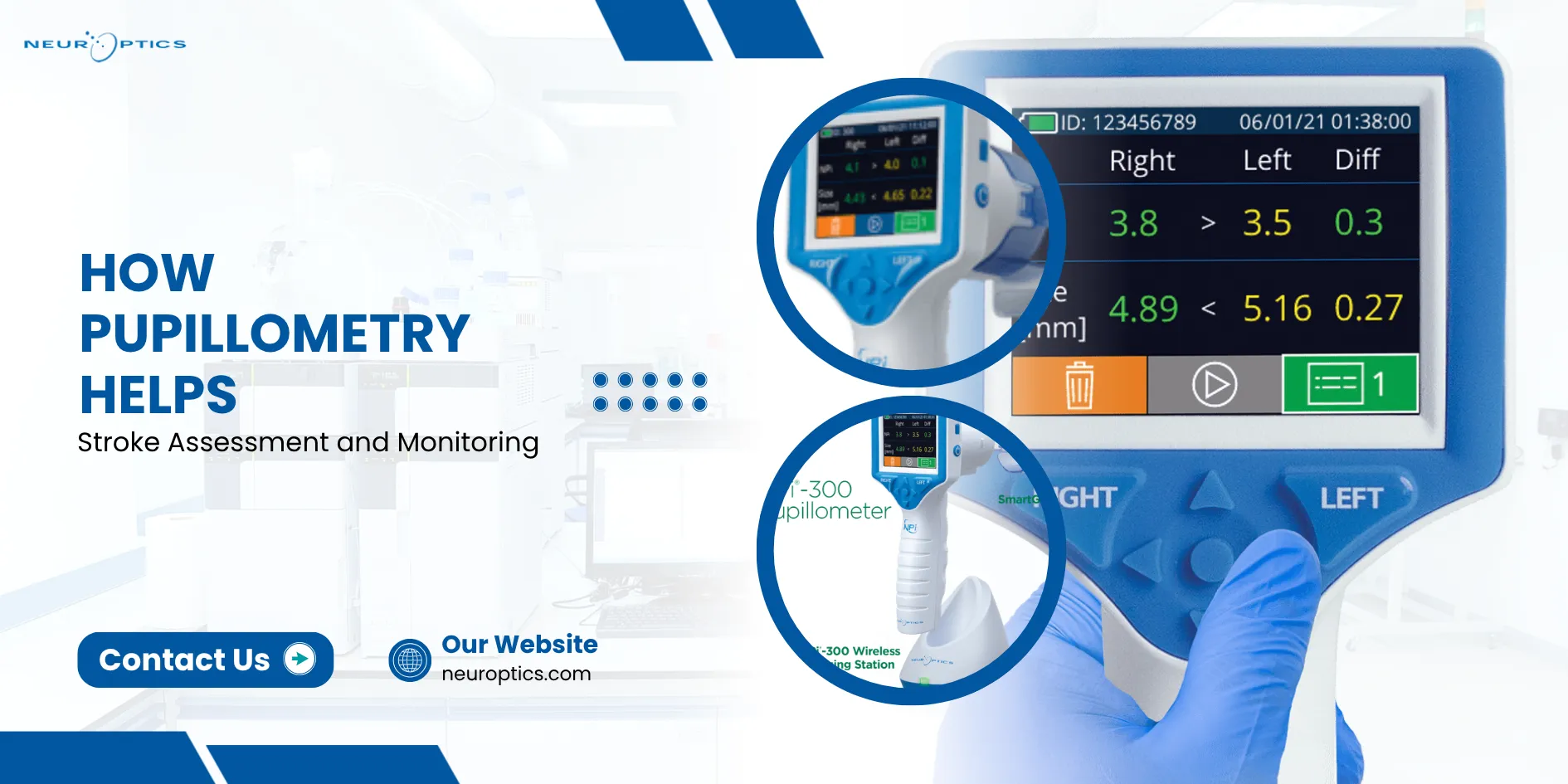

What if a three-second bedside measurement could tell your team that a stroke patient is deteriorating hours before the clinical picture changes? That's not a hypothetical. It's what objective pupil assessment is doing in hospitals that have moved past the flashlight-and-guesswork era of neurological monitoring.
Stroke remains one of the most unforgiving neurological emergencies. The window for effective intervention is narrow, and the consequences of delayed recognition are severe. For critical care teams managing these patients around the clock, the pressure to catch subtle changes early is constant. And yet, for years, one of the most telling indicators, pupil response, was assessed in ways that varied from nurse to nurse, shift to shift.
That inconsistency has real consequences. And there's now a better way to address it.
Why Subjective Pupil Assessment Falls Short
A manual neuro exam is only as reliable as the conditions in which it's performed. Lighting varies. Clinical judgment varies. Documentation varies. When a patient is being monitored across multiple shifts and multiple providers, those inconsistencies stack up quietly until a change is missed or, worse, caught too late.
This isn't a criticism of nursing skill. It's an acknowledgment of the limits of any tool that depends entirely on human perception. Stroke patients, particularly those with hemorrhagic involvement or rising intracranial pressure, need monitoring that doesn't have those limits.
Objective Measurement Changes the Clinical Picture
The NPi pupillometer addresses this gap directly. Using infrared light, the device captures the full arc of the pupillary light reflex - constriction velocity, amplitude, and recovery, and distills it into a standardized score in under three seconds. Readings don't shift based on who's holding the device or what the room looks like.
For stroke patients, this matters in two specific ways. First, it establishes a reliable baseline at admission. Second, it makes it possible to track the percent change in pupil size over time with enough precision to flag early neurological deterioration before it becomes obvious at the bedside.
That early signal is where clinical decisions get made well.
What This Looks Like in Practice
Picture a patient admitted with ischemic stroke, stable on arrival, monitored overnight. By 3 a.m., manual checks haven't flagged anything significant. But the pupillometer score has been trending down across three consecutive readings - from 3.9 to 3.4 to 2.8. That trend prompts an earlier call to neurology, an earlier imaging decision, and a faster response.
That's not a dramatic scenario. It's a realistic one. And it illustrates why quantifiable, time-stamped pupil data is more actionable than a narrative note that reads "pupils equal and reactive."
| Assessment Method | Consistency | Speed | Detects Early Change | Trend Tracking |
| Manual (flashlight) | Variable | Fast | Limited | None |
| NPi Pupillometer | High | ~3 seconds | Yes | Yes |
| CT/MRI Imaging | High | Slow | Moderate | Episodic |
Stronger Communication Across the Care Team
Stroke care rarely happens in isolation. Neurologists, intensivists, pharmacists, and rehabilitation specialists all touch the same patient, often with different pieces of the clinical picture. When pupil assessment data is objective and consistently documented, it becomes a shared reference point that the entire team can speak to without ambiguity.
Consider how shift handoffs typically go. A nurse says the pupils "looked okay" at 2 a.m. That note means something different to everyone who reads it. Replace that with a time-stamped NPi score and a documented trend, and suddenly the conversation changes. There's less interpretation required and less room for critical details to get lost in translation.
For hospitals managing high stroke volumes, that clarity compounds quickly. Better-informed rounds, faster specialist alignment, and fewer redundant assessments, it adds up to a care environment where nothing important slips through the cracks simply because the language wasn't precise enough.
Where Pupillometry Fits into the Nursing Workflow
One of the more practical aspects of modern neurological tools is that they're designed for integration, not disruption. The NPi pupillometer is handheld, requires minimal training, and fits naturally into existing assessment protocols. For critical care nursing teams already managing high patient loads, that ease of adoption matters.
A few approaches that work well in practice:
- Take a baseline reading within the first hour of admission and document it clearly in the EHR.
- Establish a reassessment schedule based on stroke type - hemorrhagic patients typically warrant more frequent monitoring.
- Use NPi trends, not just single readings, during multidisciplinary rounds.
- Define escalation thresholds in your protocol so nursing staff know exactly when to alert the attending.
None of this requires overhauling an existing workflow. It requires adding one objective data point to a process that already exists.
The Broader Impact for Hospital Teams
Beyond individual patient outcomes, there's an institutional case to be made. Objective pupil data reduces documentation ambiguity, supports clearer shift-to-shift handoffs, and strengthens the evidentiary basis for clinical decisions. When a care team is aligned on quantifiable neurological data, communication improves, and so does care coordination.
There's also a risk mitigation angle worth naming. In high-stakes neurological cases, the ability to demonstrate that monitoring was consistent, frequent, and data-driven carries weight, clinically and administratively.
FAQs
Q: Can pupillometry replace manual pupil checks entirely?
A: It's best used alongside a full neurological assessment, not in isolation. That said, for serial monitoring in acute stroke, it's significantly more reliable than manual methods alone.
Q: What does a declining NPi score indicate?
A: An NPi below 3.0 suggests compromised pupillary function and warrants immediate clinical review. Downward trends are often more informative than any single reading.
Q: Is the device suitable for all stroke subtypes?
A: Yes. Both ischemic and hemorrhagic presentations benefit from objective pupil monitoring, though escalation protocols may differ.
Q: How much training does nursing staff need?
A: Most nurses are comfortable using the device after a single session. Results display immediately, so interpretation at the bedside is straightforward.
Q: Does pupillometry integrate with EHR systems?
A: Many current models support direct data export. It's worth confirming compatibility with your specific system during the evaluation phase.
Conclusion
Stroke doesn't wait, and neither should the tools used to monitor it. The reality is that some of the most critical neurological changes happen quietly, between imaging studies, between shift changes, between the moments anyone is actively looking. Pupillometry fills that space with something care teams can actually trust: consistent, objective data that holds up regardless of who's at the bedside or what time it is.
No single tool transforms stroke outcomes on its own. But removing subjectivity from pupil assessment is a meaningful step toward a monitoring standard that patients deserve and clinical teams can rely on.
If your hospital is evaluating ways to strengthen stroke monitoring, start the conversation internally. Bring the clinical evidence to your neurology lead, run it past your critical care nursing educators, and assess whether your current protocol has gaps that objective pupil assessment could address.
NeurOptics makes that next step straightforward. The technology is proven. The workflow fit is manageable. What's left is the decision to prioritize it.




























Sign in to leave a comment.