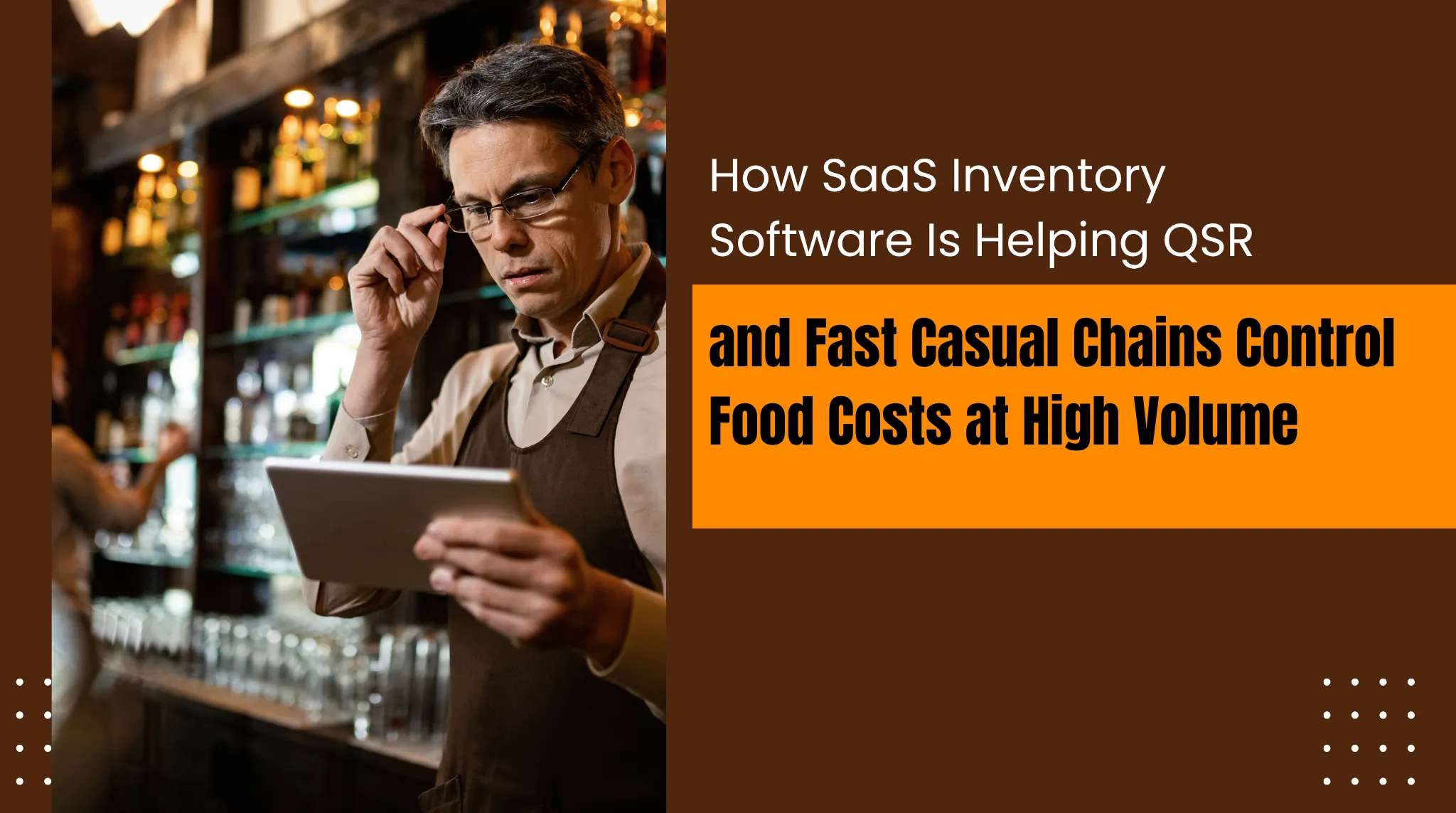

In quick service and fast casual operations, food cost is the line that decides whether a location is profitable or not. With ticket averages compressed by competitive pricing and ingredient costs continuing to fluctuate, the margin between viable and unviable is often a single percentage point. QSR food cost management software has become the default response for chains operating across multiple sites, because the volume and speed of a fast casual kitchen make manual inventory tracking unreliable within weeks of opening.
The shift is not about technology for its own sake. It is about whether a regional operations director can see, on a Tuesday morning, that location 14 is running up to 3 percent over its food cost target and what specifically is driving the variance. Manual inventory, even when done properly, cannot produce that answer on Tuesday. By the time it can, the variance has compounded.
Why Manual Stock Control Breaks at QSR Volume
A fast casual restaurant typically processes between 400 and 1,200 transactions per day. Each transaction draws ingredients from inventory in small, frequent quantities. A single shift can involve thousands of inventory deductions across dozens of SKUs.
When that environment is tracked manually, two problems emerge consistently. The first is recording lag. Counts happen at end of week, sometimes end of month, and variances surface long after they could have been corrected. The second is allocation error. A location that uses the same protein across three menu items has no clean way, on paper, to attribute usage to each item without a full theoretical versus actual reconciliation, which most multi unit operators do not have the time to run weekly.
Takeaway: Manual systems do not fail at low volume; they fail at the scale and speed that defines QSR operations.
The Three Cost Leaks Software Catches Faster
Across QSR and fast casual operations, three categories of cost leak account for the majority of food cost variance.
Portion drift. When prep teams build to memory rather than to a weighed standard, portion sizes creep up over weeks. A 2 gram drift on a high volume protein, multiplied by 800 covers a day, becomes a measurable percentage of food cost within a quarter.
Wastage that is not logged. Trim, end of day discards, and damaged stock that never makes it onto a wastage record disappears into theoretical inventory variance. Without a quick logging method built into the line workflow, it stays invisible.
Supplier price drift. Ingredient prices move week to week. A QSR chain operating across multiple states or countries deals with regional price differences on top of that. When invoice prices are not captured into the recipe cost engine within hours of delivery, menu margins are calculated on stale data.
Software does not eliminate these leaks automatically. What it does is surface them within a working week rather than at the next quarterly review.
Takeaway: Faster visibility on cost variance is the practical advantage of software over manual systems, not the existence of the data itself.
A Multi Unit Operator's Reconciliation Problem
Consider a fast casual operator running 18 locations across two US states. The operator was using spreadsheets at the location level and consolidating monthly. Food cost percentage at the group level looked acceptable, sitting around the 31 percent mark.
When a single location was audited mid quarter, the reconciliation revealed that four locations had been running between 34 and 36 percent food cost for at least eight weeks. The group average had been masking the underperformance. The cause was a combination of portion drift on the highest volume protein and a regional supplier price increase that had not been re entered into the cost sheet.
Reconstructing eight weeks of usage took the area manager close to three full working days. Had the same data been captured live, the variance would have triggered an alert within the first week. This pattern repeats across QSR groups that scale faster than their reporting infrastructure: group level numbers can look healthy while individual locations bleed margin.
Takeaway: Group averages are not management data; location level visibility is.
What QSR Operators Should Look For in Inventory Software
The features that matter for high volume QSR operations are narrower than most software demos suggest. Five capabilities cover the majority of the value: live invoice capture, ideally with AI driven scanning that pulls supplier price changes into recipe costs without manual rekeying; recipe linked inventory, so that POS sales drive automatic stock deductions and theoretical usage is calculated continuously; location level reporting that surfaces variance against target without requiring an analyst to build it; multi site transfer logging, because in any chain over five locations stock will move between sites and untracked transfers create variance noise; and mobile first stock counting, because the people doing counts are doing them on the floor, not at a desk.
For QSR operators who want to move beyond reactive monthly reconciliations, QSR food cost management software from Stocktake Online offers AI invoice scanning that updates recipe costs automatically when supplier prices change, location level gross profit reporting, and recipe templating built for multi unit operations. The National Restaurant Association's State of the Restaurant Industry research has consistently identified food and labor cost management as the top operational concern for restaurant operators, and the software stack has evolved specifically to address that pressure.
Takeaway: The right features for QSR are operational, not analytical; what matters is what gets captured at the line, not what the dashboard looks like.
The honest question for any QSR or fast casual operator is whether the cost data they review at the end of each period is good enough to act on, or only good enough to explain what already happened. Inventory software is not a strategic asset by default. It becomes one when the data it captures changes which decisions get made, and when. If the answer to "why was last month over target" still takes a week to produce, the software is not yet doing the work.




























Sign in to leave a comment.