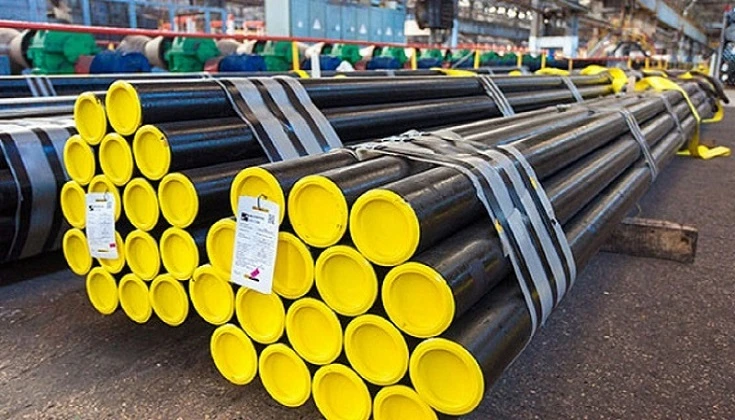

Carbon steel pipes have become essential in the bimetallic hybrid tubing industry. The tubing has an inner liner. The liner consists of stainless steel, copper or aluminum, titanium alloy steel, and so on. Carbon steel tubing has heightened mechanical performance, high corrosion resistance, excellent weldability, increased operational convenience, and high-end safety. The leading carbon steel seamless pipe manufacturers of India incorporate a surface coating technology that involves low cost and vast
usable range with the corrosion-resisting alloying technique that has complete configuration and
high tightness (where no blowhole is present) of material. That is why these pipes have high
applicability.
Manufacturing methods:
Pipe fabricators produce carbon steel pipes using several diverse techniques, each with specific
characteristics. These attributes include resilience, wall thickness, corrosion resistance, and
temperature and pressure limits. For example, pipes with the same wall thickness may have different strength and pressure limitations. Pipe producers may manufacture these pipes using different methods.
The manufacturing methods we will discuss here will include seamless, butt-welded, and spiral-welded
pipes.
Seamless carbon pipes:
As mentioned by the leading carbon steel seamless pipe manufacturers of India, they produce seamless
pipes by piercing a billet (a solid, near-molten steel rod) with a mandrel. Thus, the pipe producers create a pipe with no joints or seams.
Butt-welded carbon pipes:
Manufacturers construct butt-welded carbon pipes by feeding hot steel plates via shapers that roll them into a hollow circular form. Then they squeeze the two ends of the plate forcibly together to produce a
fused joint or seam.
Spiral-welded carbon pipes:
The least familiar method of these three methods is the spiral-welded pipe. Pipe fabricators produce spiral-welded pipes by twisting strips of metal into a spiral shape, identical to a barber’s pole. Then seamless pipe manufacturers join the open edges by welding them with one another to form a seam. Spiral welding of pipe is restricted to piping systems using low pressures due to its thin walls.
Each of these three pipe production methods has its advantages and disadvantages. Pipe producers form butt-welded carbon pipes from rolled plates that have more consistent wall thickness. And they can examine the pipes for defects before forming and welding. The manufacturing technique is specifically beneficial when manufacturers need to produce pipes with thin walls and long lengths.
Final reflections:
Since there is a welded seam, there will always be a possibility of defects that escape the
multiple quality control checks manufacturers perform during production. For this reason, The American National Standards Institute (ANSI) developed strict guidelines for manufacturing these types of pipe. For example, if the pressure piping code is B31, code B31.1.0 assigns a strength factor of 85% for the rolled pipe. The percentage changes to 60% for spiral-welded pipes and 100% efficiency for seamless tubes and pipes.
Typically, manufacturers can produce wider wall thicknesses only by the seamless method. However, the consistent welded method is the most economical for the many low-pressure uses of pipe. Seamless
pipes may have a single or double-random length.
In general, the carbon steel seamless pipe suppliers in India produce single-random lengths varying from 16′-0″ to 20′-0″. For double-random lengths, the measuring varies from 35′-0″ to 40′-0″. You should ensure to purchase the pipes from a promising pipe manufacturer in this sector. An established pipe supplier caters to superior quality carbon seamless steel pipes in both seamless and welded variations in their advanced and integrated manufacturing unit.


























Sign in to leave a comment.