

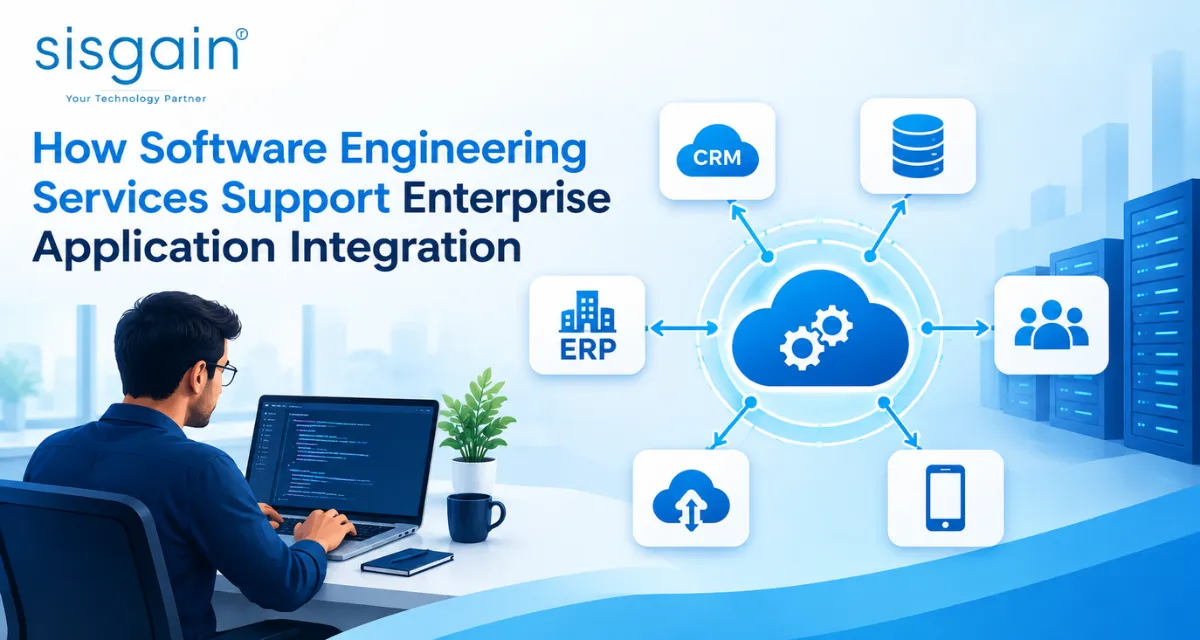
Modern enterprises rarely run on a single system. A typical organization depends on a CRM to manage customer relationships, an ERP to handle finance and operations, HR and payroll platforms for workforce management, e-commerce systems for sales, and a growing number of cloud applications for everything from analytics to collaboration. Each of these tools solves a specific problem, but when they operate independently, they create new ones.
Disconnected systems lead to data silos, duplicated records, and manual work that slows teams down. A sales representative may not know that a customer's invoice is overdue. A finance team may spend hours reconciling numbers that should already match. An HR department may re-enter the same employee data across three different platforms. These inefficiencies compound as a business grows, making integration not just a technical convenience but a business necessity.
This is where software engineering services play a central role. By designing and implementing enterprise application integration (EAI) solutions, software engineering teams help businesses connect their systems, automate data flow, and build a technology environment that supports rather than hinders operations. The result is improved connectivity, consistent data across departments, less manual effort, and an infrastructure that can scale as the business evolves.
What Is Enterprise Application Integration?
Enterprise application integration refers to the practice of connecting different software applications, databases, and business processes so they can share data and work together seamlessly. Rather than operating as isolated tools, integrated systems exchange information automatically, giving every department access to accurate, up-to-date data.
It's worth distinguishing EAI from application modernization. Modernization focuses on updating or replacing outdated technology, while integration focuses on connecting existing systems—old or new—so they function as a cohesive whole. In practice, the two often go hand in hand, since integration projects frequently reveal legacy limitations that need to be addressed.
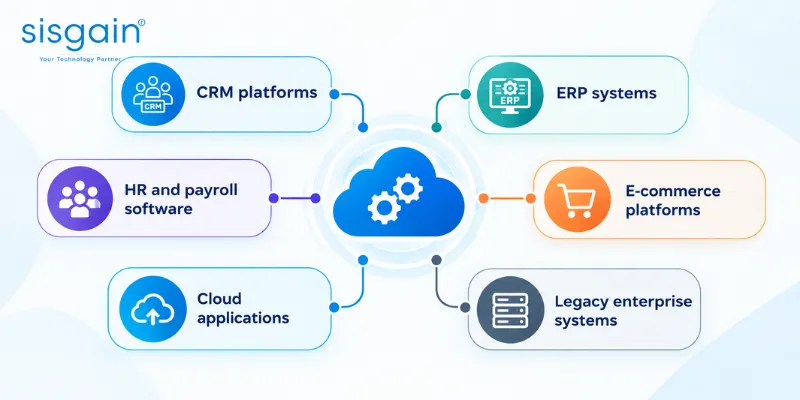
Common systems that typically require integration include:
- CRM platforms
- ERP systems
- HR and payroll software
- E-commerce platforms
- Cloud applications
- Legacy enterprise systems
Why Enterprise Application Integration Matters
Well-executed integration delivers benefits that ripple across the entire organization. It reduces data silos by ensuring information flows between systems instead of being trapped within them. It improves information sharing, giving teams visibility into data they previously had to request from another department. It supports consistent business processes, since automated workflows follow the same rules every time. It enables better decision-making by providing leadership with a unified, accurate view of operations. And it reduces repetitive manual work, freeing employees to focus on higher-value tasks.
Read More - The Future of AI Infrastructure Management for Enterprises
Common Challenges in Enterprise Application Integration
Despite its benefits, integration is rarely simple. Several recurring challenges make it a complex undertaking.
Disconnected business systems are often the starting point of the problem. Departments frequently adopt applications independently, based on their specific needs, without considering how those tools will communicate with the rest of the organization's technology stack.
Legacy application limitations add another layer of difficulty. Older systems may rely on outdated technologies or proprietary interfaces that were never designed to connect with modern software, making integration technically demanding.
Data inconsistency and duplication is a widespread issue. When the same information—such as a customer's contact details—is stored in multiple systems, discrepancies are almost inevitable, and resolving them after the fact is time-consuming.
Security and compliance requirements must be addressed throughout the integration process. Data moving between systems needs to be protected, and access controls must be enforced consistently to meet regulatory obligations.
Scalability and performance issues can also surface as data volumes and transaction demands grow. An integration solution that works well for a small dataset may struggle under enterprise-scale loads if it isn't designed with growth in mind.
Finally, complex integration management becomes a challenge of its own once multiple integrations exist across on-premises and cloud environments, each requiring monitoring, updates, and troubleshooting.
How Software Engineering Services Support Enterprise Application Integration
Software engineering services address these challenges through a structured, methodical approach.
Assessing existing systems and integration requirements is typically the first step. This involves reviewing current applications, workflows, and data sources; identifying integration gaps and business priorities; evaluating existing APIs, databases, middleware, and legacy interfaces; and creating an integration roadmap aligned with business goals.
Designing scalable integration architectures comes next. Engineering teams develop architectures that connect applications reliably, selecting integration patterns suited to the organization's specific needs. These architectures are built to support cloud, on-premises, or hybrid environments, and are designed with maintainability, performance, and future expansion in mind.
Developing APIs for seamless application connectivity is one of the most common technical components of integration work. APIs allow applications to exchange data in a structured, controlled manner. Software engineering services typically focus on RESTful APIs, proper authentication, versioning, and clear documentation, while supporting secure communication between internal and external systems and enabling reusable integration capabilities that can serve future projects.
Integrating legacy systems with modern applications allows businesses to connect older platforms with cloud-native and modern tools without discarding existing investments. This is often achieved through APIs, adapters, middleware, or carefully designed data interfaces, minimizing disruption while extending the useful life of legacy infrastructure.
Implementing middleware and integration platforms provides a layer that manages communication between systems using different technologies. Middleware, message brokers, and enterprise service buses can centralize integration management, making it easier to monitor and maintain connections across the enterprise.
Automating data synchronization and business workflows reduces the manual data entry and repetitive processes that slow teams down. Depending on business needs, synchronization can happen in real time or on a scheduled basis, improving workflow efficiency across departments.
Building secure and reliable integration solutions is a priority throughout the process. This includes implementing authentication and authorization, protecting data in transit and at rest, applying encryption, logging, and access controls, and designing for error handling, retries, and fault tolerance—all while supporting relevant compliance requirements.
Testing and monitoring integrated applications ensures that integrations continue to function correctly over time. This involves functional, integration, performance, and security testing, along with ongoing monitoring of API health, data flows, and system performance to catch failures and bottlenecks before they affect the business.
Key Enterprise Application Integration Patterns
Different integration needs call for different approaches. The table below outlines common patterns and where they typically apply.
| Integration Pattern | Description | Common Use Case |
| Point-to-Point Integration | Connects two applications directly | Simple, limited system connections |
| API-Led Integration | Uses APIs to expose and consume application capabilities | Connecting cloud and enterprise applications |
| Event-Driven Integration | Systems communicate through events or messages | Real-time notifications and workflow automation |
| Message-Based Integration | Uses messaging systems to exchange data reliably | Asynchronous enterprise processes |
| Data Integration | Synchronizes or consolidates data across systems | Reporting, analytics, and master data management |
| Hybrid Integration | Connects on-premises and cloud applications | Enterprise cloud adoption |
Benefits of Using Software Engineering Services for Enterprise Integration
Partnering with experienced software engineering teams delivers measurable advantages. Improved data accuracy and consistency results from connected systems that eliminate duplicate and conflicting records. Greater operational efficiency follows as automation reduces manual processes and boosts productivity. Better customer and employee experiences emerge when integrated systems provide faster access to accurate information. Enhanced scalability and flexibility allow well-designed integrations to support business growth and the addition of new applications. Stronger security and compliance come from consistent controls and improved visibility across data flows. And reduced long-term maintenance complexity is achieved through reusable APIs, thorough documentation, and centralized monitoring.
Enterprise Application Integration Use Cases
Integration touches nearly every business function:
- CRM and ERP integration synchronizes customer, order, inventory, and financial data, improving visibility across sales and operations.
- E-commerce and payment system integration connects online stores with payment gateways, inventory, and fulfillment systems, supporting smoother order processing.
- HR and payroll system integration exchanges employee information between HR, payroll, and benefits platforms, reducing repetitive administrative work.
- Cloud and legacy system integration connects existing enterprise applications with modern cloud services, supporting gradual digital transformation.
- Data and analytics integration consolidates data from multiple business systems to support reporting, dashboards, and business intelligence.
Best Practices for Successful Enterprise Application Integration
Organizations that succeed with integration tend to follow a consistent set of practices: define clear business objectives before selecting technologies; choose the right integration architecture for the systems and workflows involved; prioritize API security and data governance; use standardized data formats and contracts; design for scalability and fault tolerance; implement comprehensive testing and monitoring; document integrations for easier maintenance; and plan for ongoing optimization as systems and business needs change.
How to Choose the Right Software Engineering Services Provider
Selecting the right partner is critical to a successful integration project. Decision-makers should evaluate a provider's experience with enterprise application integration specifically, along with their expertise in APIs, middleware, cloud, and legacy systems. Security and compliance capabilities deserve close scrutiny, as do development, testing, and monitoring practices. Look for a provider that emphasizes scalable and maintainable solutions, offers ongoing support and integration management, and can point to relevant case studies and technical expertise that align with your industry and systems.
The Future of Enterprise Application Integration
Enterprise integration continues to evolve. API-first architectures are becoming the standard approach for connecting systems, while event-driven architectures are seeing increasing adoption for real-time responsiveness. AI-assisted development and monitoring tools are beginning to streamline integration work, and cloud-native integration platforms are gaining wider use. There is growing emphasis on real-time data connectivity, as well as the integration of AI-powered applications into existing enterprise systems. Throughout all of this, security, governance, and interoperability remain central concerns that shape how integration solutions are designed and maintained.
Conclusion
Software engineering services give enterprises the technical expertise needed to connect disparate applications, automate workflows, and establish consistent, reliable data flow across the organization. From assessing existing systems to designing scalable architectures, developing APIs, and implementing secure, well-tested integration solutions, these services address the full lifecycle of enterprise application integration.
As business systems continue to multiply and diversify, the organizations that invest in scalable, secure, and maintainable integration architectures will be best positioned to operate efficiently and adapt to change. Now is the time for businesses to assess their current systems and develop an integration strategy that supports their long-term goals.





















Sign in to leave a comment.