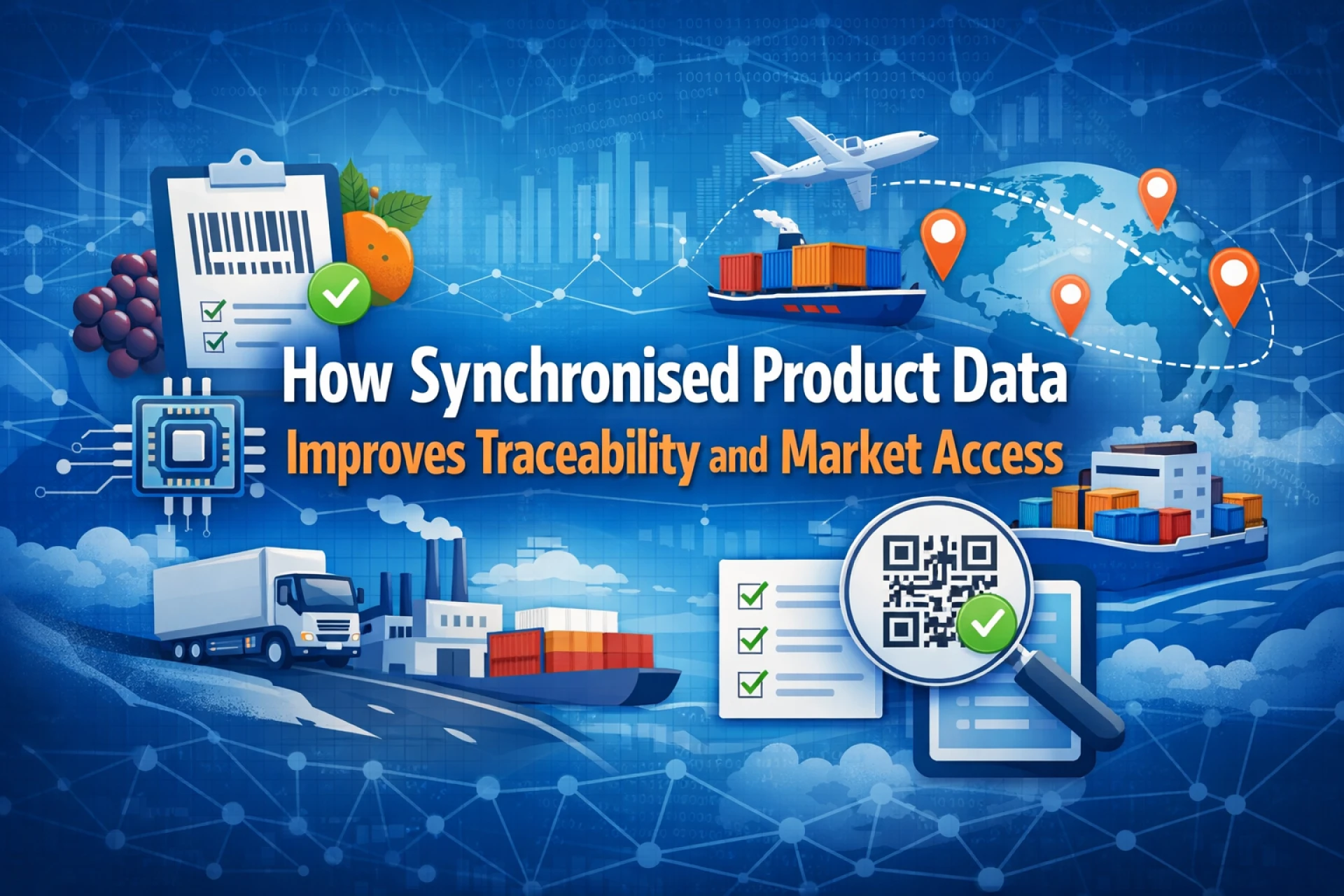

Your product may be excellent. Your packaging may be compliant. But if your product data is outdated, inconsistent, or locked in silos, your business will face friction. Listing rejections, traceability gaps, and blocked market access often stem from data issues rather than product quality.
Modern commerce runs on data accuracy. Retailers, marketplaces, regulators, and logistics partners rely on structured, consistent product information to function smoothly. This is where synchronised product data becomes a business enabler.
When data is aligned across systems and partners, it supports traceability, accelerates onboarding, and unlocks new markets. In this blog, we explore why data synchronisation matters, how it strengthens traceability and access, and how businesses can operationalise it today.
What Is Synchronised Product Data and Why Does It Matter
Synchronised product data means that every stakeholder in the value chain has access to the same product information. This includes manufacturers, brand owners, distributors, retailers, marketplaces, and logistics partners.
Without synchronisation, problems multiply quickly. Multiple versions of product attributes appear across channels. SKUs conflict with each other. Certifications are missing or outdated. Listings are delayed or rejected. Inventory systems lose accuracy. Traceability efforts suffer from blind spots.
Consistent data forms the backbone of operational reliability. When attributes such as identifiers, packaging levels, licences, and labels are aligned, systems can interpret products correctly at every touchpoint. This directly supports product traceability, because items can be identified and followed without ambiguity.
Platforms built for advanced data management highlight features such as certification mapping, digital QR generation, and identifier linking. All of these functions exist to ensure that data stays aligned. Once data is synchronised, downstream systems can finally work as intended.
How Synchronised Product Data Enables Product Traceability
Traceability refers to the ability to identify a product and follow its movement across the supply chain. This includes manufacturing, storage, transport, retail, and consumer interaction. For traceability to work, product data must be consistent at every node.
Consider a simple scenario - A barcode is scanned at a retail outlet. If the scanned identifier does not match the product description stored in the system, the result is undesired. The product may be rejected, returned, or delisted. The issue is not the barcode itself, but unsynchronised data behind it.
Now consider a recall situation. If batch or lot data is not updated uniformly across channels, affected products may remain in circulation. This weakens product traceability and increases regulatory and reputational risk.
Advanced data platforms allow businesses to link identifiers with certifications, licences, packaging hierarchies, and digital labels. When this information is aligned, brands can trace products across channels, meet regulatory obligations, and reassure partners and consumers. This is the operational power of synchronised product data in action.
Synchronised Product Data and Market Access: The Business Link
Market access today depends heavily on data readiness. E-commerce platforms demand enriched and validated product attributes. Retail chains reject products with incorrect identifiers or missing data. Export markets expect standardised information and proof of traceability.
These barriers are data-driven. Manual uploads and fragmented systems struggle to keep up with platform requirements. Each channel introduces new formats, validations, and compliance checks.
Synchronised data changes this dynamic factor. Businesses upload product information once into a central system. That information is then shared with multiple partners in standard formats. Updates flow in real time. New SKUs appear faster. Promotions launch without delay.
This approach also supports regulatory compliance in various sectors. Certification and packaging data can be maintained centrally and shared where required. The result is smoother onboarding, fewer rejections, and faster expansion into new retail and export channels. Synchronised product data becomes a lever for scale rather than a bottleneck.
Step-by-Step Action Plan: Deploying Synchronised Product Data
Implementing data synchronisation requires structure, not guesswork. The process can be broken down into clear steps.
Step 1:
Assess your current data landscape
Review SKU count, variants, data sources, and channel feeds. Identify silos and duplication.
Step 2:
Move to an advanced data management platform
Choose a solution that supports enriched attributes, identifiers, images, certifications, and packaging levels.
Step 3:
Upload and cleanse your product master data
Standardise descriptions, validate identifiers, and attach compliance documents.
Step 4:
Configure sharing and integrations
Set up feeds or APIs for retailers, marketplaces, and partners. Ensure identifier accuracy.
Step 5:
Monitor synchronisation continuously
Apply version control, update rules, and alerts for mismatches or missing data.
Step 6:
Connect traceability workflows
Use aligned data to support batch, lot, and movement tracking across the supply chain.
This structured approach turns data management into a growth engine rather than an operational drain.
Key Business Benefits and ROI
The return on investment from data synchronisation is both operational and strategic.
- Faster listing approvals and channel onboarding
- Reduced returns caused by incorrect descriptions or identifiers
- Stronger product traceability in regulated environments
- Improved brand credibility with retailers and partners
- Scalable launches across geographies and portfolios
When data is aligned, teams spend less time fixing errors and more time building markets. Consistency reduces friction across the ecosystem. Over time, the cost of poor data far exceeds the investment required to manage it properly.
Common Objections and How to Address Them
Some businesses hesitate to adopt structured data synchronisation. These concerns are common, but solvable.
“We already manage data in our ERP.”
ERP systems are not designed to act as a shared source of truth across external channels.
“The cost feels high.”
Reduced rework, faster listings, and fewer rejections deliver measurable ROI.
“Data synchronisation seems complex.”
Modern platforms provide guided onboarding, automation, and technical support.
“We only sell locally.”
Even local retailers benefit from consistent data, and readiness supports future growth.
Addressing these objections early, accelerates adoption and value realisation.
Conclusion
Data quality now defines commercial success. Inconsistent information slows listings, weakens compliance, and blocks growth. Synchronised product data is no longer optional for businesses that want traceability and market access.
When data is aligned, product traceability becomes reliable, audits become simpler, and partners gain confidence. Businesses move faster and scale with less friction.
Now is the time to evaluate your data maturity. Upgrade your data processes, centralise control, and transform product information into a strategic asset. Better data is not just operational hygiene, it is a growth-led decision.
FAQs
1. What is synchronised product data, and why is it needed?
It ensures all partners use the same accurate product information.
2. How does data synchronisation support traceability?
Aligned data enables consistent identification and tracking across systems.
3. Can synchronised data integrate with marketplaces and ERPs?
Yes, modern platforms support APIs and structured feeds.
4. How soon can benefits be seen after implementation?
Many businesses see improvements within the first few listing cycles.
5. Is data synchronisation useful for small brands?
Yes, it reduces errors early and supports future scale.































Sign in to leave a comment.