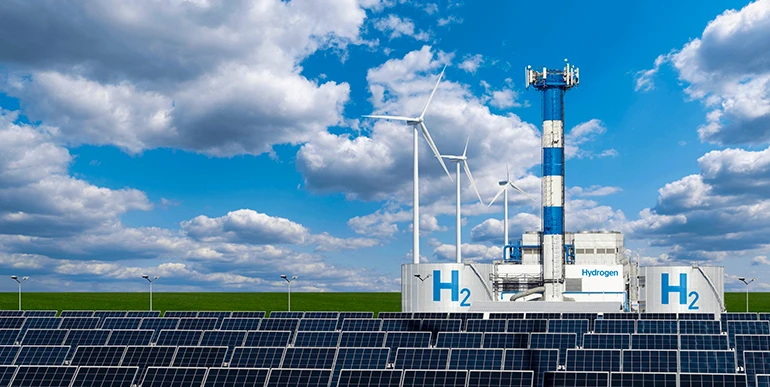

If you follow India’s energy transition, you’ve probably heard about the green hydrogen revolution. It’s been around for a while, but it’s no longer something only for the future. Green hydrogen is real, and it’s starting to matter for heavy industries in India.
Industries like steel, cement, and fertilizer use a lot of energy and produce a lot of carbon. They also have the money and infrastructure to make a shift. To reach India’s net-zero goals by 2070, these industries need something that can handle heavy energy use. Green hydrogen fits that need.
Why Green Hydrogen Matters
Hydrogen isn’t new. It’s been used in chemical processes for decades. Most hydrogen until now hasn’t been green. It comes from natural gas and produces CO₂. Green hydrogen is made by splitting water into hydrogen and oxygen using solar, wind, or hydro power. It produces almost no carbon.
At scale, this can change heavy industries. Steel plants could run on hydrogen instead of coal. Cement kilns could use hydrogen instead of fossil fuels. That would cut emissions a lot. Investors are starting to prefer low-carbon products. Old-style heavy industries might lose out if they don’t adapt.
The Opportunity for Indian Heavy Industries
Steel production alone makes up about 7 to 8 percent of India’s emissions. Cement and fertilizer are not far behind. The potential for green hydrogen is practical, not just theoretical. Some Indian industrial players have started pilot projects. Scaling is not easy. Electrolyzers cost a lot. Renewable energy supply can be inconsistent. Existing processes need adjustments to work with hydrogen.
This is where Green Hydrogen Company India comes in. Domestic companies are offering solutions for industrial hydrogen use. Some supply hydrogen. Some provide integrated systems. A few focus on storage and transport. Hydrogen is light, volatile, and tricky to store. But these are engineering challenges that can be solved with expertise and investment.
Beyond Emissions: Economic and Strategic Gains
Green hydrogen is not just about cutting carbon. India could become a global supplier. Europe and Japan are paying high prices for low-carbon hydrogen. India could produce it domestically and export it. Heavy industries could get new revenue streams while decarbonizing.
It also improves energy security. India imports a lot of coal and gas. Hydrogen made locally with renewables can reduce dependence on imports. Industries can plan with more certainty and costs could stabilize. Climate benefits are part of the package.
Challenges Nobody Talks About
Green hydrogen is not simple. Electrolyzers cost a lot and use energy. Renewable energy availability can fluctuate. Storage is difficult. You can’t just put a tank of hydrogen next to a furnace.
Mindset is another challenge. Industries have run on fossil fuels for decades. Changing processes and training engineers takes time. Hydrogen is not a silver bullet. It’s one tool in a bigger decarbonization strategy.
Why Timing Is Critical
If India wants to lead the green hydrogen revolution, timing matters. Other countries are moving fast with export projects. India cannot wait until costs drop further.
The pieces are coming together. Solar and wind are cheaper than ever. Electrolyzer efficiency is improving. Domestic companies are ready to act. Early adopters in heavy industries will gain both economically and in reputation. Waiting too long could mean losing the advantage.
A Personal Take
I have seen a lot of energy technologies over the years. Some get hyped and never make a difference. Others quietly change industries. Green hydrogen belongs in the second group. It’s complicated and costly, but it works and scales. Heavy industries in India can benefit if they address engineering challenges and invest in the ecosystem.
Not all emissions reductions have to be revolutionary. Small improvements combined with hydrogen adoption can be very effective. Smart application matters more than flashy announcements.
The green hydrogen revolution is not just a headline. It’s a practical pathway. Steel, cement, and chemical industries can transform operations, stay competitive, and reduce emissions. The question is whether they are ready to adopt it.









Sign in to leave a comment.