

A forceps that closes off-axis is not a minor quality issue when the working field is brain or spinal tissue. That is why buyers should judge Mediwave Neurosurgery Instruments by handling, finish, alignment, reprocessing compatibility, and repeatability—not catalogue photos alone. WHO’s medical-device reprocessing manual has guided healthcare facilities since 2016 and treats cleaning, disinfection, and sterilization as controlled steps. In neurosurgery, instrument quality affects surgical work before the tray even reaches theatre.
What the Instrument Has to Get Right
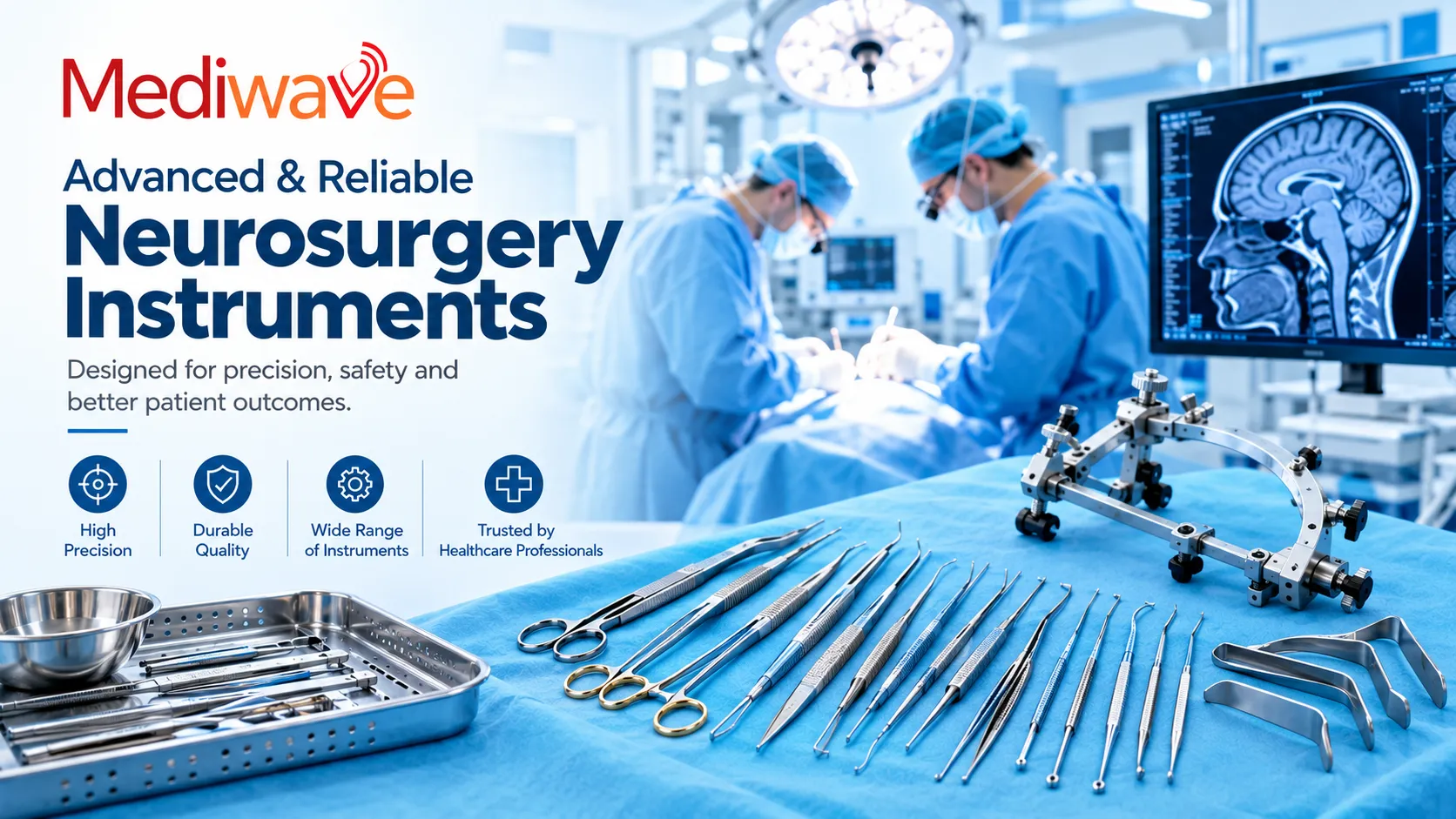
Mediwave lists five neurosurgery categories: neurosurgical forceps, neurosurgical scissors, bone punches, trephines, and neurosurgery sets. Its range also names Yasargil micro scissors, Yasargil tumor grasping forceps, Scoville trephines, and Kerrison bone punches.
Tip Geometry, Alignment, and Grip
Here’s the detail buyers often skip: two instruments can share a name while feeling completely different at the tip. Fine forceps should meet evenly; scissors should cut cleanly; punches should close without side play. Mediwave specifies medical-grade stainless steel, corrosion resistance, reusable construction, and autoclave compatibility.
Surface Finish and Reprocessing
Glare, rough joints, trapped residue, and damaged working edges create avoidable problems. CDC guidance classifies surgical instruments contacting sterile tissue as critical items that must be sterile before use. Which means material and finish decisions need to survive validated cleaning and sterilization, not merely dispatch inspection.
Five Supplier Answers Worth Testing
1. Material traceability: Ask what grade is used and how batches are controlled. “Surgical steel” with no detail is a bad answer.
2. Functional inspection: Ask how tip alignment, joint movement, cutting action, and punch closure are checked. “We visually inspect every piece” is weak for micro instruments.
3. Reprocessing compatibility: Ask for cleaning and sterilization instructions. CDC recommends centralized processing where practical to improve quality control.
4. Replacement policy: Ask what happens if a tip arrives misaligned or a joint binds. “Case by case” is not a policy; it is a future argument.
5. Supply clarity: Get SKU, quantity, packing, lead time, and dispatch commitment in writing. Matching replacements six months later is often harder than placing the first order. Price cannot rescue a bad working end.
Where Better Instruments Protect Buyer Risk
Controlled tip response reduces unnecessary hand correction during delicate work. Corrosion resistance and joint stability can reduce premature replacement. Standardized sets help OT and CSSD teams spot missing or mismatched pieces before a case. And predictable balance keeps the surgeon focused on the field, not the instrument.
Better specifications also protect purchasing margins. The cheapest unit becomes expensive after repair, emergency replacement, or failed reprocessing is added. WHO’s 2022 aide-memoire describes decontamination as a sequence from collection through processing, storage, and distribution, so reusable instruments must perform through that whole path.
Neurosurgery Instrument Supply Across India
For hospitals comparing Neurosurgery Instruments Manufacturers in India, location matters less than dispatch discipline, replacement access, and repeat-order consistency. Mediwave lists A-74, New Dashmesh Nagar, Jalandhar 144003, Punjab, plus a 24/7 call line. That northern base supports national dispatch, but freight speed should never replace stock confirmation. Neurosurgery Instruments Suppliers should confirm the exact SKU before promising a delivery date.
For procurement teams seeking Precision Neurosurgery Instruments Manufacturers, written specification matching is more useful than a vague “same model available” assurance.
One Source, Fewer Procurement Gaps
We offer many clinical categories so a hospital won‘t have to call a new vendor for every family of instruments. Our live listing has 10 core clinical categories which include neurosurgery, orthopedic, ENT, dental, vascular, diagnostic, urology and trays/accessories.
This is an example of operating detail that we users can confirm. We are therefore displaying five distinct subcategories of neurosurgery rather than smooshing them all into a generic surgical webpage. We do that because a Kerrison bone punch, Yasargil micro scissor and neurosurgical forceps should never be assessed as interchangeable “neuro instruments”.
We keep our phone line available 24/7. We ask buyers to send the instrument name or SKU, required quantity, delivery location, and any set or packaging requirement. Our MOQ is confirmed against the exact item and order mix rather than presented as one blanket number across every neurosurgery product. We quote more accurately when those four details arrive together.
We would rather clarify a tip pattern before quoting than discover a mismatch after dispatch.
Conclusion
Choosing Mediwave Neurosurgery Instruments should come down to precision, handling, reprocessing compatibility, and clear supply terms. Mediwave currently separates its neurosurgery range into five defined categories, giving buyers a practical starting point for specification matching. The next purchasing advantage will come from treating instrument data as seriously as instrument price.
FAQs
1. What are Mediwave Neurosurgery Instruments used for?
They encompass brain and spinal business via forceps, scissors, bone punches, trephines, and neurosurgery arrangements. Precise assortment relies on surgeon inclination and business.
2. What should hospitals ask Neurosurgery Instruments Manufacturers before ordering?
Request material, finish, tip pattern, size, sterilize compatibility, test, lead time, and replacement terms. Only a catalogue picture can make sure functional conformity.
3. Are Neurosurgery Instruments Manufacturers in India suitable for institutional procurement?
Yes, provided that specifications, quality control, reprocessing directions, and supply conditions are established. Warning: source alone cannot guarantee batch uniformity.
4. What should I compare between Neurosurgery Instruments Suppliers?
Compare SKU level specs, packaging, stock position, replacement support and delivery commitment. Only compare price once these points are satisfied.
5. Why choose Precision Neurosurgery Instruments Manufacturers?
Tip shape, balance, joint movement, finish and repeatability are all essential considerations for fine work. Regardless of these, samples should always be checked before the go-ahead is given for an extensive institutional order.
























Sign in to leave a comment.