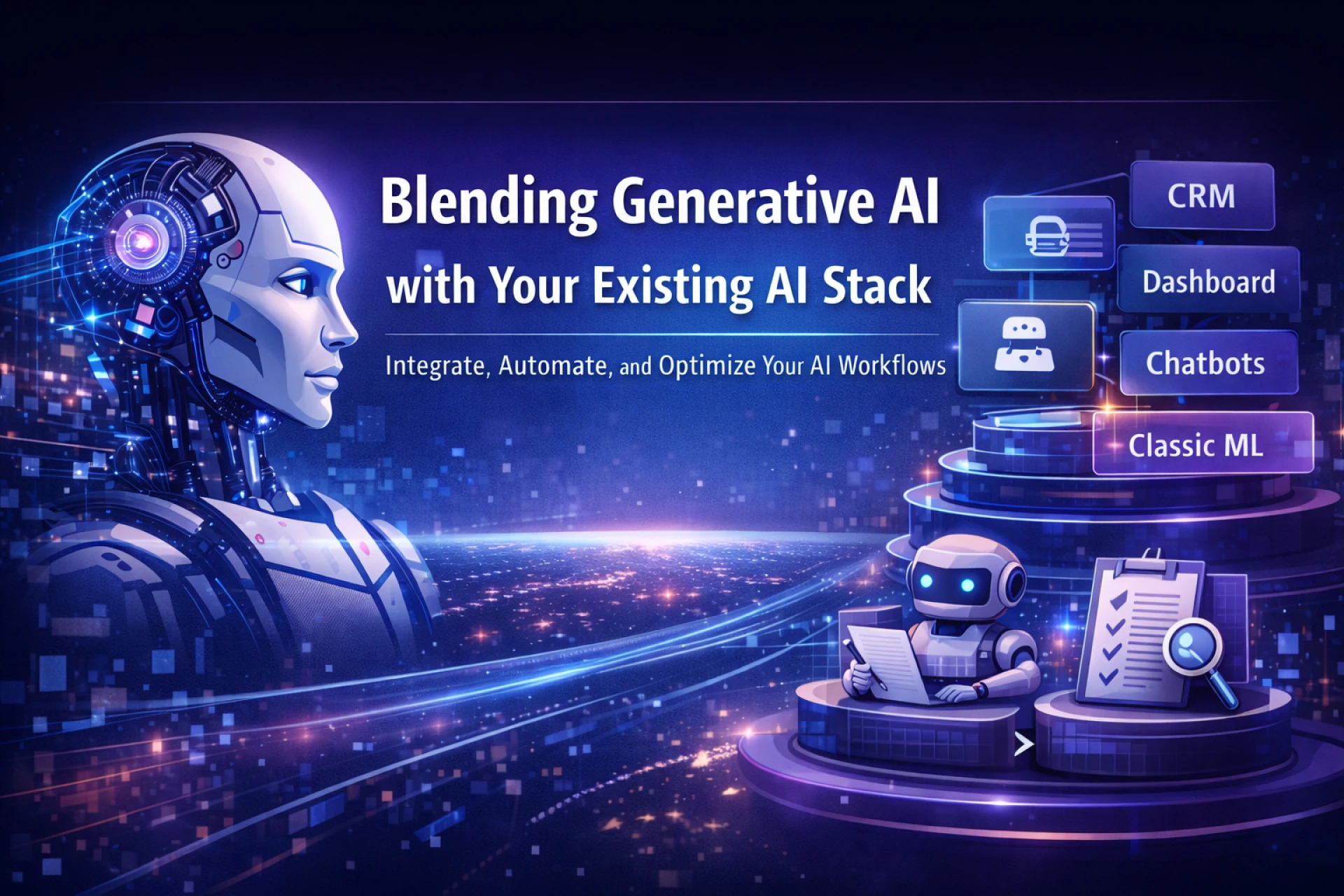

A couple months ago, a colleague told me, “We already have dashboards, chatbots, and automation… why do we need generative AI too?” Fair question. Most teams aren’t starting from zero—they’ve got predictive models, rules engines, CRM workflows, maybe even OCR or speech-to-text running quietly in the background. The real win comes when you integrate generative AI into that setup rather than treating it as a shiny side project.
That’s also why a Generative AI course for managers can be surprisingly practical: it helps you connect the dots between what’s already working and what’s newly possible. If you’re leading a team and trying to make Gen AI for managers feel less “tech demo” and more “Tuesday morning workflow,” let’s walk through a clean way to do it.
Start with one workflow, not ten tools
Integration goes sideways when you begin with a vendor list. Start with a single workflow that’s frequent, frustrating, and has clear inputs/outputs—such as handling inbound customer emails, creating weekly sales recaps, or screening vendor contracts. Assess your current workflows for AI readiness to ensure a smooth start and effective scaling.
Once the workflow is clear, define what stays deterministic (rules, approvals, calculations) and what can be generative (drafting, summarizing, rewriting, suggesting options). This is where Gen AI for managers becomes practical: you’re not “adding AI”; you’re redistributing work among people, automation, and models.
Before you build, agree on the failure you fear most: wrong price, wrong compliance clause, or a tone-deaf reply. This focus on guardrails helps managers feel secure about risks.
Build the integration layer: GenAI + retrieval + classic ML
Most real deployments look like a stack:
- Retrieve the right context (docs, tickets, policies)
- Generate a draft (reply, summary, recommendation)
- Validate with checks (rules, classifiers, thresholds)
Picture support emails. Your generative model is great at wording, but it shouldn’t invent specs. Add retrieval (RAG): pull the relevant product paragraphs, then generate using that context. Reliability improves fast, and your older systems stay valuable.
Classic ML still shines, too. Sentiment classifiers can flag angry messages. Routing models can send tickets to the right queue. Then generative AI turns those signals into a human-ready explanation.
This is where a Generative AI course for managers pays off: managers don’t need to code RAG, but they do need to spot when “just prompt it” is the wrong architecture. Also underrated: structured extraction—use generative AI to pull fields from messy text, then push them into the BI dashboards your org already trusts.
If you’re planning autonomy later, introduce Agentic AI frameworks early, because the moment systems “take actions,” you’ll want permissions and logs from day one.
Add an agentic layer (carefully) to connect systems
After retrieval and validation, the next step is orchestration: read an email → look up order status → check policy → draft reply → open a ticket → notify a manager for high-value refunds.
This is the territory where Agentic AI frameworks come in. The goal isn’t “let AI run wild.” It’s “let AI follow a playbook and use tools like an assistant.”
A practical setup: the model decides the next step, calls tools (CRM lookup, database query, ticket creation), and your system enforces boundaries (approval gates, rate limits, role-based access). In finance or HR, a simple rule works wonders: “Draft is automatic; send is manual.”
If you’re evaluating Agentic AI frameworks, focus on tool calling, audit logs, and traceability (“why did it do that?”). Those features beat flashy demos.
And training matters. Strong Generative AI for managers programs teach task definition, constraints, and escalation paths, helping managers feel prepared and in control of AI deployment.
Roll it out like a product, not an experiment
The rollout is where pilots either create savings or fade out.
Pick workflow metrics. Support teams track handle time and escalation rate. Sales ops tracks time-to-proposal and revision cycles. Then add lightweight governance:
- One owner for prompts/templates and updates
- A weekly review loop for failures
- Clear rules for sensitive data
- Logs that capture inputs, sources, and outputs
Adoption is mostly enablement. Teams that only “announce AI” don’t get consistent use. Teams that train people on what the tool can’t do—and when to escalate—see it stick. That’s why, in many organizations, a generative AI course for managers becomes a change-management toolkit, not just training.
As you scale across departments, Agentic AI frameworks help standardize access to tools, logging, and permissions. That consistency prevents “ten slightly different bots” nobody can maintain, and it keeps Gen AI for managers grounded in repeatable operations.ge
Conclusion: Integration is the real superpower
Generative AI gets headlines, but integration makes it useful: retrieval to keep it grounded, classic ML to keep it sharp, automation to keep it moving, and governance to keep it safe. Start with one workflow, set guardrails, and build the smallest version that saves real time.
If you’re mapping your next learning step, a Generative ai course for managers can help you lead these integrations with confidence—especially when it includes practical Gen AI for managers use cases and a grounded view of Agentic AI frameworks. Pick one workflow this week and ship a small win.

























Sign in to leave a comment.