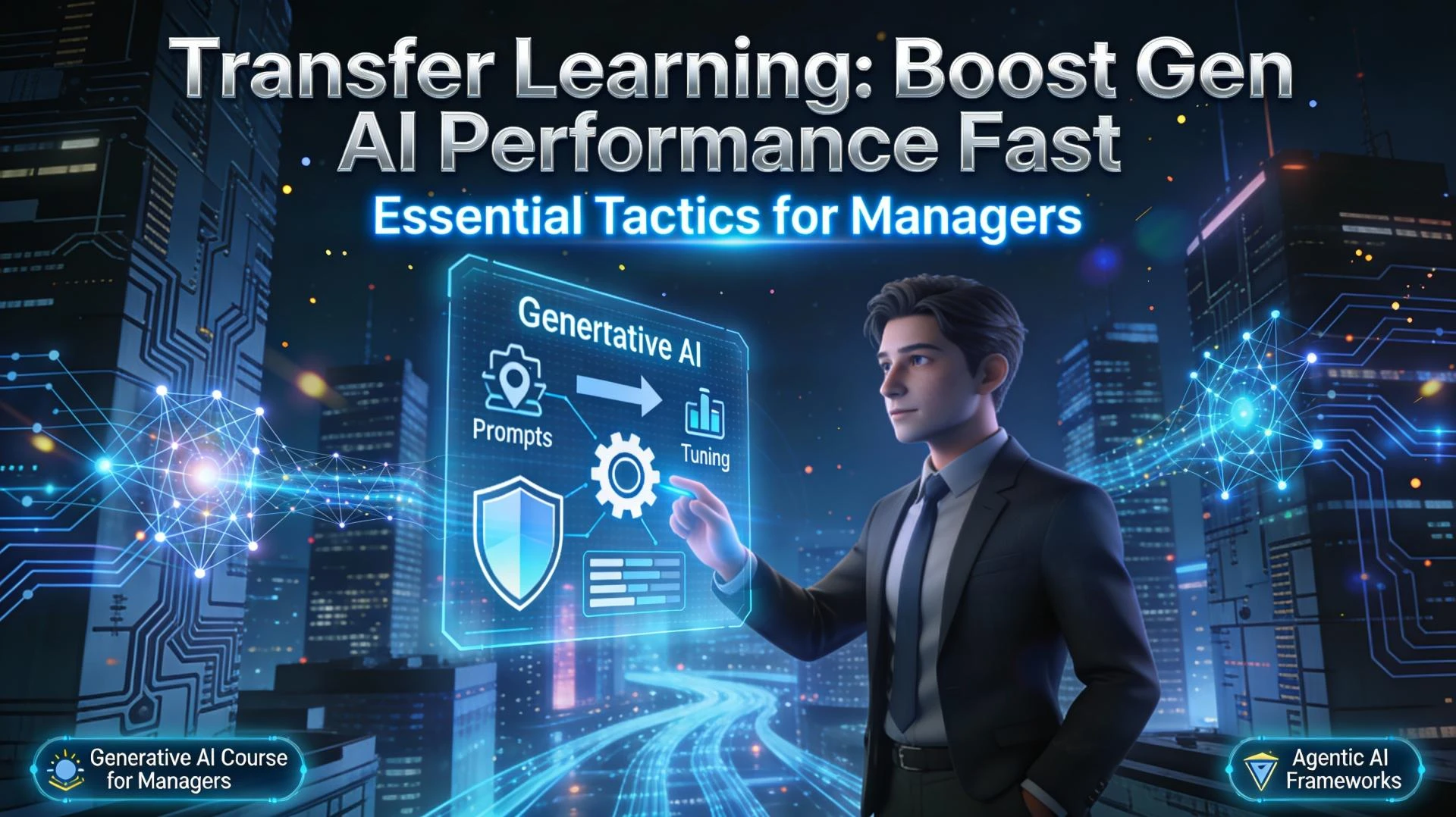

Organizations often adopt a foundation model but still experience uneven output quality, such as inconsistent tone, domain errors, and weak performance with internal terminology. The recurring question is straightforward: how can performance improve without building a model from scratch or waiting months for a large data program? Transfer learning offers a shortcut and is a core capability covered in a generative AI course for managers because it connects technical options to measurable business outcomes.
Transfer learning reuses knowledge learned by a pre-trained model and adapts it to a specific domain, task, or organizational style. It reduces training cost and time, and it often improves accuracy and reliability when data is limited. For leaders responsible for delivery, governance, and ROI, transfer learning becomes less of a research topic and more of an execution tool.
What Transfer Learning Changes in Generative AI Programs
A modern generative model is broadly trained on general language and patterns. This general knowledge is useful, but it rarely matches an organization’s vocabulary, policies, and preferred formats. Transfer learning narrows the gap by guiding the model toward domain-specific patterns while retaining the general capabilities that make foundation models valuable.
For Gen AI for managers, the practical value is predictability. Teams can reduce the number of prompt iterations needed to reach acceptable output. They can also standardize outputs across departments by aligning tone, structure, and terminology, which improves adoption and reduces rework.
Transfer learning also helps to improve system reliability when it is combined in conjunction with Agentic AI frameworks. In a lot of deployments models do not work on its own; it is within a workflow that designs steps, reviews limits, and makes calls to tools. An improved model is likely to follow directions more effectively and reduces the risk of failure in multi-step orchestration and tool-calling.
A Generative AI course for managers typically frames transfer learning as a set of choices: whether to tune weights, tune prompts, add retrieval, or combine methods. The right choice depends on risk tolerance, data sensitivity, deployment constraints, and the required accuracy level.
Transfer Learning Methods That Deliver Measurable Gains
Transfer learning is not a single technique. It is a family of approaches with different tradeoffs in cost, speed, and control. Selecting the method early prevents wasted effort later in evaluation and rollout.
Common approaches include:
- Prompt adaptation and structured prompting standardize inputs and output formats without changing the model’s underlying weights.
- Retrieval-augmented generation, which grounds outputs in approved internal documents and reduces hallucinations.
- Lightweight fine-tuning, like adapter-based tuning, tweaks just a small set of parameters to help the model fit a specific domain.
- Full fine-tuning updates a larger part of the model, which can improve alignment but also adds more risk and maintenance work.
Gen AI for managers often emphasizes that retrieval is not a replacement for tuning. Retrieval improves factual grounding, but it does not fully solve formatting discipline, brand voice, or policy adherence. For those gaps, a tuned model or an instruction-tuning layer tends to help.
Agentic AI frameworks introduce another consideration: the model must behave reliably across steps such as planning, routing, verification, and tool execution. In those setups, transfer learning can focus on tool-use patterns, safe refusal behaviors, and structured output consistency. That combination reduces orchestration complexity and lowers the number of exception paths that need manual handling.
A Generative ai course for managers also highlights maintainability. A solution that is easy to update can outperform a more complex approach when policies, products, and documentation change frequently.
Data, Governance, and Risk Controls for Transfer Learning
Transfer learning depends on data quality and governance for success. The most common issue is not model choice but noisy training signals that teach the model incorrect patterns. Strong controls reduce this risk while keeping the program on track.
Key data and governance practices include:
- Clear scope definition: the tasks, document sources, and output constraints must be explicit.
- Use training examples that are clear, accurate, and aligned with policy. A smaller set of strong examples usually works better than a large set of low-quality ones.
- Sensitive data handling: data minimization, access control, and redaction policies should be formalized before any tuning run.
- Change management: when policies or product definitions change, the dataset and evaluation set must update as well.
For Gen AI for managers, governance also includes accountability. Transfer learning alters model behavior, so auditability and approval workflows should be part of the process. This includes dataset lineage, training configurations, and decision logs detailing what was tuned and why.
Agentic AI frameworks add operational risk areas such as tool permissioning and action boundaries. If an agent can trigger external actions, transfer learning must reinforce guardrails, including refusal behaviors, step verification, and structured outputs that downstream validators can parse. The objective is safe autonomy, not maximum autonomy.
A Generative ai course for managers frequently positions transfer learning as a controlled lifecycle: define, adapt, evaluate, release, and monitor. That lifecycle matters because tuned models can drift in performance as data, prompts, and tools evolve.
Evaluation: Proving Performance Gains and Keeping Them
Transfer learning is supposed to give measurable improvements, other than subjectively better answers. Assessment should be based on the actual use situations: dirty inputs, policy limitations and time-pressure. Without that realism, improvements can disappear after deployment.
A strong evaluation plan includes:
- Use task-based benchmarks that tie directly to business results, such as time to resolution, compliance rates, and the amount of editing needed to reach the final draft.
- Reliability tests for format compliance, refusal behavior, and internal policy constraints.
- Hallucination and grounding checks, especially when retrieval is used.
- Regression testing across model updates, prompt changes, and tool API changes.
Gen AI for managers often tracks two categories of metrics: quality and operational cost. Quality covers accuracy, completeness, and compliance. Cost covers latency, token usage, and the time spent on human review. Transfer learning can reduce cost by improving first-pass quality, even if tuning introduces a small upfront training expense.
Agentic AI frameworks require additional evaluation around multi-step success rates. A model that performs well on single-turn tasks can still fail in multi-step orchestration if it misroutes, loses context, or produces unparseable tool arguments. Transfer learning can target these failures directly by training on structured tool-call traces and validated step outputs.
A Generative ai course for managers also treats monitoring as non-negotiable. Once tuned, the model should be tracked for output drift, policy violations, and shifts in user behavior that change the input distribution.
Conclusion: Transfer Learning as a Managerial Advantage
Transfer learning turns a generic foundation model into a domain-aligned system that produces more consistent, policy-aware outputs with less iteration. It supports faster rollout, clearer measurement, and stronger governance when the program is designed as a lifecycle rather than a one-time build. This is why a Generative AI course for managers often treats transfer learning as a practical management lever, not a purely technical detail.
Teams planning scaled deployment can strengthen results further by pairing transfer learning with disciplined evaluation and controlled orchestration through Agentic AI frameworks, while keeping decision rights, audit trails, and safety constraints explicit. For organizations prioritizing execution, Gen AI for managers becomes most effective when transfer learning choices are tied directly to business metrics and operational controls.




























Sign in to leave a comment.