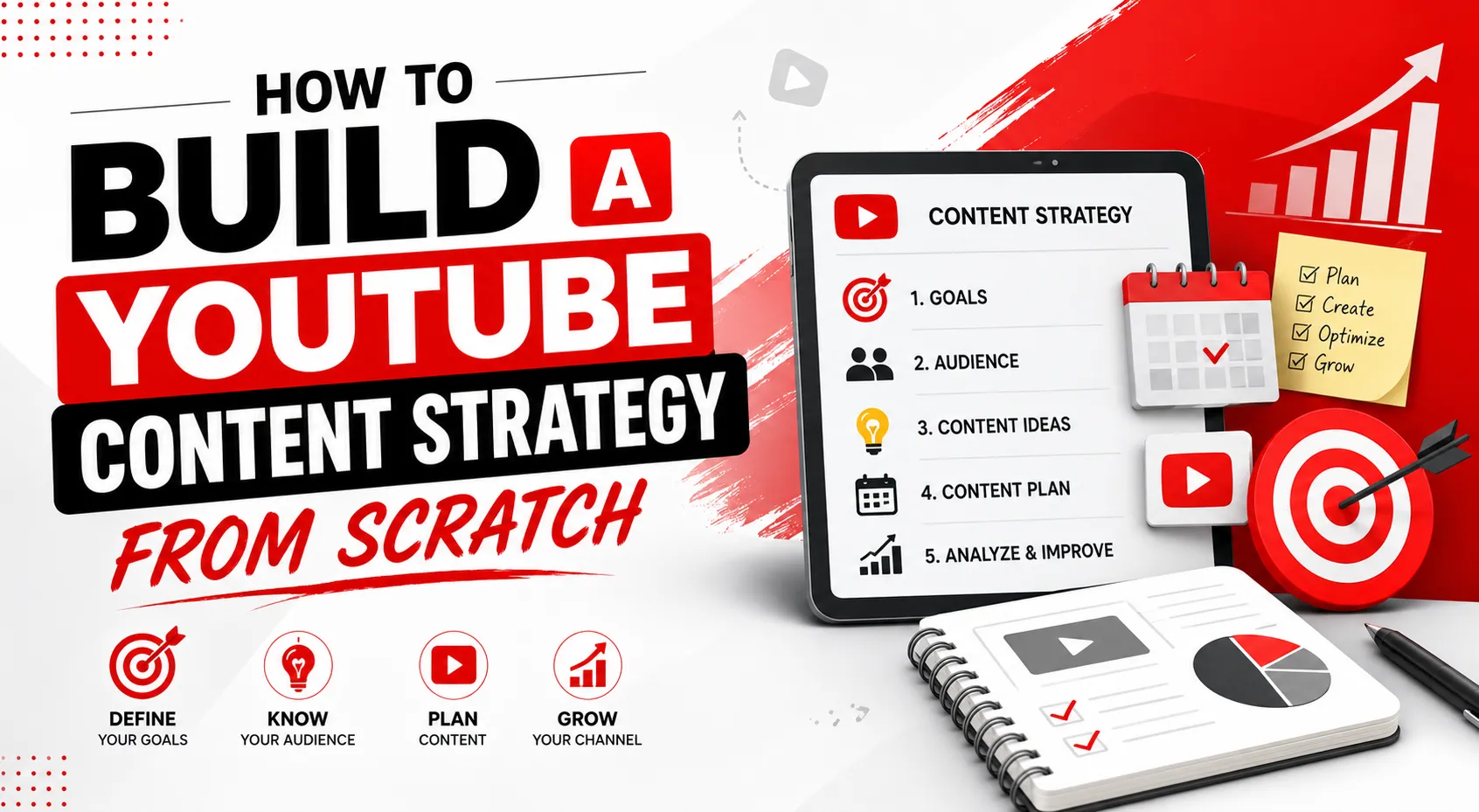

Most creators start YouTube the same way.
They have an idea for a video. They record it. They upload it. Then they wait to see what happens.
When nothing happens, they have another idea. They record that too. Then another. Then another.
Six months later they have 30 videos, 47 subscribers, and no clear direction.
The problem is not the videos. The problem is there was never a strategy behind them.
A content strategy is not complicated. It is a clear plan for what you will make, who you will make it for, and how each video connects to the next. This guide shows you how to build one from scratch.
Start With One Clear Goal
Before you plan a single video, decide what you want YouTube to do for your business or career.
This sounds obvious. Most creators skip it anyway.
Different goals require different strategies. A creator who wants to build a personal brand makes different content than a business trying to generate leads. A creator chasing monetization focuses on different metrics than one building an audience for a course launch.
Pick one primary goal. Some options:
Drive traffic to a website or service. Build an audience around a specific topic. Generate ad revenue through the YouTube Partner Program. Sell a product, course, or coaching offer. Build credibility in a niche.
Write it down. Every content decision you make from this point should connect back to this goal. If a video idea does not serve the goal, it does not belong in the strategy.
Define Your Target Audience With Precision
Most creators define their audience too broadly.
"People who like fitness" is not an audience. "Women in their late twenties who want to build strength at home without a gym membership" is an audience.
The more specific your audience definition, the easier every other decision becomes. You know what topics to cover because you know what problems your audience has. You know what tone to use because you know how they talk. You know what keywords to target because you know what they search for.
Write a one paragraph description of your target viewer. Include their age range, their main problem or goal, what they already know about your topic, and what they want to learn.
Every video you make should speak directly to that person.
Choose Your Niche and Own It
Your niche is the specific corner of YouTube you are going to own.
Not "fitness." Not "technology." Not "business." Something specific enough that a viewer immediately understands what your channel is about and why they should subscribe.
"Home workouts for busy parents" is a niche. "Productivity tools for freelance designers" is a niche. "YouTube growth strategies for small creators" is a niche.
The narrower your niche, the faster the algorithm learns your channel and the faster you build a loyal audience. A channel that tries to cover everything attracts nobody consistently because YouTube cannot figure out who to show it to.
Pick your niche before you plan your first video. Then make every video within that niche until you have a clear audience and the algorithm understands your channel.
Map Out Your Content Pillars
Content pillars are the three to five main topic areas your channel covers within your niche.
They give your content strategy structure. Instead of thinking "what should I make next," you think “which pillar does my next video belong to.”
For a YouTube growth channel, pillars might look like this:
YouTube SEO and keyword research. Thumbnail and title optimization. Audience retention and video structure. Channel growth strategy. YouTube analytics and data.
Every video you make fits into one of these five areas. This keeps your content focused, builds topical authority in each area, and makes it easier for the algorithm to understand what your channel covers.
Map out your pillars before you plan individual videos. Aim for three to five. More than five and your content becomes scattered. Fewer than three and you run out of ideas fast.
Build a Keyword Bank Before You Record Anything
A keyword bank is a list of video topics your audience is actively searching for, organized by pillar.
This is the most important planning step most creators skip.
Go to YouTube and type your niche topic into the search bar. Look at the autocomplete suggestions. Each one is a real search phrase. Write down every relevant suggestion.
Use TubeBuddy or VidIQ to check search volume and competition for each phrase. Keep the ones with real search volume and manageable competition. Discard the ones with no search demand.
Do this for each of your content pillars. Aim for 10 to 15 keywords per pillar. That gives you 30 to 75 video ideas before you have recorded a single frame.
A keyword bank solves the "I do not know what to make next" problem permanently. You never run out of ideas because you planned them in advance based on what people are actually searching for.
Plan Your First 10 Videos
Your first 10 videos set the foundation for your entire channel. The algorithm uses them to understand your niche. New visitors watch them to decide whether to subscribe.
Plan them before you record any of them.
Choose one keyword from your bank for each video. Pick topics that cover different pillars so your first 10 videos give a complete picture of what your channel offers.
Order them with intention. Your first video should cover the most searched topic in your niche. This gives you the best chance of getting early views from search. Your second and third videos should cover related topics that build on the first.
Write the title for each video before you record it. The title determines the keyword you are targeting and the viewer you are speaking to. Recording a video without a title is like driving without a destination.
Create a Realistic Posting Schedule
Consistency matters more than frequency.
One video per week posted every week for six months beats three videos one week and nothing for the next three weeks. Every time.
Look at your available time honestly. How many hours per week can you realistically spend on YouTube? A 10 minute video typically takes three to five hours to script, record, edit, and optimize. Work backwards from that number.
If you have five hours per week, one video per week is realistic. If you have ten hours, two videos per week is possible. If you have two hours, one video every two weeks is better than burning out trying to post weekly.
Set a schedule you can maintain for six months without dropping. That is the only schedule worth committing to.
Plan Your Internal Linking Strategy
Most creators think of their videos as separate pieces of content. The best creators think of their channel as a connected library.
Every video you make should link to at least one other video on your channel. In the video itself, mention a related video by name. In the description, link to two or three related videos. Use end screens to push viewers to the next logical video in your content library.
This builds watch time at the channel level. A viewer who watches three videos instead of one generates three times the watch time signal for the algorithm. Channels with strong internal linking grow faster because they keep viewers watching longer.
Plan your internal links before you record. When you script a video, identify which existing videos it connects to and plan where you will mention them.
For a complete breakdown of how to get your videos in front of more people once your content strategy is in place, this guide on get views on youtube covers the full distribution strategy in detail.
Build Promotion Into Your Strategy From Day One
A content strategy without a promotion plan is incomplete.
YouTube's algorithm distributes your content to existing audiences. But it needs performance data before it does that. New channels have no performance data. So new channels get almost no algorithmic distribution.
You need to generate your own traffic in the early stage. This means sharing every video in communities where it genuinely helps people, writing supporting content that links to your videos, and using YouTube Shorts to reach new audiences fast.
Some creators also use YouTube promotion services to give new videos an early watch time signal. When done right, this gives the algorithm the data it needs to start distributing the video organically.
If you want to accelerate your channel's early growth, a reliable youtube views boost service that delivers real engagement can help you build the initial momentum your strategy needs to gain traction.
Review and Adjust Every 90 Days
A content strategy is not a fixed document. It is a living plan that improves as you learn more about your audience and what works on your channel.
Every 90 days, sit down with your YouTube Analytics and review your strategy.
Which videos performed best? Do more of that topic and format. Which keywords drove the most search traffic? Add more videos in that area. Which pillar has the strongest audience retention? That is where your audience is most engaged.
Adjust your keyword bank, your pillars, and your posting schedule based on what the data shows. Your strategy in month nine should look different from your strategy in month one because you will know far more about your audience by then.
For a deeper look at how to read your channel data and turn it into better decisions, this guide on youtube channel analytics covers every signal that matters and how to act on it.
And if you want to understand what holds most channels back even with a solid strategy in place, this breakdown of how to improve youtube retention covers each mistake and how to fix it.
The Strategy Is the Shortcut
Most creators think strategy slows them down. They want to start making videos, not planning them.
The creators who plan first consistently outperform the ones who jump straight into recording. Not because planning is magic but because it removes the two biggest time wasters on YouTube: making videos nobody searches for and making videos that do not connect to each other.
A clear strategy means every video you make has a purpose, a target audience, and a keyword. Every video connects to the next. Every video builds toward your goal.
That is not slower than making random videos and hoping something works. It is faster. Because every hour you spend making a video with a strategy behind it compounds. Every hour you spend making a random video does not.
Spend one afternoon this week building your strategy. Map your pillars. Build your keyword bank. Plan your first 10 videos.
Then start recording. With a strategy behind every video you make.



























Sign in to leave a comment.