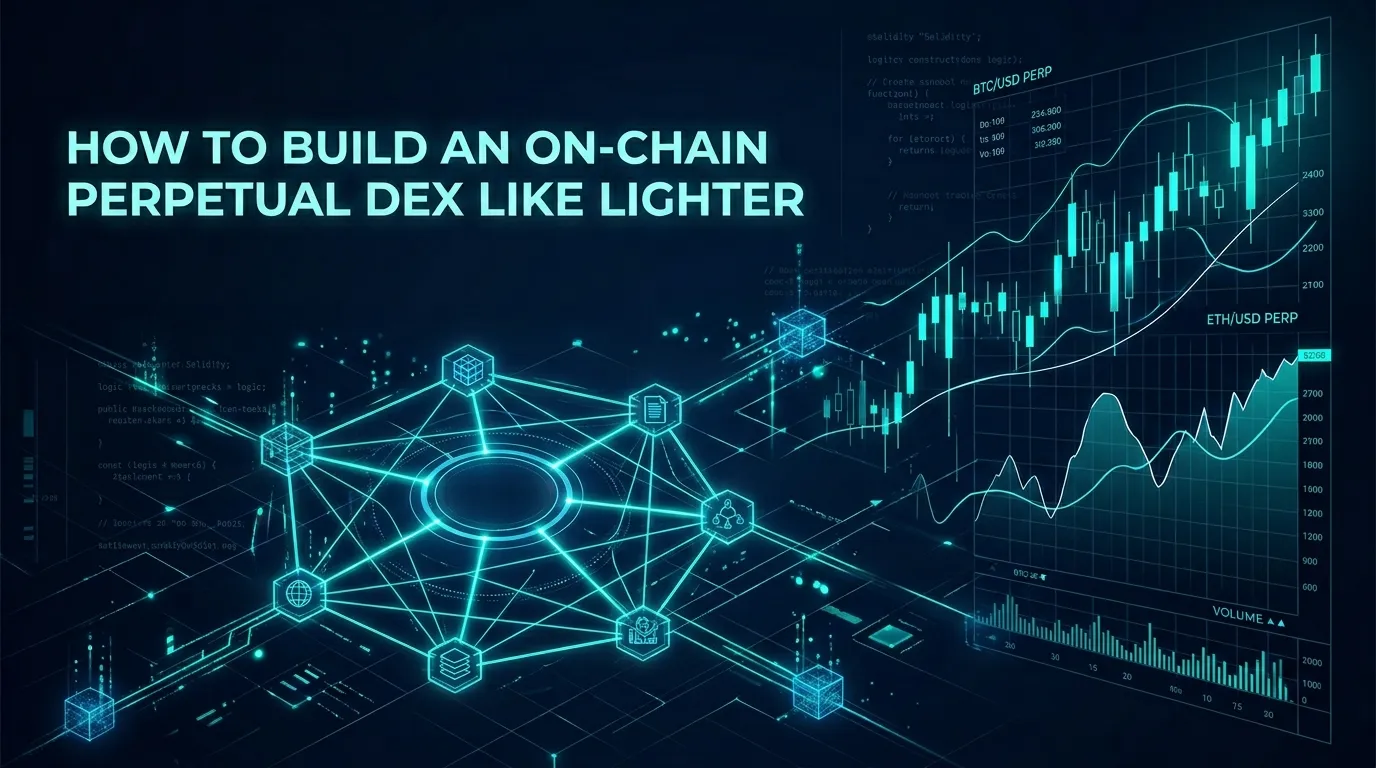

Building an on-chain perpetual decentralized exchange (DEX) like Lighter is one of the most advanced challenges in decentralized finance infrastructure today, combining elements of high-frequency trading systems, derivatives pricing theory, blockchain engineering, and robust risk management architecture. Unlike traditional spot exchanges, perpetual DEXs enable traders to hold leveraged positions indefinitely while maintaining price alignment with underlying assets through funding mechanisms, making the system far more complex in terms of execution logic and financial stability. Designing such a platform requires careful consideration of architecture, liquidity design, oracle systems, margining logic, and liquidation safety mechanisms, all while ensuring scalability and security in a trustless environment. The increasing demand for decentralized derivatives trading has led to rapid innovation in this sector, where performance and decentralization must coexist without compromise, and where firms often rely on Crypto Perpetual Exchange Development Services to accelerate the engineering process and reduce architectural risk.
Core Architecture Design of a Perpetual DEX System
A perpetual DEX architecture is not a single system but a layered financial infrastructure where each component plays a specific role in maintaining trading continuity, risk safety, and execution integrity. The architecture must ensure low latency execution while maintaining full transparency and on-chain settlement guarantees, which makes system design significantly more complex than traditional DeFi applications.
- Execution Layer and Trade Processing Logic
The execution layer is responsible for processing orders, matching trades, and ensuring accurate state transitions for every position. In high-performance designs like Lighter-style systems, order matching often happens off-chain to achieve speed, while final settlement occurs on-chain to preserve transparency. This hybrid approach balances performance with decentralization, ensuring traders experience near real-time execution without sacrificing trustless verification. - Settlement Layer and Blockchain Integration
The settlement layer records all finalized trades, margin updates, and liquidations on-chain, creating a verifiable audit trail. This layer must interact seamlessly with smart contracts while minimizing gas costs and preventing congestion-related delays. Optimized rollup-based environments are often used to ensure scalability without compromising Ethereum-level security guarantees. - State Management and System Consistency
Maintaining synchronized state across orders, positions, and collateral balances is critical to avoid discrepancies. The system must track every change in real time and reconcile off-chain computations with on-chain records. Any mismatch in state synchronization can lead to liquidation errors or incorrect margin calculations, impacting system stability. - Infrastructure Scaling Strategy
Scalability is achieved through modular design, where trading, liquidation, and pricing systems operate independently yet communicate through secure message passing. This separation allows the protocol to scale horizontally as user demand increases. Many projects rely on Crypto Perpetual Exchange Development Services to design scalable architecture that can handle high-frequency trading environments.
Trading Engine and Order Matching Logic
The trading engine is the core of a perpetual exchange, responsible for executing trades efficiently while maintaining fairness and price accuracy. Unlike simple swap-based DEXs, perpetual platforms require continuous order flow processing, margin validation, and risk-aware execution logic.
- Order Book-Based Execution System
Order book models provide professional-grade trading experiences similar to centralized exchanges. Traders can place limit, market, and conditional orders, which are matched based on price-time priority. While this model improves price discovery and reduces slippage, it requires sophisticated infrastructure to handle real-time updates efficiently, especially under high trading volume. - Hybrid Off-Chain Matching with On-Chain Finality
To achieve performance comparable to centralized exchanges, many systems implement off-chain matching engines that process orders rapidly before submitting batches to the blockchain for final settlement. This reduces gas costs and improves throughput while preserving transparency. Lighter-style architectures heavily rely on this hybrid model. - Latency Optimization and Execution Speed Control
Execution latency directly affects trading outcomes, especially in leveraged environments where price movement can trigger liquidations. Systems must be optimized to process thousands of orders per second with minimal delay. Efficient memory management, parallel processing, and batch execution techniques are commonly used to achieve this. - Fairness and Anti-Manipulation Controls
Preventing front-running and order manipulation is essential in decentralized environments. Mechanisms such as batch auctions, sealed-bid execution, and priority queuing are used to ensure fairness. These safeguards maintain trust in the system while preventing exploitation of transaction ordering.
Oracle Systems and Price Integrity Framework
Accurate pricing is essential for perpetual contracts because all margin calculations, funding rates, and liquidations depend on real-time asset valuation. Oracle systems act as the external truth source that feeds price data into the protocol, and any manipulation can destabilize the entire exchange.
- Decentralized Price Feeds and Aggregation Models
Reliable oracle systems aggregate price data from multiple exchanges to form a consensus price. This reduces dependency on any single data source and protects against manipulation. Aggregation also smooths volatility spikes and ensures consistent pricing across trading pairs. - Time-Weighted Average Pricing Mechanisms
TWAP systems reduce the impact of short-term price manipulation by averaging prices over a defined time window. This ensures that sudden price spikes do not trigger unfair liquidations. However, TWAP introduces slight latency, which must be carefully balanced with responsiveness. - Circuit Breakers and Volatility Safeguards
During extreme market conditions, oracle systems may activate circuit breakers that pause liquidations or widen margin requirements. These safeguards protect the protocol from cascading failures during flash crashes or liquidity shocks. - Redundant Oracle Architecture Design
High-reliability systems often use multiple oracle providers simultaneously to cross-verify price inputs. This redundancy ensures that even if one data source fails or is compromised, the system continues to operate safely. Crypto Perpetual Exchange Development Services often include oracle design consultation to ensure robust integration.
Margin System and Risk Management Engine
The margin system defines how much capital traders must allocate to open leveraged positions and how risk is managed across the platform. It is one of the most mathematically intensive components of a perpetual DEX.
- Isolated Margin Configuration for Risk Containment
Isolated margin ensures that each position is backed by separate collateral, limiting risk exposure to individual trades. This design protects traders from cascading losses but reduces capital efficiency, making it more suitable for conservative trading strategies. - Cross Margin Optimization for Capital Efficiency
Cross margin allows multiple positions to share collateral, improving capital utilization and reducing liquidation probability. However, it increases systemic risk since losses in one position can affect others. Proper risk isolation logic is essential in this model. - Dynamic Leverage and Position Monitoring
The system continuously evaluates account health by monitoring unrealized profit and loss, collateral ratios, and exposure limits. Adjustments to leverage or margin requirements may occur dynamically based on market volatility and liquidity conditions. - Automated Risk Calculation Engine
Real-time risk engines compute liquidation thresholds and margin requirements for every account. These calculations must be highly optimized to prevent delays that could result in undercollateralized positions or protocol insolvency.
Liquidation Mechanism and System Stability
Liquidation is the safety layer that ensures the exchange remains solvent even when traders default on their obligations. It is one of the most critical and sensitive parts of the entire system.
- Automated Liquidation Trigger System
Positions are automatically marked for liquidation when margin falls below maintenance levels. This ensures that losses are contained before they exceed collateral value, protecting the protocol from bad debt accumulation. - Keeper-Based Liquidation Execution Model
External actors, often called keepers, compete to execute liquidations and earn incentives. This decentralized approach ensures fast execution while preventing single points of failure within the liquidation system. - Partial Liquidation Strategy for Market Stability
Instead of closing entire positions at once, systems may liquidate positions partially to reduce market impact. This approach helps stabilize price movements during volatile conditions and prevents sudden liquidity shocks. - Incentive Structures for Liquidators
Proper incentives are required to ensure liquidators act quickly and efficiently. Reward mechanisms are designed to encourage participation even during high-risk market conditions, ensuring continuous system protection.
Funding Rate Mechanism and Market Equilibrium
Funding rates are a core economic mechanism that keeps perpetual contract prices aligned with spot markets. Without this system, price divergence would make perpetual contracts unreliable.
- Dynamic Funding Rate Calculation Models
Funding rates adjust based on long-short imbalance in the market. When one side dominates, the other compensates through periodic payments, maintaining equilibrium between contract and spot prices. - Real-Time Sentiment Reflection in Pricing
Funding rates act as a reflection of trader sentiment and market positioning. High demand for longs or shorts results in increased funding costs, encouraging balance in open interest distribution. - Manipulation Resistance Design
To prevent artificial inflation of funding rates, systems use aggregated open interest data and multi-source pricing validation. This reduces the risk of coordinated manipulation strategies. - Settlement Frequency Optimization
Funding payments are typically settled at fixed intervals, such as hourly or every eight hours. The frequency must balance responsiveness with gas efficiency and computational overhead.
Security Engineering and Protocol Hardening
Security is foundational in any perpetual exchange because the system handles leveraged financial positions with real monetary risk. A single vulnerability can lead to systemic collapse.
- Smart Contract Security Framework
Contracts must be designed with strict validation checks, reentrancy protection, and minimal external dependencies. Modular architecture ensures that vulnerabilities in one component do not compromise the entire system. - Formal Verification and Mathematical Proofing
Critical components such as liquidation logic and margin calculations are often formally verified to ensure correctness under all conditions. This reduces the likelihood of edge-case exploits. - Upgrade Control and Governance Safety
While upgradeability is necessary for long-term evolution, it must be balanced with governance safeguards to prevent malicious updates. Time locks and multi-signature controls are commonly implemented. - Continuous Auditing and Stress Testing
Systems undergo repeated audits and simulated market stress tests to evaluate behavior under extreme volatility. Many teams engaging in Crypto Perpetual Exchange Development Services prioritize security audits as a core development phase.
Conclusion
Building an on-chain perpetual DEX like Lighter requires far more than standard smart contract development; it demands the design of a complete financial ecosystem capable of handling leveraged trading, real-time risk management, and high-frequency execution under decentralized constraints. Every component, from oracle systems to liquidation engines, must be engineered with precision to ensure stability during extreme market conditions while maintaining scalability and transparency. As decentralized derivatives markets continue to expand, platforms that successfully integrate performance optimization with robust risk architecture will define the next generation of trading infrastructure. Many projects accelerate this process through Crypto Perpetual Exchange Development Services, which provide the specialized expertise needed to build secure, scalable, and production-ready perpetual exchange systems capable of competing with centralized trading platforms.






















Sign in to leave a comment.